
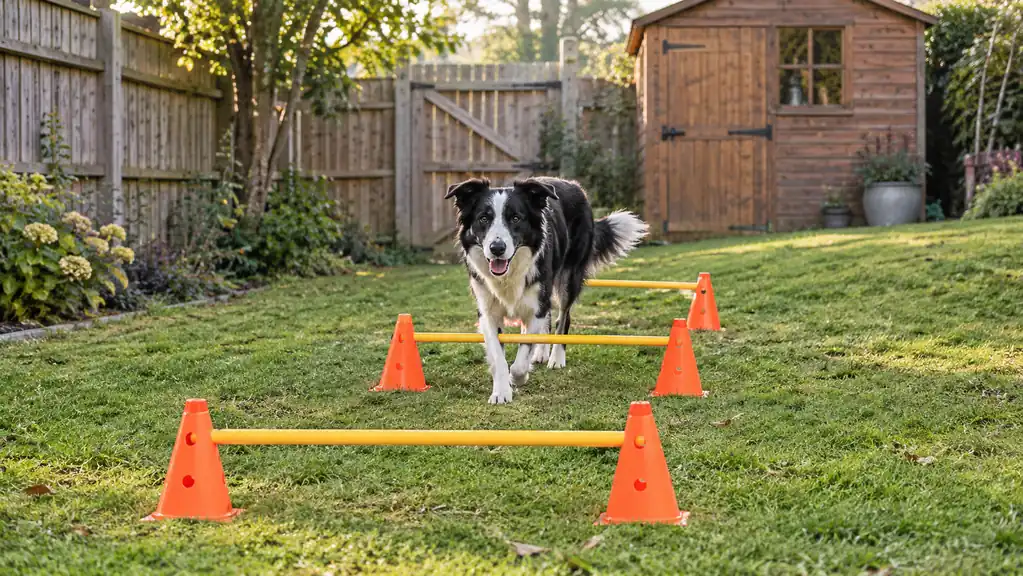
Two years ago I bought the TRIXIE Dog Agility Hurdle Cone Set for the most boring reason possible. I wanted to find out whether my dog and I would actually stick with agility before I spent real money on it. I had a border collie mix named Juno, a fenced back yard with a slope in it, and about fifteen spare minutes on a Tuesday evening. That was the whole plan, such as it was.
Here is the part no product page tells you. The jumps are not what makes agility work. The jumps are what you point at while you learn how to teach. A box of cones and rods gives you something to aim for, and that is genuinely worth having, but it does not arrive with any understanding of your dog inside it. Two years in, I have a much clearer list of what this set does well and where it runs out of road than I did on the day the bag arrived.
The Quick Verdict
A solid, honest starter kit for a small or medium dog. It makes three low jumps, it packs away small, and it will not survive a gusty day or a fast dog at full speed.
Amazon Check Today's Price →The set I still carry out to the yard on Tuesday nights, two years later.
Six cones, three rods and four marked heights. It is the simplest way to find out whether home agility suits you and your dog before you buy anything bigger.
Amazon Check Today's Price on Amazon →What Actually Comes in the Box
Six cones, three rods, a carry bag, and a short booklet of training tips. The listing says exactly that and the listing is accurate. What it does not spell out is the arithmetic. Six cones and three rods make three hurdles, because each rod needs a cone under each end. Three jumps in a line is the whole course, unless you get creative and use the cones on their own.
The rods rest in the tops of the cones at four marked heights, listed at 2.5 inches, 5.5 inches, 8.5 inches and 13 inches. You are not measuring with a tape and you are not loosening a collar or pulling a pin. You lift the rod out, drop it in the next setting, and you are done. Assembly is quick enough that I can set the whole thing out and take it down inside a fifteen minute session without feeling like I spent the session building furniture for a dog.
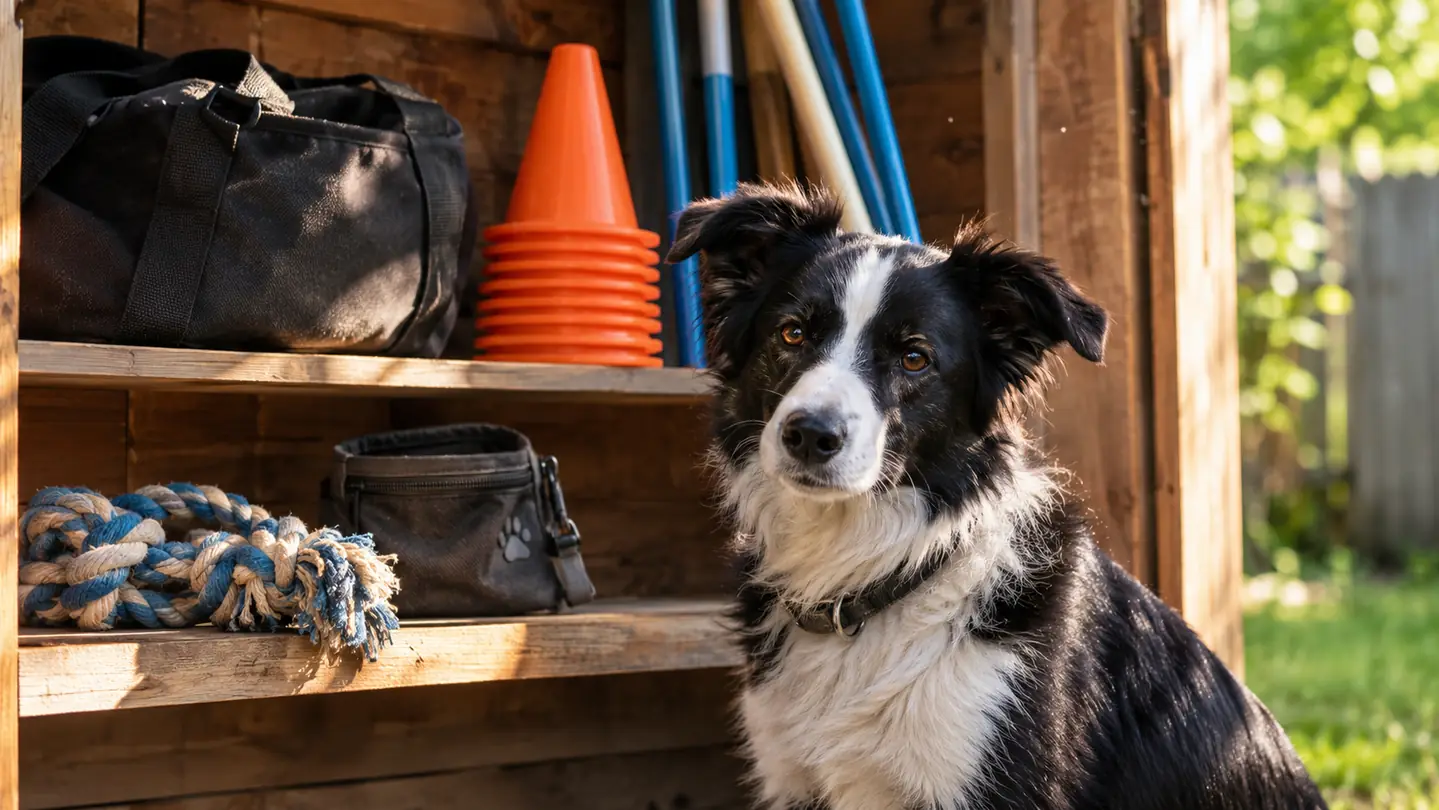
The TRIXIE set is listed at 2.82 pounds on a package that measures 30.7 by 9.1 by 11.8 inches. That is light enough to carry from the shed to the middle of the yard in one hand, and compact enough that the bag hangs on a nail instead of taking up a shelf. Everything goes back in the bag and back on the shelf when we are finished. Nothing has broken in two years, and the listing warranty is one year, which I have never had to use.
Where the set went in my yard took two tries. I put the first line along the slope at the top of the yard, and the jumps looked fine standing there, but Juno came at the whole line downhill and picked up more speed than I had any idea what to do with on a fifteen minute plan. I moved the line across the slope instead, on the flatter strip between the shed and the back fence, and that is where the jumps have lived ever since. The rod rests in the top of each cone, so as long as the two cones sit on ground at roughly the same height, the bar comes out level. Across the slope, it does. Up and down the slope, it did not.
How the Four Heights Went With My Dog
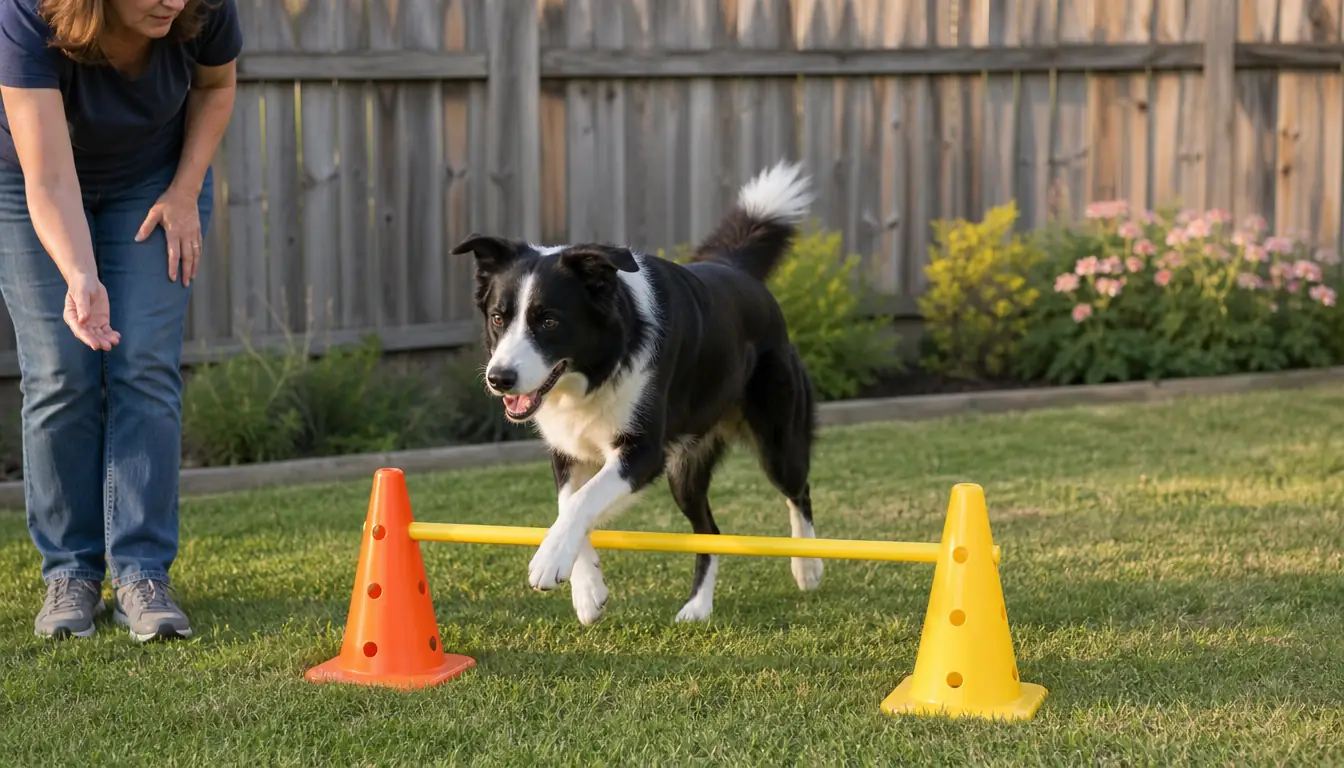
Juno is about 17 inches at the shoulder and 28 pounds. We started on the 2.5 inch setting with her walking over the rod rather than jumping it. That is not a training philosophy I invented so much as the thing that felt sensible for a dog who had never seen a jump in her life. Walking over a rod near the ground teaches the dog that the object in the grass is not a trap. We spent the first week there, and it was the right call.
The 5.5 inch setting came after about three weeks, once she was trotting the low rod without hesitating. The 8.5 inch setting came after about two months. And 8.5 inches is still where we are, two years later. I tried the 13 inch setting a handful of times and went back to 8.5 every time, because what I want out of a Tuesday evening is clean, easy repetition, not height. Height is a club thing. Clean repetition is a back yard thing, and I am a back yard person.
A Tuesday session, in case the shape of it helps, goes like this. I set the three jumps in a line with about six feet of grass between them, at whatever height we are working that week. I walk the line with Juno on a loose lead once, no reward, just so she sees the rods and stops staring at them. Then three or four reps with a small soft treat after each one, fed from my hand, while I stand still and try not to lurch. Then a minute where she gets to sniff along the fence and I reset whatever she clipped on the way through. Then three more reps and we are done. Twelve to fifteen minutes, and honestly a good slice of it is me picking rods up off the grass.
Your dog is not my dog, and I will not pretend a schedule that suited a 28 pound collie mix will map neatly onto a leggy dog or a heavy one. The four settings exist so you can find your own floor and move it when you are both ready. The point is not that 8.5 inches is the correct height. The point is that you have four choices and none of them require a toolbox.
Two years in, we still jump at 8.5 inches. The set did not turn my dog into anything. It gave us a place to practice, twice a week, without a club field.
The Rods Fall Down, and That Is the Good Part
This is the most useful thing about the design and it reads like a complaint in a lot of the reviews. The TRIXIE rods sit loose on top of the cones. If a dog clips one, it falls. Not a little. The whole rod comes down and the jump stops being a jump.
For a beginner, that is exactly what you want. A dog that knocks a jump is not corrected by a sharp clatter of plastic and is not struck by a solid bar that stays put. The obstacle simply stops existing and you walk over and reset it. The cost is that you will spend a fair slice of every session putting rods back up. I got used to it inside a month, and I would rather pick up a rod forty times than watch a young dog learn to flinch at a jump.
Where It Falls Short, Honestly
It is light. That is the trade you make for 2.82 pounds and a bag that hangs on a nail. On a breezy day the cones tip and the course goes flat without a dog anywhere near it. I check the wind before I set it out now, and on the days it is gusting I train something else instead, or I set the cones out flat on the garage floor and call it a slalom. If your yard is exposed and the wind never really stops, that will get old fast.
It is a starter kit and not club equipment. A young, fast dog taking a jump at speed will knock this set around in a way that a heavier set would not. That is not exactly a defect, because this is what the set is for and the listing says so. But if you already have a dog running clean sequences at speed, you are going to want something with more mass under it, and this will feel like a toy.
The 13 inch setting is where the arithmetic of a starter kit shows itself. Once your dog is clearing 13 inches cleanly and enjoying it, there is nothing left in the bag to move up to, and the next step is either different equipment or more time on a field where somebody else already owns the tall stuff. I am not sorry about that. I have had two years out of four settings and I am still on the third one. But if you are buying this expecting it to grow alongside a dog all the way to competition height, it will not, and the four settings run out sooner than the enthusiasm does.
The booklet is short and general. It gives you the idea of a jump and not a great deal more. The real instruction in my case came from a Saturday morning beginner group at the county fairgrounds, where the jumps are full size and somebody can stand ten feet away and tell you your timing is late. If you never go anywhere with a club, expect to read, re read, and film yourself from an awkward angle on your phone.
What I Would Have Told Myself Before Clicking Buy
Buy it for the height settings, not for the course. Six cones and three rods is three jumps, and three jumps in a small yard is a line, not an obstacle course. The value sits in the four settings and in the two seconds it takes to change one, which means you can work the same jump for a whole session without babysitting hardware. That is a quiet thing but it is the reason the set still comes out of the shed.
Expect to be the one doing the learning. I spent the first month convinced my dog was slow. She was not slow. I was late with my hand, late with my reward, and unclear about where I wanted her to go. None of that got fixed by the cones. It got fixed by repetition and by somebody at the club being blunt with me about my own feet. The gear does not fix handling. Nothing fixes handling except handling.
One more thing about learning without a club, since nobody told me. A phone propped against the shed windowsill is a genuinely useful coaching tool and I wish I had started using it in the first month instead of the first year. Watching the video back was the first time I understood that I was dropping my shoulder and cutting into Juno's path instead of sending her on ahead of me. That is not a gear problem, and the TRIXIE set cannot solve it, but the set goes up fast enough that you can shoot four short takes in one evening and actually see the difference between them. Four takes in one session beats one take and a vague memory of how it felt.
And keep the sessions short. Fifteen minutes on a Tuesday and fifteen on a Thursday is our whole schedule. The set is easy enough to put out that a short session still feels worth doing, which is more than I can say for equipment that takes twenty minutes to assemble and twenty to pack away.
What I Looked At Instead
Before I bought anything I read through plans for a homemade PVC pipe jump. I worked out the pipe, the fittings, the cutting and the drilling, and then I decided I did not want to spend a weekend building three jumps I could not adjust. I have never built one, so I am not going to sit here and tell you a pipe jump is worse. I can tell you the adjustable settings were the thing that sold me, and a fixed pipe jump does not have them.
What put me off the plans was the cutting more than anything else. To build three jumps of any width you are looking at a length of pipe cut down into sections, elbows and tees for the feet, and holes drilled at intervals on both uprights so a crossbar can sit at a height. That means a saw, a drill, a tape measure, a straight edge to mark the holes, and somewhere dry to store three rigid frames that do not fold down. I have a shed with a nail in it and a bag that hangs on the nail. The TRIXIE set folds into the bag and the bag goes on the shelf. That was the whole comparison, and it did not take me long to make it.
At the club the jumps are heavier and taller and they belong to the club. I have never owned a set like that and probably never will. Everything I keep at home is deliberately on a small scale, because my yard is about 40 by 60 feet with a slope in it, and full size equipment would leave me nowhere to stand while my dog worked.
What I Liked
- Four marked heights from 2.5 to 13 inches, so a dog can start on the ground and move up without new gear.
- Sets up and comes down in about two minutes, which makes a fifteen minute session actually worth doing.
- Rods fall free when touched, so a dog that is still learning is not hit by a solid bar.
- 2.82 pounds, packs into the carry bag, lives on a shed shelf.
- Six cones and three rods make three jumps, and the cones alone work as a slalom.
- Indoor or outdoor, and rated for small and medium breeds.
Where It Falls Short
- Light enough that wind tips the cones and flattens the course.
- A fast dog at speed will knock it around. It is not club equipment.
- Three jumps is a line, not a course. You are buying heights, not variety.
- The booklet is short. Real instruction has to come from somewhere else.
- At 13 inches there is not much left to move up to before you need different gear.
Who This Is For
This is for someone standing where I was two years ago. You have a small or medium dog, a patch of grass, and a curiosity about whether agility is something you would enjoy twice a week. You want to find out without filling a shed with gear you never touch. It also suits a dog that is cautious about new objects, because a rod that falls over cannot hurt them and the cones can be walked around long before they are ever walked over.
It suits a handler who is happy to be bad at something for a while. My first month was clumsy and I knew it. The set did not care. It sat there, three jumps in a line, and let me be clumsy at it until I was less clumsy.
Who Should Skip It
Skip it if your dog is already running clean sequences and you want to build speed and tighter turns. Six cones and three rods will not give you that, and you will be frustrated inside a week. Skip it if you are on an exposed ridge where the wind never stops, because you will spend more time standing cones back up than training. Skip it if what you actually want is an obstacle course in a box. This is three jumps and a set of cones, and the rest of a course is a tunnel, weave poles and contact equipment you do not own yet.
What has not changed around here is that Juno still needs her walks. The jumps did not make her a different dog and they certainly did not make me a trainer. We are the same pair we were two years ago, on the same small scale, with three jumps in a line on a Tuesday evening and a carry bag back on the shed shelf by seven.
Three jumps, four heights, and a bag that fits on a shed shelf.
If you are at the very start and you want to know whether this hobby will stick, this is a sensible place to begin. It is what I bought with my own money, and it is what I am still using two years later.
Amazon Check Today's Price on Amazon →