
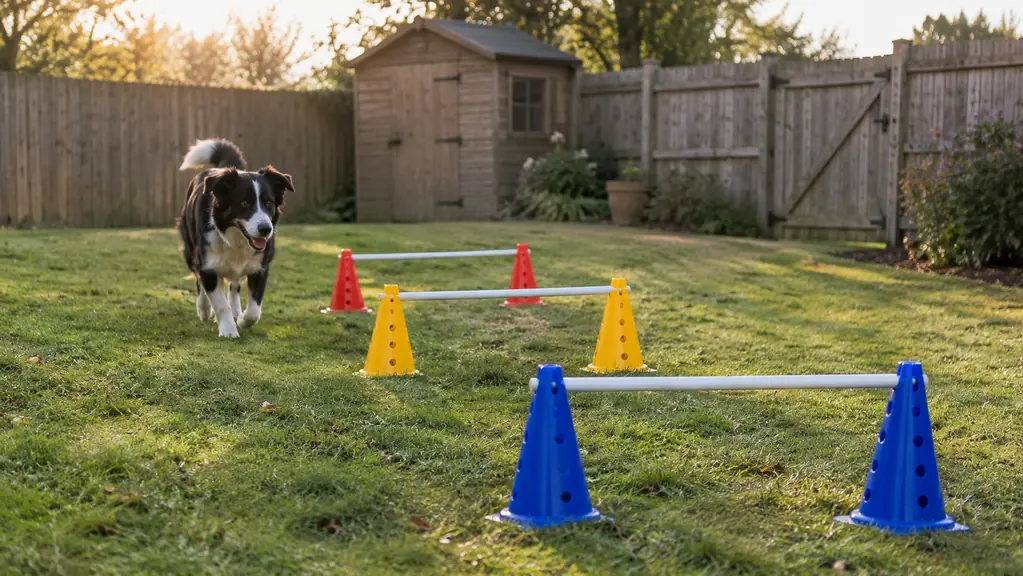
Short answer: the TRIXIE Dog Agility Hurdle Cone Set is the easier way to start. Not because a homemade PVC jump is a bad idea. Because easier is a specific thing, and it means no cut list, no saw, no drill, no second trip to the hardware store for the fittings you forgot, and a set of jumps standing in the grass in about the time it takes to walk to the shed and back.
I bought the TRIXIE set 24 months ago, the month I started agility with Juno. She is five now, a border collie mix, 28 pounds, about 17 inches at the shoulder, and she came home from a shelter when she was one. I am 52 and I keep books part time. We train in a fenced back yard with a slight slope, Tuesday and Thursday evenings, about 15 minutes a session, and there is nobody out there but the two of us.
I have never built a PVC jump. I have read the plans all the way through more than once, the ones with the cut list and the drill sizes and the note about sand in the uprights. Then I closed the tab and went back to the cones. That is the whole comparison in one sentence, really, but the reasons are worth spelling out, because the pipe jump does win a few things and I would rather say so than pretend otherwise.
| TRIXIE Agility Hurdle Set | DIY PVC Pipe Jump | |
|---|---|---|
| Getting it ready | Cones and rods, no tools, a couple of minutes | Cut list, saw, drill, tape measure, and an afternoon |
| Heights available | Four settings: 2.5, 5.5, 8.5 and 13 inches | Whatever you drill, plus a fresh set of rods per height |
| Width of each jump | One width, set wherever you place the cones | Cut to any spread you want |
| Wind | Light at 2.82 pounds, so a gust tips a cone | Can be sand weighted or pegged at the feet |
| Between sessions | Folds into the carry bag and sits on a shelf | A bundle of long pipe looking for a wall |
| When a dog clips a rod | The rod lifts off and rolls, nothing to reset with tools | Depends on the build, plenty of them are rigid |
| Tools needed | No tools needed | Saw, drill, tape measure, and a way to get it home |
| How many jumps | Three, from six cones and three rods | As many as you build |
| Warranty | One year, per the listing | You are the warranty |
| Holding up over time | Two years in, nothing broken, kept in the bag | Lasts well if it comes in, goes brittle if it stays out |
| Best for | A first jump and a fast start | A handy owner who wants exact sizes |
What the TRIXIE Set Actually Is
Six cones, three rods, a carry bag, and a small booklet of training tips. That is the whole kit. You stand a pair of cones apart, lay a rod across the tops, and you have a jump. Six cones and three rods make three jumps, which in my yard sit in a straight line about six feet apart.
The crossbar has four settings: 2.5 inches, 5.5 inches, 8.5 inches, and 13 inches. You change the height by moving the rod and nothing else. The listing gives the packed size as 30.7 by 9.1 by 11.8 inches at 2.82 pounds, which matches what I carry out to the grass in one hand.
There is a one year warranty on the listing. The kit is described as lightweight and portable, and that is accurate in both directions: easy to carry out, easy for a gust of wind to move. I have watched a cone go over on a blustery afternoon, and I have learned to set the line across the wind instead of straight into it.
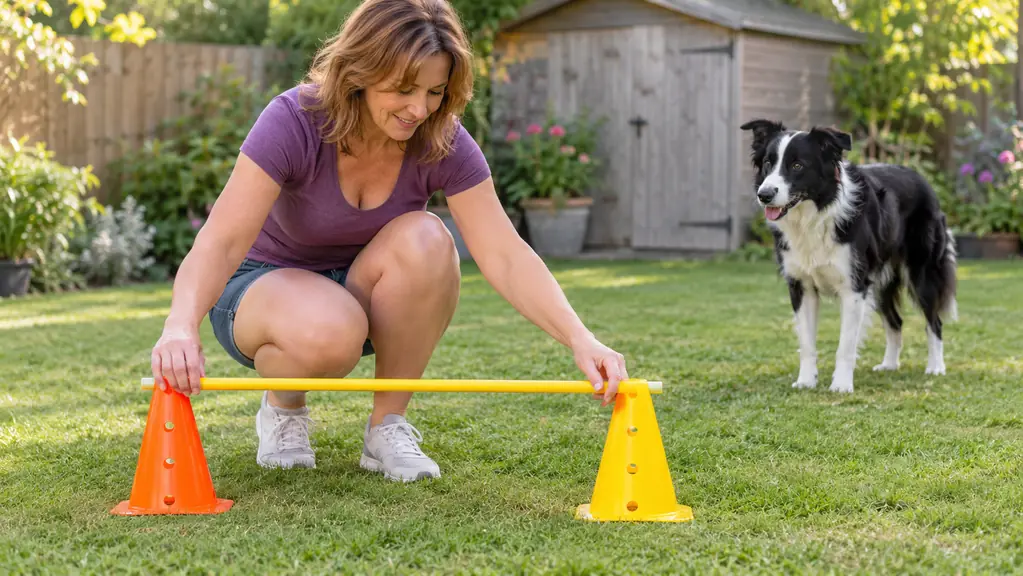
What a Beginner Actually Needs in Week One
Not a course. One jump. Possibly one jump at the lowest height with a dog walking over it and getting a piece of chicken for the trouble. I cut my soft chicken treats to about the size of a pea and keep them in a bag on my hip, because fumbling in a jacket pocket costs you the exact second you were trying to reward.
The second thing a beginner needs is gear that will not punish a mistake. Juno knocked rods off constantly in the first month, mostly because I was late with my hand and my timing was dreadful. A rod that falls and rolls is a non event. I picked it up, set it back, and we went again. Nothing about the equipment made that harder, and that is the highest compliment I can pay a starter kit.
The third thing is a way to stop. Fifteen minutes is plenty for a dog who is still learning, and I would argue it is plenty for the handler too. I end on something she does well, we tug for ten seconds, and we go inside. The gear has to fit into a life. It should not be the reason the life gets rearranged.
A Weeknight Session, Start to Finish
Tuesday, about 6:30, still light. I take the bag off the shed shelf and set three jumps in a line about six feet apart, all at 8.5 inches. That takes me two minutes and most of it is walking.
We start with the first jump on its own. Juno goes over, I mark it, and she gets a piece of chicken from the bag on my hip. Then two jumps, then three in a row. If she knocks a rod I set it back with my foot and we go again from the top of the line. If she looks at me like I have lost my mind, which happens, we drop back to one jump and finish there.
We end with a short tug, about ten seconds, and then the tug goes back in my hand and we walk to the gate. Fifteen minutes from the first jump to the shed shelf. That is the whole session, and it has not changed much in two years except that she is faster and I am slightly less late with my hand.
My First Two Months With It
Week one was 2.5 inches and a walk over. Not a jump. She had never seen one, and I did not want her to think I had put a wall in the yard.
About three weeks in I moved to 5.5 inches. About two months in I went to 8.5. That is still where we are. I have set 13 a handful of times and gone back to 8.5 every single time, because what I want out of a Tuesday is clean easy repetition and not height. I am not chasing anything. I have never entered a trial and I do not have a ribbon to my name.
A rod that falls off when a dog touches it is not a weakness in the gear. On a first jump, it is the entire reason the gear works.
The surprise was the garage. On rainy weeks I have set the cones out on the concrete as a simple slalom, just weaving, no jumps at all. That is not what the kit is sold for, but cones do not care what you ask them to do, and Juno does not care either as long as the chicken keeps coming.
Where TRIXIE Wins
Setup and storage. The kit lives in its carry bag on a shelf in the shed. Out, three jumps, fifteen minutes, back in the bag. There is no version of a pipe jump that beats that on a Thursday evening after a day of receipts. It is one hand and one trip, and I have never once decided against training because setting up was too much work.
The knock down, which I have already gone on about but will say once more plainly. Nothing is bolted. A dog that clips a rod sends it rolling and keeps running, and I reset it in two seconds with the side of my shoe. On a first jump that is worth more than any amount of adjustability, because a dog who gets corrected by the equipment learns to slow down and a dog who gets nothing but a rolling rod learns to keep going.
And no tools. No cutting, no measuring twice, no sand, no fittings, no wondering whether a joint will hold through a winter. Someone who is not sure they even like agility can find that out in an afternoon instead of a weekend. Add a one year warranty on the listing and the whole thing is about as low risk as gear gets.
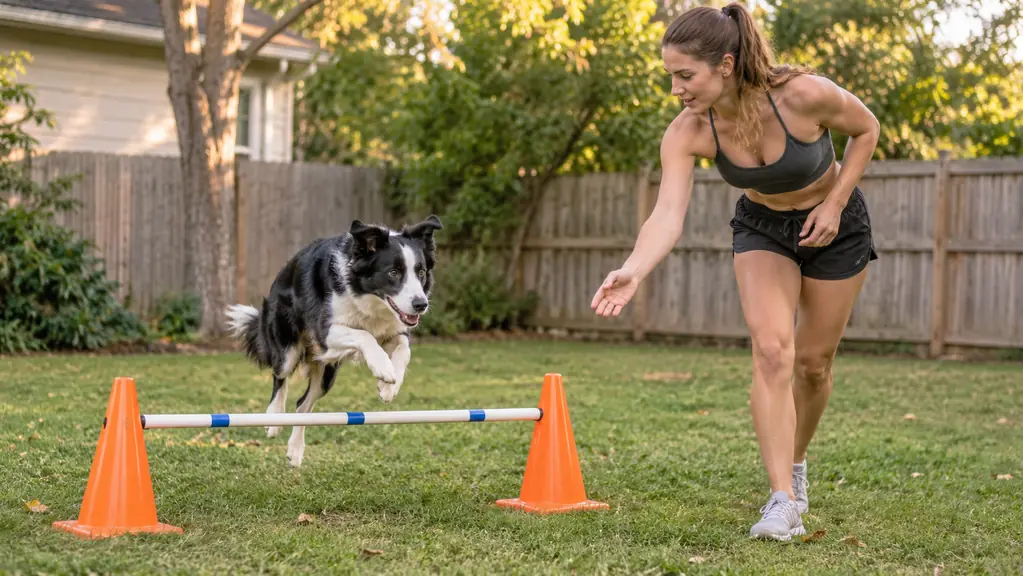
Where the DIY PVC Jump Wins
Custom sizing, and for some people that is not a small thing. If you want 10 inches, or 11, or a spread that matches a jump your friend built, pipe gets you there and my four settings do not. A frame drilled at several heights gives you more rungs than four, and you cut the width to suit your yard instead of setting cones wherever the yard happens to allow.
Stability in weather. My cones are light, and light is the trade off you accept for a bag you can carry in one hand. A pipe frame weighted with sand, or pegged at the feet, is not going anywhere in a gust. If your yard is exposed and your training nights are windy, that is a real advantage and I will not pretend otherwise.
Volume. Six cones and three rods make three jumps. A bundle of pipe makes as many as you care to build, in whatever shape you want them, and if you enjoy the building half as much as the training half you will get more out of an afternoon with a saw than I ever will. The parts are ordinary hardware store stock, which is the other argument people make and it is a fair one.
The jump I set up twice a week for two years
Six cones, three rods, four height settings from 2.5 to 13 inches, and a bag that fits on a shed shelf. If you want to find out whether you like agility before you buy a saw, start here.
Amazon Check Today's Price on Amazon →The Part Nobody Warns You About
The honest reason the pipe jump lost at my house has nothing to do with jumping. A homemade hurdle starts with a cut list. You need a saw, or a store that will cut for you, and a way to get the lengths home, and a plan for what happens if one measurement comes out wrong. I drive a small SUV and I stood in that aisle with a cart, looked at the list, thought about the dust and the drive back, and put it all down again.
Then storage. A finished pipe jump is a bundle of long pipe living in a shed next to a mower, and every session starts with untangling it. The cones stack into a bag roughly the size of a duffel and go back on the shelf above the rake. If you have a garage wall, a saw, and a Saturday you actually want to spend that way, build the pipe jump. If you read that sentence and felt tired, you already know your answer.
There is also the question of whether you will still be using it in a year. I know myself well enough to know that a project I did not enjoy is a project I stop maintaining. The cones have survived two years of me because they ask nothing of me between sessions, and that is worth more than a custom spread.
Two Things I Got Wrong at the Start
I set the jumps too far apart. Six feet felt like a proper course to me and it looked impressive from the kitchen window. For a dog still learning to go over one obstacle and then find the next one, closer is easier. I moved them in to about four feet for a while and the whole thing smoothed out. The cones had nothing to do with that mistake. I did that all by myself.
I also trained too long at the start. Fifteen minutes sounds short until you are standing in a yard with a dog who has quietly stopped trying. I cut back to ten minutes for about a month and everything got better. Neither of those fixes came in the bag with the cones, and neither would have come free with a pipe jump either. Gear fixes gear problems. It does not fix handler problems.
Who Should Buy Which
Buy the TRIXIE set if you are where I was two years ago. Curious, training alone in a back yard, not sure yet whether agility is your thing, and not looking for a project. It sets up in minutes, it stores on a shelf, the four heights will carry you through a first year comfortably, and it travels in the car if you ever want to take it somewhere that is not your own grass.
Build the pipe jump if you already own the tools, you like the build, and you want heights and widths no starter kit offers. Hang it on a wall, weight the feet, and enjoy the extra control. What I would not do is buy a saw and a bundle of pipe to find out whether your dog enjoys jumping at all. Find that out first with something you can carry in one hand.
And if you are somewhere in the middle, which is most people, start with the cones. The pipe jump will still be there in a year, and by then you will know exactly what heights and widths you actually want, instead of guessing at a hardware store counter.
Start with three jumps you can carry in one hand
Six cones, three rods, crossbar settings at 2.5, 5.5, 8.5 and 13 inches, and a one year warranty on the listing. Two minutes to set up and a shelf to put it back on.
Amazon See the TRIXIE Hurdle Set on Amazon →