
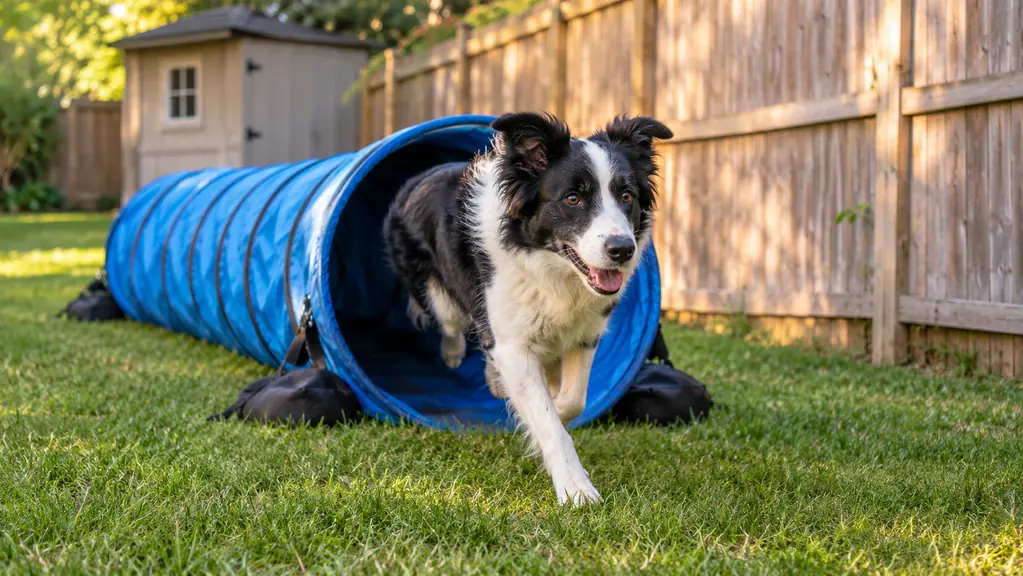
The first time I unrolled the HDP 18 Ft open tunnel across my back lawn, Juno walked a wide circle around it and gave it a look I have come to recognise. She is a five year old border collie mix, twenty eight pounds, about seventeen inches at the shoulder, and at that point she had never been near a tunnel. I had bought my hurdle set six months earlier and assumed a tube would be the easy next step. It was not easy that first evening. It is, eighteen months later, the piece of yard gear I would replace first if it ever wore out.
I train at home on Tuesday and Thursday evenings, about fifteen minutes a session, in a fenced yard of roughly forty by sixty feet with a slight slope and a shed by the back gate. I am not a trainer. I am a hobby handler who started two years ago and who goes to a beginner class on Saturday mornings at the county fairgrounds, where the club owns the real equipment. Everything in my yard I bought with my own money after looking at what the club used and working out what would actually fit at home. That is the whole basis for this review. One dog, one small yard, a lot of repetition.
The Quick Verdict
It holds a curve, it survives a dog hitting it at speed, and pinned down it stays where I put it. The trade is yard space and a drying routine after wet grass.
Amazon Check Today's Price →The obstacle Juno stopped walking around and started running at
An 18 ft open tunnel with a 24 inch opening, a steel spring frame and a Dacron cover, 2.4 pounds packed. Staked down it takes a full speed hit without sliding across the lawn, and it shortens to about five feet for a dog who needs to see daylight first.
Amazon Check Today's Price on Amazon →How I've Used It
The HDP tunnel came into the yard eighteen months ago. Before that I had three jumps made from the hurdle set and a dog who had learned to go over them in a straight line. A tunnel is a different ask. A jump is a decision the dog makes in the air. A tunnel asks her to run into a place where she cannot see the far end until she is already inside it, and that is a completely different conversation.
Our sessions are short by design. Fifteen minutes, twice a week, and tunnel work comes after the jumps, when Juno is already warm and already working. It ends with about ten seconds of tug on the rope and then the rope goes back in my hand. That order has not changed in eighteen months. Same fifteen minutes, same yard, same dog, same small soft chicken treats cut to pea size and carried in the bag on my right hip.
I have used it in a straight line exactly once, that first week. Since then it has run in a gentle curve along the back fence at close to full length. It has been out in dry grass and wet grass, and through a stretch of cold mornings where I wore gloves and fumbled the staking anyway. It has never been left out overnight. It has never been left out for Juno to lie in. Nothing has torn, and nothing has kinked.
What 18 Feet and a 24 Inch Opening Actually Change
Eighteen feet is long enough to matter for a small dog moving at speed. At twenty eight pounds and seventeen inches, Juno needs a little over a second to run the whole length, and a second is enough time for the tunnel to become a real handling problem for me. I have to be at the exit before she is. On a short tunnel I can be late and get away with it. On eighteen feet I cannot, and that has made me a more deliberate handler than I was.
The 24 inch opening is the number that decided it for me. My dog is small, so a wider mouth would be wasted on her, and a narrower one would have made those first two weeks harder than they needed to be. Twenty four inches is more than her shoulder height, which means once she stopped hesitating at the entrance she stopped looking at the edges of it altogether. She moves between my tunnel and whatever the club sets up on a Saturday without a second look, which tells me the picture is close enough.
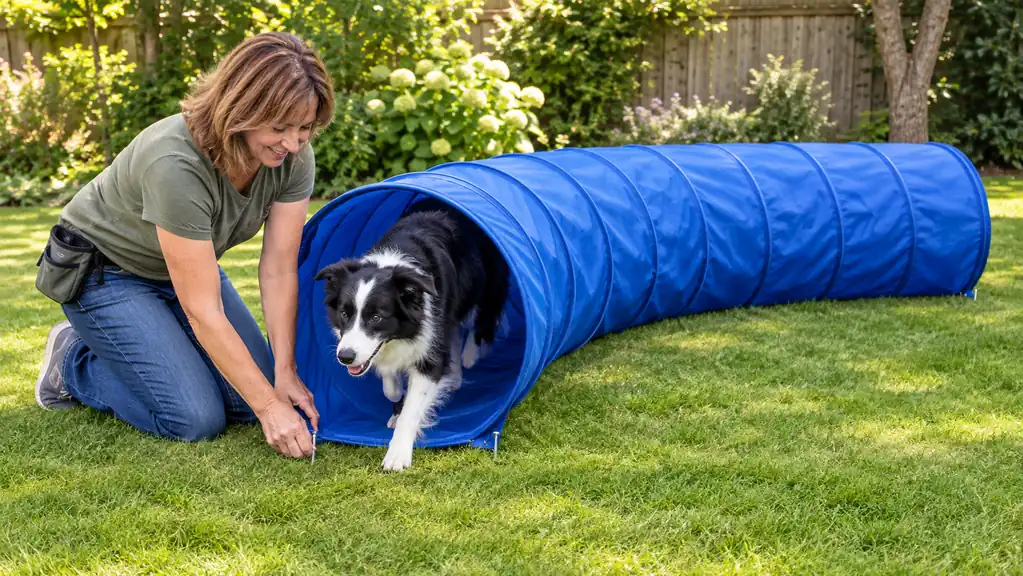
The frame is a steel spring under a Dacron cover. That reads like a technical detail and mostly is, but it is the reason the tunnel holds a curve instead of collapsing into a circle. I bend it along the fence line and it stays roughly where I bent it. It is also the reason I could shorten it down to about five feet for a nervous dog and let it spring back out later, which is not something you can do with a tunnel that has one fixed shape.
Weight matters too. It is 2.4 pounds. I carry it out from the shed one handed, which matters when the other hand has treats and a leash in it. It also means the tunnel goes where a dog puts it, and that is a sentence about physics rather than about quality. A light tunnel shifts when something hits it at speed. That is not a fault. That is what 2.4 pounds does, and it is why the next section exists.
Setting It Out, Staking It Down, and Packing It Away
Five minutes. That is the honest number for setting it out, and I have timed it because people at the club ask. Unroll it, open it along the fence, bend a gentle curve, then stake the base down at both ends first and work along the middle. Twenty minutes of practice does not deserve a longer setup than that, and if it did I would stop doing it on a Thursday.
Staking is not optional and I want to be blunt about it. It is 2.4 pounds. Juno at twenty eight pounds sends it sliding if it is loose, and she is a small dog. A heavier dog hitting a loose tunnel would move it several feet, and worse, that dog learns that the tunnel is a thing you can shove out of the way. That is a lesson you then have to untrain, and untraining is always slower than training it right. Stake it every single time.
Packing away is the part nobody warns you about. The HDP cover wipes clean in dry grass. In wet grass it comes back dirty. After rain it holds water in the folds and it cannot go back in the case damp, so it goes over the fence rail to dry and I put it away the next morning. It is a small chore, twice a week. I do it because a tunnel packed wet is a tunnel that smells, and because I want this one to last another eighteen months.
Then it goes in its carry case onto the shed shelf, out of the sun, with the stakes in beside it. Nothing has rusted. Nothing has torn. There are a few grass stains on the cover that I have not bothered trying to shift.
Getting a Cautious Dog Through It the First Time
Four sessions over two weeks. That is how long it took before Juno ran the full length without stopping in the middle. I am not counting the first evening, where she would not put her head in at all. I count from the first time she went in.
What worked was shortening the tunnel, not coaxing. I pushed it down to about five feet with my hands, held it open, and let her see daylight out the other end from a standstill. A five foot tunnel is barely a tunnel. It is a doorway you can see through, and that is the point. She went through it for a treat on the second session and looked genuinely surprised to come out the other side.
Over the following week I let it back out a couple of feet at a time, and each time she checked the far end before she committed. That is fine. That is a dog thinking about it. By the end of two weeks it was full length and she was going through at her own pace with me saying nothing. The thing I got wrong early was standing at the entrance. Standing at the entrance pulls the dog back to you the moment she comes out, and it teaches her to turn around inside the tunnel. Stand at the exit, off to one side, so the only place to go is forward.
The other thing I got wrong was talking. I chatter when I am nervous and Juno reads it. On the fourth session I said nothing at all and she went through clean. It was not the tunnel that needed fixing. It was me.
Mud, Rain, and the Honest Wear Notes
Eighteen months of twice weekly use on grass. Here is what has actually happened. Grass stains on the cover that are never coming out. Mud inside the curve from a wet dog turning. Water sitting in the folds after overnight rain. One run of stitching that has gone a slightly lighter colour, which I keep an eye on and which has not opened up.
The HDP cover has not torn. Nothing has snapped. The spring has not kinked and I have not had to replace a single part. Being fair, eighteen months of fifteen minute sessions twice a week is not heavy use. A club that puts a tunnel out for three hours every Saturday will wear through this faster than I have, and I would not pretend otherwise just because mine is still fine.
The mud is the real annoyance rather than the wear. A tunnel on grass is a tunnel that gets dragged through mud at the entrance, and then a wet dog runs through it and carries the mud inside. My routine is a rag around the inside of both ends after a wet session and nothing else. It is outdoor gear. It does not have to look new and mine does not.
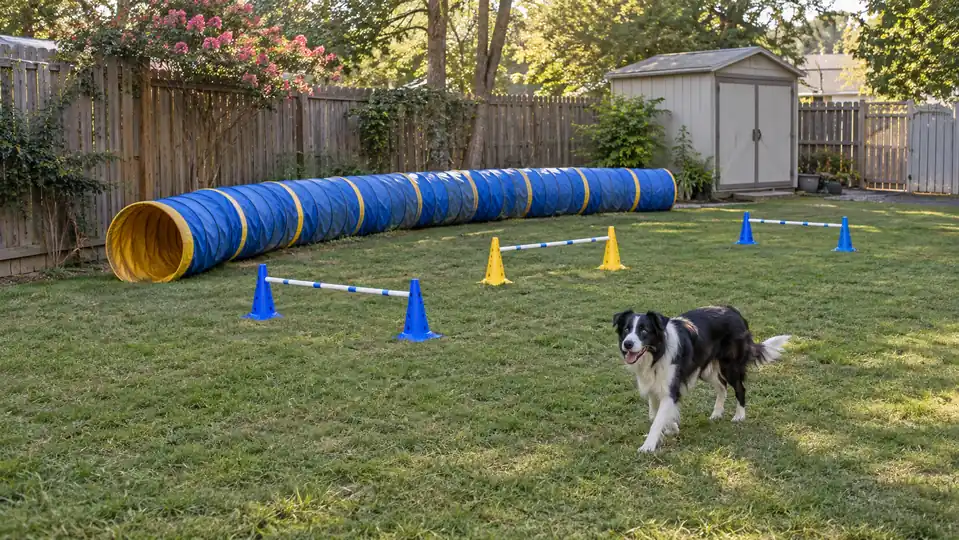
The thing I would flag for anyone with a smaller yard than mine is where it lives. This is a long object. Eighteen feet along the fence is eighteen feet I no longer have for a jump line, and I ended up running the jumps parallel to the tunnel instead of across the yard. That trade is worth it for us. It might not be for someone with half the grass.
Why I Picked This Over a Pop-Up Play Tunnel
I looked hard at pop-up play tunnels before I bought this. I handled one in a pet store. I have never owned one and never trained with one, so read this as the reasoning of someone who went the other way, not as a test result.
A pop-up play tunnel is built to fold small and travel. That is genuinely useful if the tunnel has to leave the house. Mine does not leave the house. It sits along the same fence in the same yard two evenings a week, and for that job I wanted something that holds a curve and does not slide. Those are two different briefs and both of them are legitimate. If I were driving out to a park every week, I would look much harder at the foldable one, and I would expect to give up some stability for the convenience.
The other difference is how a dog meets it. A light pop-up tunnel shifts under a dog, and a shifting tunnel teaches a cautious dog that the obstacle is alive. My HDP tunnel is light too, at 2.4 pounds, but with the base staked it does not move at all when Juno hits the entrance. I think that mattered for a dog who needed two weeks to commit. I cannot prove it, and I would not argue with anyone whose dog took to a pop-up on day one.
What I Liked
- Runs at the full 18 ft length along a fence and holds a gentle curve once bent
- The 24 inch opening is generous for a small dog without becoming a different picture from club equipment
- Staked down it takes a full speed hit without sliding across the lawn
- 2.4 pounds comes out of the shed one handed in about a minute
- Shortens to roughly five feet for a nervous dog and springs back out to full length
- Nothing torn, kinked or rusted in eighteen months of twice weekly yard sessions
Where It Falls Short
- Eighteen feet eats most of a small yard, and I had to move my jump line to fit it
- The cover picks up mud and grass stains and holds water after rain
- It has to dry over a fence before it can be packed away
- Staking it down every session adds a few minutes and skipping it is not an option
- It is a yard tunnel. It is not something you throw in the car for an afternoon at a park
Four sessions over two weeks, and she went from refusing to put her head in to running the full eighteen feet without stopping once.
Who This Is For
This is for someone with a back yard, a dog who is already going over a jump or two, and about an hour a week to spend. It suits a first tunnel, and it suited mine. It is also the right buy if your dog is cautious about new things and you want an obstacle that does not wobble or shift under her, because you can shorten this one down to almost nothing and let it back out at her pace.
It is a reasonable choice if you already train at a club and want the same movement pattern available at home between Saturdays. The opening is 24 inches and the length is 18 feet, and that has been close enough that I have not had to teach Juno a different picture on my lawn. Practising at home is also the only reason we got through the four session wobble at all. Fifteen minutes on a Tuesday did more for her confidence than an hour on a Saturday.
And it is a sensible buy for a single dog household with something like a forty by sixty foot yard or larger, because that is roughly the space this needs to be worth setting out twice a week. Smaller than that and you will spend more time rearranging the yard than training in it.
Who Should Skip It
Skip it if your training space is a driveway, a patio, or a strip of grass narrower than a car. Eighteen feet is eighteen feet. There is no version of this that fits on a small concrete pad, and it does not shorten permanently, so you would be staking and unstaking a long object you cannot leave out.
Skip it if the tunnel has to travel. It goes in a case, but it is a long object when packed, and I would not choose it for a weekly trip to a park when a foldable play tunnel does that job better and is built for it.
And skip it if you are expecting the gear to do the training. Setting out takes five minutes, drying takes an evening, and the dog still has to be shown the way through one short length at a time. I bought a tunnel that does its job well. I did not buy a shortcut, and after eighteen months I would not want one.
Eighteen months in, this is the yard gear I would buy again first
The HDP 18 ft open tunnel: a 24 inch opening, a steel spring frame and a Dacron cover, 2.4 pounds packed. Pinned down at the base it stays put for a dog hitting it at speed, and it shortens down for a dog who needs to see through it before she commits.
Amazon Check Today's Price on Amazon →