
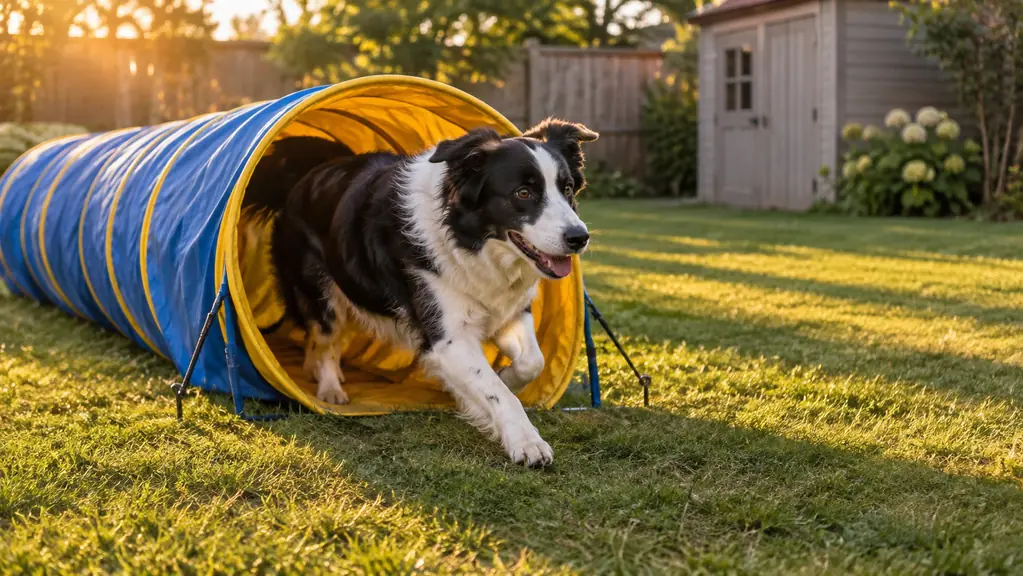
Everybody buys jumps first. I did. The TRIXIE hurdle set was in my yard a full six months before anything else, and I spent those six months learning that a jump asks a dog to do something on purpose, at speed, with a handler flapping beside it. A tunnel asks a dog to do something she already wants to do, which is run. That is the whole reason I would hand a beginner a tunnel before a jump. Mine is the HDP 18 Ft Open Tunnel, bought eighteen months ago, and it is the piece of gear that turned Tuesday and Thursday evenings from a drill into something Juno runs to the gate for.
I train Juno, a five year old border collie mix, about 28 pounds, in a fenced yard roughly 40 by 60 feet with a slight slope. Fifteen minutes, twice a week, and that is the whole programme. I am not a trainer. I am a part time bookkeeper in Easley who took up agility two years ago and who has never entered a trial. So these ten reasons are not a case for competition gear. They are the plain reasons the HDP tunnel earned its spot, and why I would buy it again before I bought a second set of jumps.
Start with the obstacle your dog can see the end of
The HDP 18 Ft Open Tunnel: 24 inch opening, eight 7 inch stakes, a carry case, and about five minutes of setup for one person.
Amazon Check Today's Price on Amazon →Ten Reasons the Tunnel Comes First
Your dog can see daylight the whole way through
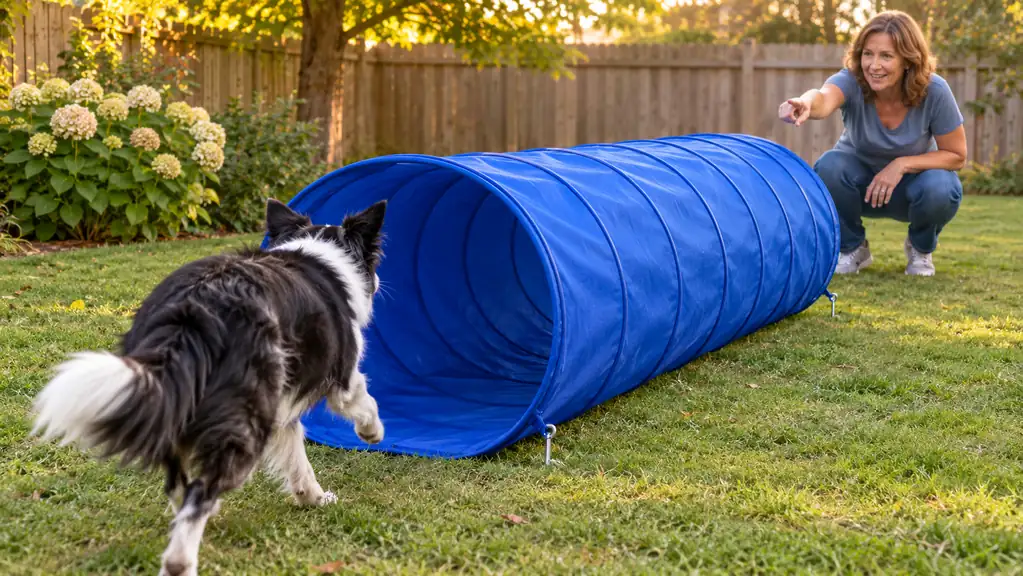
An open tunnel has no door and no dark middle. A dog standing at the entrance can see the far end and the grass beyond it, and that is worth more than any amount of coaxing from me. When I first put mine out I pushed it down to about five feet, so Juno had a short, bright run with an obvious exit. It still took her four sessions over about two weeks before she ran the whole thing without stopping to check. I did not train that out of her. The shape of the obstacle did most of it.
You decide how long it is, and you can change your mind
The HDP tunnel is 18 feet at full length, and it does not have to be used at 18 feet. I pushed mine down to roughly five feet for the first two weeks and let it out a little at a time as Juno got quicker. A jump does not offer that. A jump is 8.5 inches or it is not, and if your dog is not ready then she is not ready. Length is the dial you actually have on a tunnel, and it costs nothing to turn.
Eight stakes turn a light tunnel into a fixed one
Two point four pounds is the whole tunnel. That is good when you are carrying it out of a shed by yourself and bad when a dog hits the entrance at speed. Mine has eight stakes of about 7 inches and grommets along the base, and I drive every stake through every grommet, every session, including the fifteen minute ones. Staked down, the tunnel stays where I put it. I do not have to think about it again until I pull the stakes at the end.
It forgives a late send
I am a hobby handler and I send late. I know it, I work on it, and I still do it. On a jump, a late send means the dog either refuses or takes the rod off, and the rep is gone. On a tunnel, a late send usually still means the dog goes in, because there is a mouth 24 inches wide and it is the obvious thing to run at. That forgiveness is why the tunnel is where I practise my timing and the jumps are where I find out whether it worked.
The send is the real skill, and the tunnel teaches it to the handler too
Agility is mostly the handler. I did not understand that until I was standing in my own yard with a tunnel and a dog who did not need me within three feet of her. She runs it, turns, and looks at me for the next thing. So I had to learn to stand still, point, and say go. Two years in, that is still the part I get wrong most. The tunnel put that lesson in front of me early, before I had enough equipment to hide behind.
One person can set it out in about five minutes
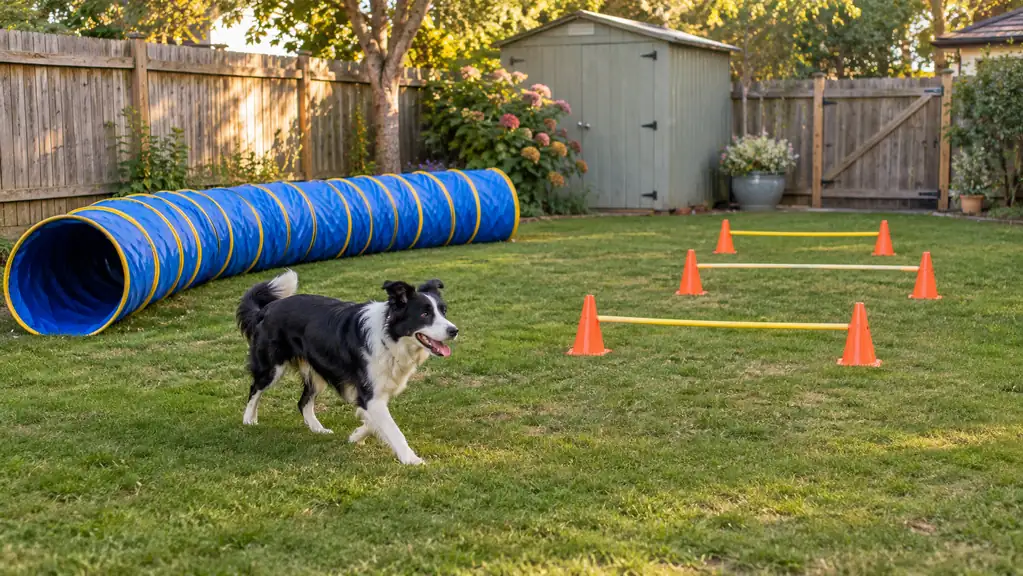
Nobody helps me. There is no one to hold Juno, no one to reset a rod, no one to drag the other end. So equipment that needs two people is equipment I do not use. From the shed shelf to staked and ready takes me about five minutes, and most of that is walking out and back. The spring in the HDP tunnel opens it, the case holds it, and I do the whole job with one pair of hands before Juno is out of the house.
A gentle curve is the next lesson, and it comes free
Once Juno was running a straight five feet without hesitating, I let the tunnel out and bent it into a gentle curve along the back fence side of the yard. A curve asks a dog to commit to something she cannot see the end of. Same tunnel, same stakes, same five minutes of setup, and a much harder question. That is what you want from a first obstacle. It should still have somewhere to go after the first month.
It packs into a case, with two honest caveats
The tunnel folds down into the carry case it ships with and lives on the shed shelf between sessions. Two things I would tell a friend. The fabric picks up mud and grass, and after rain it holds water, so it has to go over the fence to dry before it gets packed. And 18 feet takes up most of a small yard while it is out. Neither of those is a defect. They are what you accept for a real tunnel instead of a play toy.
It goes after the jumps, not instead of them
My Tuesday and Thursday sessions are jumps first, then the tunnel. Three hurdles in a line, a couple of passes, then across the yard and through the tunnel, then ten seconds of tug. The tunnel does not replace the jump work and it does not compete with it. It gives the session a second act, so fifteen minutes has a shape and Juno is not doing the same thing eleven times in a row. One obstacle on its own cannot do that.
The worst case is boring, which is what you want
Say your dog will not go near it. You shorten it, you stake it, you roll a treat through to the far end, and you try again Thursday. Say she still will not. You have a tunnel for play and a dog who is not a tunnel dog yet, and you found that out from one piece of gear instead of a whole kit. Nothing broke, nothing was wasted, and nothing about it pushed her. That is the kind of failure I want in a first obstacle.
She needed four sessions over about two weeks before she ran it without stopping. I did not teach her that. The shape of the obstacle did.
What I'd Skip
If you are putting a first kit together and something has to come off the list, take the pop up play tunnel off it. I have never owned one, so I am judging from listings and from handling one in a pet store, and the difference is not subtle. A play tunnel is a fabric tube for a dog to run through on the lawn. The HDP tunnel is staked through grommets, has a steel spring that holds a curve, and stays where you put it when a dog hits it at speed. For running through in the yard, the play tunnel is fine and probably more fun. For training, you want the thing that does not move. I would also skip buying everything at once. One tunnel, one set of jumps, a bag of soft treats and a tug is enough for a year.
The obstacle I would buy first, eighteen months later
If you are starting from nothing, start with the tunnel. Juno was running it clean inside two weeks and it is still the first thing I set out on a Tuesday.
Amazon Check Today's Price on Amazon →