
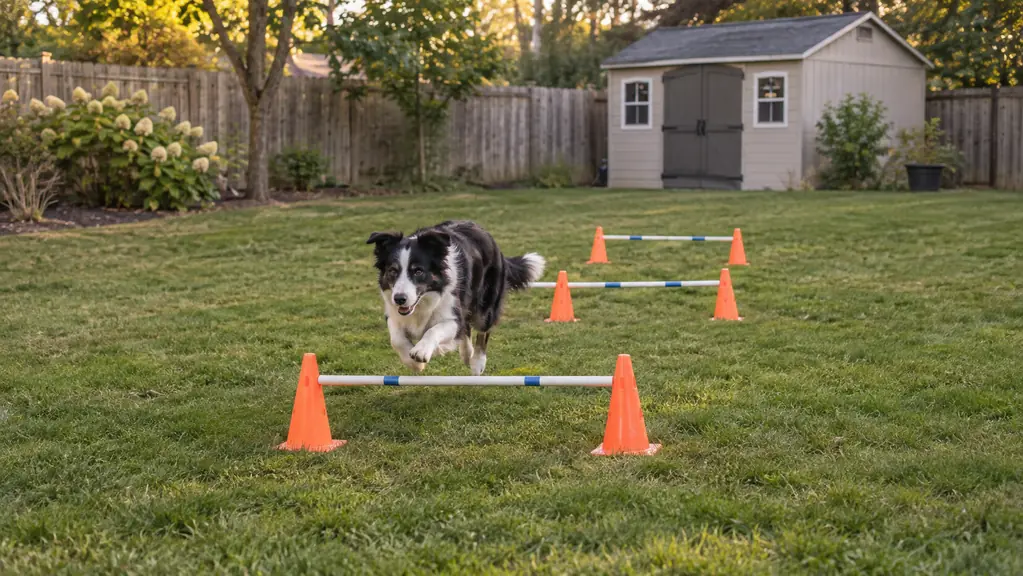
Juno is a 28 pound border collie mix who came home from a shelter at a year old. She learned sit and down in a single weekend and then spent the next four days staring at me, waiting for a job. The TRIXIE Dog Agility Hurdle Cone Set was the first piece of agility gear I ever bought, 24 months ago, the same month I joined a beginner group that meets Saturdays at nine on a field at the county fairgrounds. Six cones, three rods, a carry bag and a short booklet. It makes three jumps.
Here is what this kit is, before I get into the rest of it. It is a starter set. It is not club equipment, it is not built for a dog running flat out, and it will not teach your dog to weave, because it cannot. What it does is show a dog that a bar across two cones means go over, and it does that in a back yard with room for a shed and a clothesline. I have set it up and packed it away close to two hundred times. Nothing has broken, nothing has cracked, and no cone has split.
The Quick Verdict
The right first jump for a handler who trains alone in a small back yard, and the wrong tool the day your dog starts running hard.
Amazon Check Today's Price →Three jumps that fit on a shed shelf
Six cones, three rods, four heights from 2.5 to 13 inches, and a bag you can carry in one hand. This is the set I started on and the set I still put out on Tuesday nights.
Amazon Check Today's Price on Amazon →How I've Used It
My routine is Tuesday and Thursday evenings, about fifteen minutes, in the back yard. I get home from bookkeeping work, change out of the good trousers, clip the treat bag onto my right hip and set the three hurdles in a straight line about ten feet apart. Juno waits at the back door and complains about the waiting. Fifteen minutes is the whole session, and most of it is not jumping.
The first evening I ever set them out, I put the crossbar at 2.5 inches and walked Juno over it on a loose lead, one deliberate step at a time, with a pea sized piece of soft chicken treat after every pass. She looked at the bar, looked at me, and stepped over it like it might bite her. It took about four passes before she stopped checking it with her nose. Three weeks later we were at 5.5. About two months in we were at 8.5, and 8.5 is where we still are.
Fifteen minutes is not much, and I want to be honest that it is not much. This is a hobby I do after work with one dog in my own yard. Tuesday is usually the better session because I am less tired. Thursday is the one where I notice how much of the training is really my concentration rather than Juno's, and how quickly she reads it when my concentration goes.
I have set 13 inches a handful of times. Juno clears it. The trouble is me. When the bar goes up she speeds up on the approach, and a faster approach means my handling has to be sharper than it is, so we get sloppy turns and me saying the wrong thing at the wrong moment. I went back to 8.5 every time. Clean and easy beats high and scrappy, at least at my level.
The rod drops the instant a dog touches it. That is deliberate, and it is my favourite thing about the set. The bar giving way teaches the dog where her feet are without anyone correcting her, and nothing catches a leg the way a fixed bar will. It does mean you stop and reset. If stopping irritates you more than a stiff bar worries you, this is not the jump you want.
The Four Heights, and Why 13 Inches Is a Different Jump
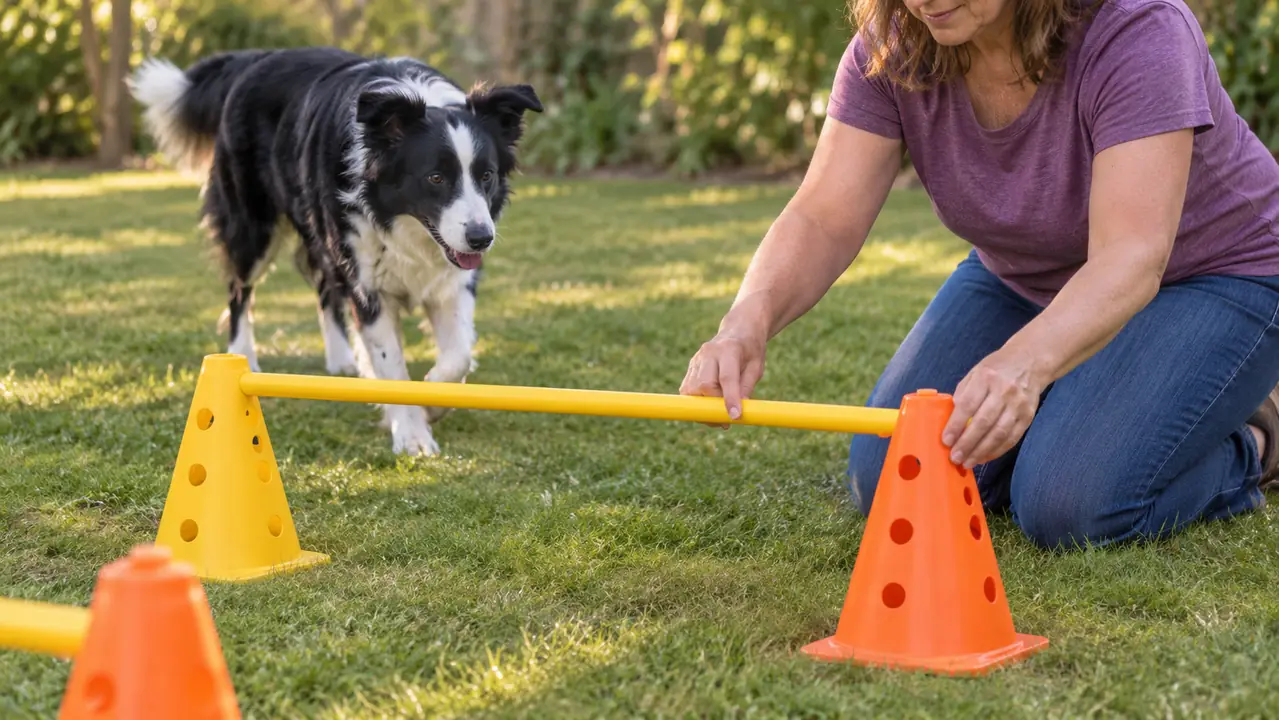
The crossbar sits at 2.5, 5.5, 8.5 or 13 inches. Those are the four settings on the listing and those are the four I have used. Working up in that order is the obvious way to use them, and the gap from 2.5 to 5.5 is gentle enough that a nervous dog barely notices it changed.
The jump from 8.5 to 13 is the one that changes things. It is a bigger step than the others and it arrives right where a dog has to fold her legs to clear the bar rather than step over it. Juno managed it the first time I tried it. She also started launching from further back and landing harder, and after a handful of attempts I put it back down. I am not a trainer and I am not going to pretend to be one. I know what my handling looks like when she is running faster than I can think.
For what it is worth, there is nothing to assemble. You stand the cones where you want them and drop a rod across each pair of them. The listing calls the set quick and easy to put together and set down, and that matches my experience of two years of Tuesday nights. I have never had to fetch a tool, read a diagram twice, or leave a session early because something would not go together.
If I were starting again, I would probably spend the first two weeks lower than feels necessary. On the 2.5 setting Juno was not really jumping at all, she was stepping. That looked like nothing. It is the reason she stopped worrying about the bar, and the reason 5.5 and 8.5 went as smoothly as they did.
What the Cones and Rods Do on Grass
My back yard is fenced, grass, roughly forty by sixty feet, with a slight slope running down toward the back gate and a garden shed in one corner. The cones sit level enough on the flat of it. On the slope side, a hurdle set parallel to the fall line sits noticeably crooked, so I lay the line of jumps across the slope instead, and the whole thing stays square.
The kit is light. The listing puts the whole set at 2.82 pounds and that is about right, which is both the good and the bad of it. Good, because I can carry the TRIXIE bag with one hand along with my keys. Bad, because a strong wind will tip the cones over between sessions. I do not leave them out. They go out when I train and back in the bag when I finish, and on a windy afternoon I pack them up a little sooner than I otherwise would.
The listing says the set is for indoor and outdoor use, and it does work indoors, within reason. On the odd rainy week I have set the cones out in the garage in a simple slalom, spaced wide, and walked Juno through the gaps. The garage is not big enough for a proper jump and a slalom is not the same skill, but it keeps her brain working on a wet Tuesday. I have been glad of that more than once.
Clean and easy beats high and scrappy. I would rather have a hundred boring repetitions at 8.5 inches than five rushed ones at 13.
The Carry Bag, the Booklet and the Shed Shelf
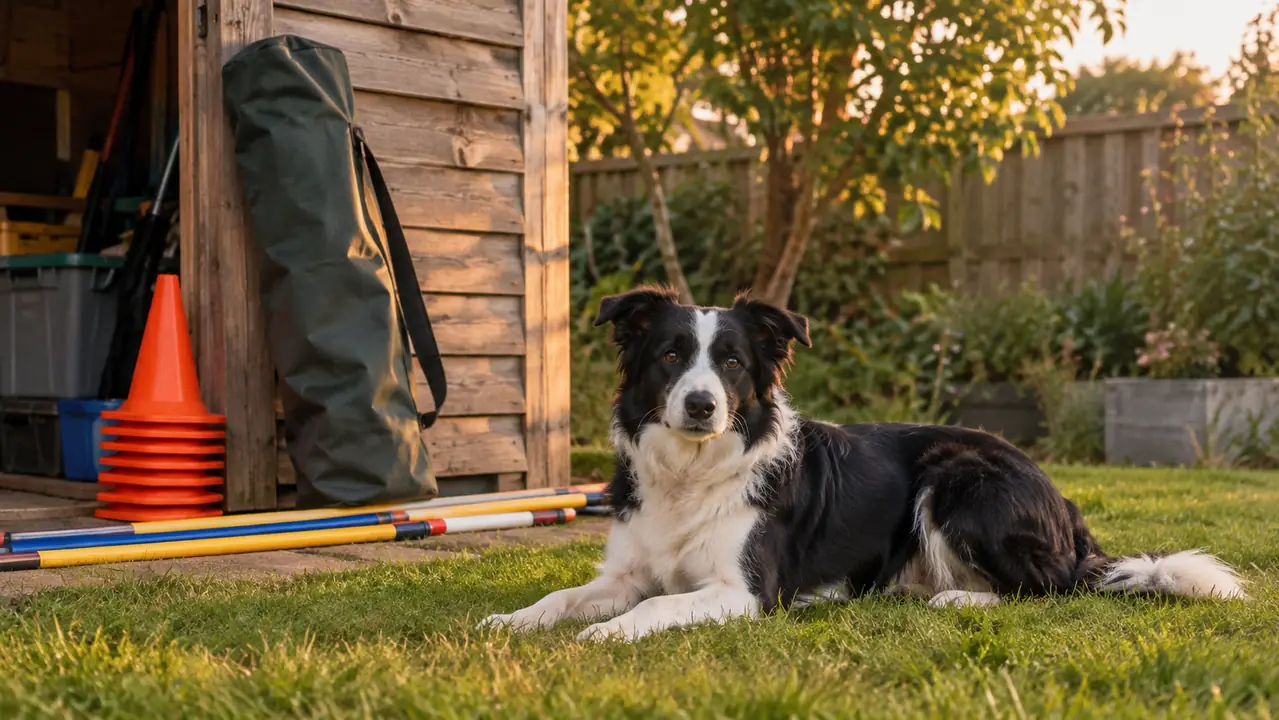
Everything packs into the carry bag, which measures about 30.7 by 9.1 by 11.8 inches and weighs next to nothing when it is empty. It lives on the shelf in the garden shed above the rake, and I have never once had to move anything else to get it out. That sounds like a small thing. It is the single reason this set gets used twice a week instead of twice a season.
There is a small booklet of training tips in the bag. I read it once, at the kitchen table, the week the set arrived. It is short and it is basic, and it got me far enough to know what to do on the first evening. If you have already done a few weeks at a club you will not learn anything from it. If you are starting alone in a back yard with no idea at all, it will get you to your first jump.
The listing carries a one year warranty. I have never needed it. Twenty four months of grass, a couple of accidental kicks, and one cold winter on a shed shelf, and the cones are still cones and the rods are still straight.
Where a Starter Kit Runs Out
The Saturday club has proper full size equipment, including the weave poles and the contact obstacles. Nobody at that field is training on cones. The first time I set the TRIXIE hurdles beside real competition jumps I understood the difference in about four seconds. Real hurdles are heavier, they are wider, and they do not scatter when a fast dog clips them.
That is not a flaw in the kit, it is what the kit is for. A dog who has never seen a jump should not meet a stiff competition hurdle first, and a handler who has never trained one should not be learning on the equipment the club depends on. The cones are a teaching tool. They are also easy to store and easy to live with, which matters in the months when you are not yet certain you will still be doing this next spring.
The other limit is simple arithmetic. Six cones and three rods make three hurdles and no more. Three is plenty for a straight line and for building rhythm through a sequence. Three is not a course, and it will not be a course no matter how you arrange it. If your plan involves turns, a curved line or anything that resembles a run, you are going to want a fourth and fifth jump fairly soon.
The other thing I looked at before I bought was a homemade PVC pipe jump. I read through the plans online and pictured myself cutting lengths in the driveway with a handsaw, because I do not own a saw that would do the job properly. I never built one. What decided it for me was the storage: a PVC jump does not fold into a bag that goes on a shelf above a rake. That was the whole argument and I have not regretted it.
How It Fits With the Rest of My Gear
The jumps are the first half of a session and the tunnel I bought eighteen months ago is the second half, set up after the hurdles and staked through the grommets. The hurdle set handles the straight line work and the tunnel handles the confidence work. I would not want to give up either one for the other, and I would not want to run a session with only the jumps in it either.
Every session, home or club, the treat bag sits on my right hip with the rope tug in the side pocket. The jumps get food. The tug comes out at the end of a sequence for about ten seconds of play and then it goes back in my hand. Juno worked out the difference fast. By the time I lean toward the pocket she has already started her victory lap.
The disc is a separate thing entirely, Sunday mornings only, low flat throws over the grass. It has nothing to do with the hurdles and I have never mixed the two. Neither has turned Juno into a different dog, and I still make handling mistakes that no amount of equipment is going to fix for me.
What I Liked
- Goes up and comes down in a couple of minutes, with nothing to assemble
- Four crossbar settings from 2.5 to 13 inches
- The rod drops on contact instead of catching a leg
- The whole kit packs into one bag that fits on a shed shelf
- Light enough to carry in one hand at 2.82 pounds
Where It Falls Short
- Light enough that a strong wind tips the cones between sessions
- Not club equipment, and a hard running dog will scatter it
- You stop to reset the rod every time it drops
- Three jumps is the ceiling, so it cannot build a course
- The top setting of 13 inches arrives fast after 8.5
Who This Is For
This is for a handler who trains alone in a small back yard, or on a driveway, or in a garage on wet days, and whose dog has never seen a jump. It suits a small or medium dog, which is what the listing recommends, and it suits an owner who wants to try agility before committing to club sized gear. It also suits the person who will pack it away every single time, because that habit is what keeps a lightweight kit in good order for two years.
It suits someone who is happy to be a hobby handler. I am never going to a trial with Juno. What I wanted was fifteen minutes on a Tuesday where she has to think and I have to think, and the set has given me that about two hundred times now.
Who Should Skip It
Skip it if your dog already jumps clean and fast over a real hurdle. The cones will scatter, the rods will drop constantly, and you will spend more of the session resetting than training. Skip it if you want to train height seriously, because 13 inches is the top and the gaps between settings are wide. And skip it if you want one set to last forever. It is a starter kit and it is built like one.
Start with three jumps you can carry in one hand
Six cones, three rods, four heights and a carry bag that sits on a shed shelf. Twenty four months in, mine is still doing Tuesday and Thursday nights.
Amazon Check Today's Price on Amazon →