
I bought the TRIXIE agility hurdle set 24 months ago, the same month I started a beginner agility class, and it is still the only jump equipment I own. Two years on, I have never built the PVC pipe jump I once printed plans for, and I have never wished for something fancier. Not because the set is remarkable. Because it removes nearly every excuse I used to have.
Here is what that looks like. I train Tuesday and Thursday evenings in a fenced back yard about 40 by 60 feet with a slight slope. Sessions run about 15 minutes, never in the heat of the day, and the whole system depends on setup costing me almost nothing. If you are a hobby handler trying this sport on for size, that is the thing that decides whether you keep going. Not the equipment catalog. The five minutes between the shed and the first rep.
The jump set that made a 15-minute session possible
6 cones, 3 rods, four heights from 2.5 to 13 inches, 2.82 pounds packed. Two years of Tuesday and Thursday evenings and nothing has broken.
Amazon Check Today's Price on Amazon →Six cones and three rods make three separate jumps
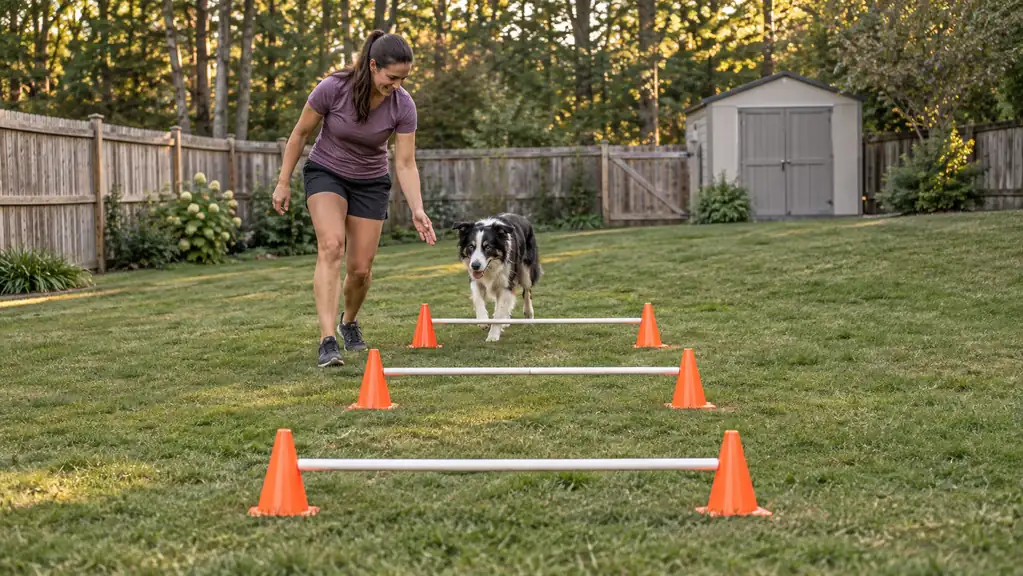
The set arrives as 6 cones and 3 agility rods, and each rod rests across a pair of cones to make one hurdle. That is three jumps out of the box, which is more than I expected and more than one dog needs. Most evenings I set two in a straight line and one turned at a gentle angle, because a 28 pound dog at my level needs rhythm more than she needs a puzzle. The third jump comes out when I want to send Juno to one and recall her to another. There is also a short set of training tips in the box, which is roughly the level of instruction a hobby handler actually wants.
Four crossbar settings, starting at 2.5 inches off the ground
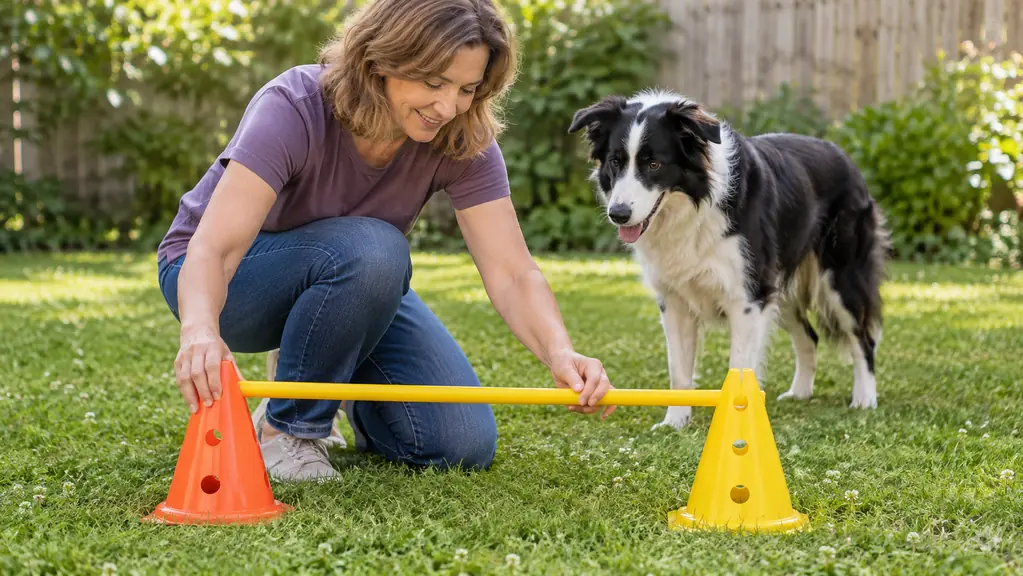
The rod can sit at 2.5, 5.5, 8.5 or 13 inches off the ground. My first week was the 2.5 setting with Juno walking over it, and honestly it looked like nothing was happening. Three weeks later we had the rod at 5.5. Two months in we settled at 8.5, and 8.5 is where we still are. I tried 13 a handful of times and went back down. I want clean, boring repetition, not height, and the set gives me four choices without a tape measure.
A touched rod falls, so the mistake is visible from ten feet away
The rods are not fixed in place. If a leg catches, the rod drops, the dog keeps moving, and nothing about it feels like a correction. That is the whole reason I like training with this set. I can see from across the yard whether a rep was clean without squinting at footwork. A knocked rod costs me three seconds and one walk back to set it on the cones again, and Juno gets no sting out of the mistake at all.
It sets up in the time it takes to fill a water bowl
The TRIXIE set takes me about two minutes from shed shelf to first rep. That number matters more than it sounds, because a 15-minute session only survives if the setup is shorter than the session. Nothing locks. Nothing bolts to the ground. Nothing needs stakes. I set the cones out, drop the rods across, and we go. At the end I pull the rods, gather the cones and it is back on the shelf before Juno has finished sniffing the gate.
At 2.82 pounds, one person carries the whole course
The listed weight is 2.82 pounds for everything, and packed it measures about 30.7 by 9.1 by 11.8 inches. I am 52 and I carry it one handed with a mug in the other. That is not a small point for a hobby handler. The heavier the kit, the fewer sessions you run, and I have watched that happen to people with bigger equipment. Most days this set travels about eight feet, from the shelf behind the shed to the middle of the lawn.
Three jumps fit a small yard without eating the whole lawn
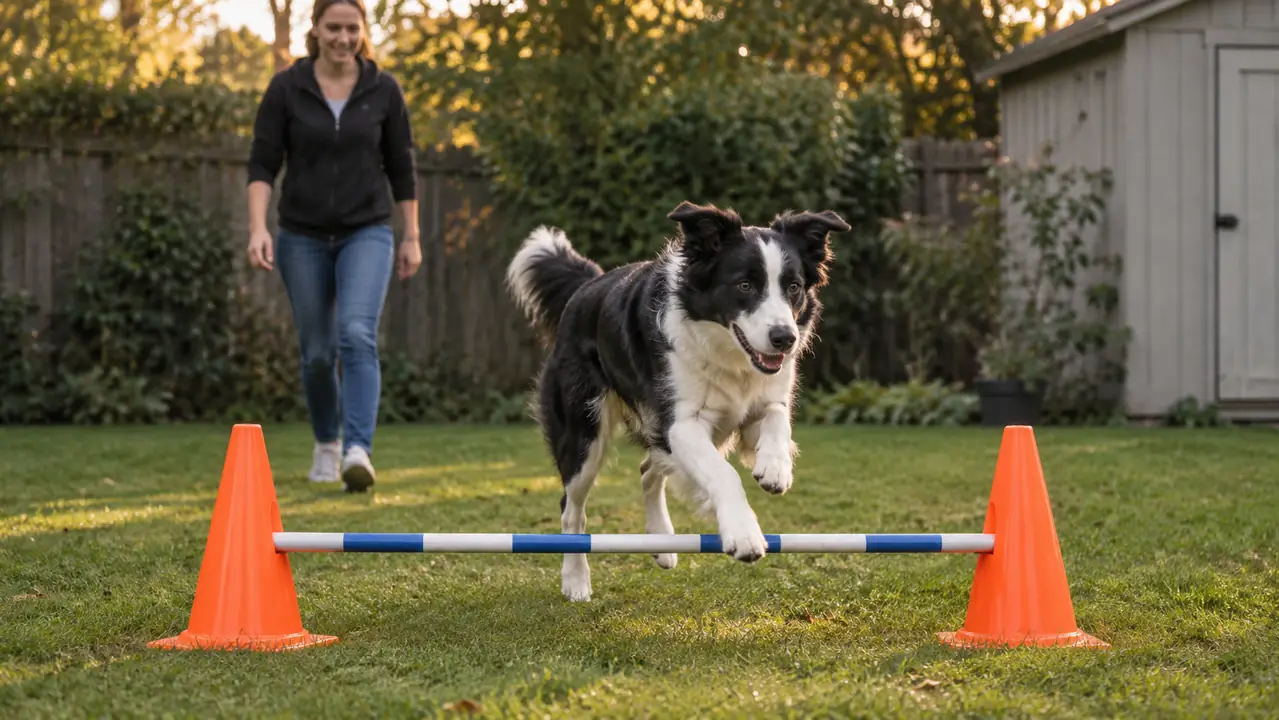
A line of three jumps needs a strip of grass, not a field. In a yard about 40 by 60 feet with a slight slope, I can set the line, leave the middle clear for recall work, and still have room to throw a disc on Sunday morning. That is the practical case for cones over anything larger. It lives alongside normal back yard life instead of replacing it. Nothing is permanent, nothing is sunk into the ground, and the mower still gets through on Saturday.
It works in a garage on a wet week
On the odd rainy week I set the cones in the garage and run a simple slalom, or a straight line at 2.5 inches. It is not a substitute for a proper session outside, but it keeps a five year old border collie mix from bouncing off the walls, and it keeps her thinking about the game. This is the one use where the low settings earn their keep. A garage floor gives you less room to recover from a mistake, so low and slow is the right call anyway.
No cutting, gluing or lengths of pipe in the shed
Before I bought anything I read plans for a PVC pipe jump, then did the sums on the shopping trip, the cutting and a length of pipe living in my shed for years. I never built it. Not once. The cone set does the same job with no tools, no sharp cut ends near a dog's legs and no stray pipe leaning in a corner. I am not against a home build. I just know myself, and the build would have quietly become the hobby.
Low setup effort is why the Tuesday session actually happens
This is the reason I would buy it again. Two short sessions a week in the back yard do more for a beginner handler than one big weekend session, but only if the short ones are easy enough to run when I am tired after a day of bookkeeping. The TRIXIE set is the difference between too much bother tonight and a rod on the grass at 8.5 inches ten minutes later. Gear you do not dread is gear you use.
It shows you plainly when a dog has outgrown it
The set is light, so a strong wind tips the cones, and it behaves like a starter kit because that is what it is. I like that honesty. I know exactly where my gear gets thin, and I know it is not pretending to be club equipment. When Juno and I are ready for bigger jumps, the club owns the full size obstacles on the field at the county fairgrounds, and I will learn on those. Until then, being honestly limited beats being overbuilt.
I tried 13 inches a handful of times and went back to 8.5. Clean repetitions did more for us than height ever did.
What I'd Skip
The things I would skip are the ones that cost more in money or in evenings than they give back to a beginner. A full weave pole set, a contact obstacle, a regulation height jump: the club owns those, they live on a field at the county fairgrounds, and there is no sensible place for them in a 40 by 60 yard with a dog jumping at 8.5 inches. I would also skip the PVC build I spent a week reading about and never started, and I would skip any kit that needs two people to move it.
One more, and this one surprised me. I would not buy a second jump set. Three hurdles is enough for one dog and one handler at this level, and I have never once needed a fourth. If you find yourself wanting six, that is usually a sign you are ready for a club rather than a bigger shed.
If you are starting this month, start with the cones
It is a starter kit and it says so. That is exactly what a first season needs. The full size equipment will still be on the field when you are ready for it.
Amazon See the TRIXIE Agility Hurdle Set on Amazon →