
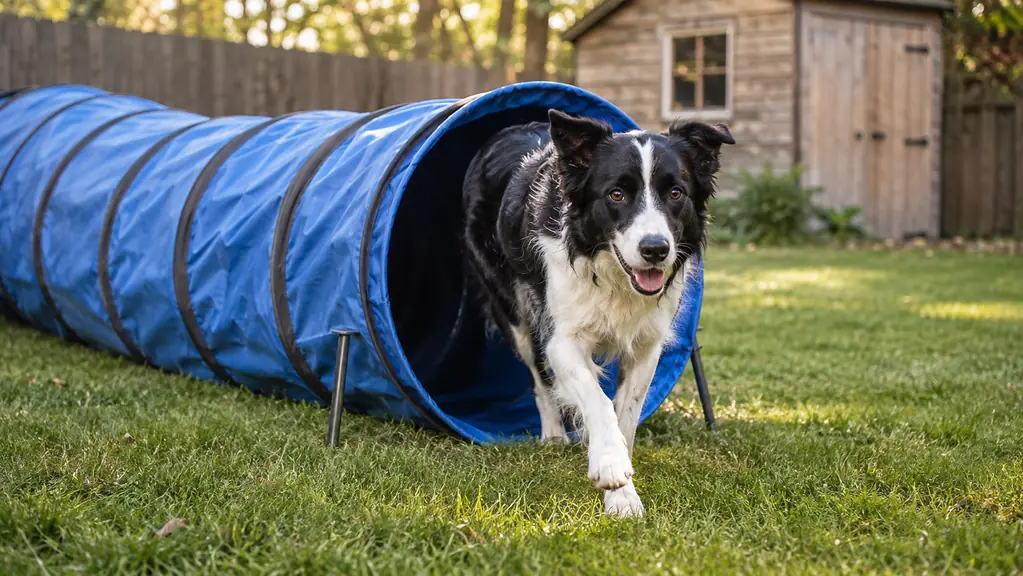
For two years my back yard was three jumps in a line and a dog who thought that was the whole sport. Juno is a border collie mix, five years old, twenty eight pounds, and she learned the hurdle set fast enough that I ran out of things to teach her on a Tuesday evening. What she did not have was anything that asked her to go somewhere she could not see the end of. That is the part of agility I kept reading about and the part my yard could not do. So eighteen months ago I bought the HDP 18 Ft Dog Agility Training Open Tunnel, and the yard stopped being a place where we practiced and started being a small field.
At the club on Saturday mornings the tunnel is there and Juno will run it. The difference is that a club tunnel gets one pass inside a group of eight dogs and then you drive home. Fifteen minutes of real work on a Tuesday evening in my own yard is worth more to both of us than a single pass on a Saturday. I knew that going in. What I did not want was another thing folded in the shed with the tag still on it.
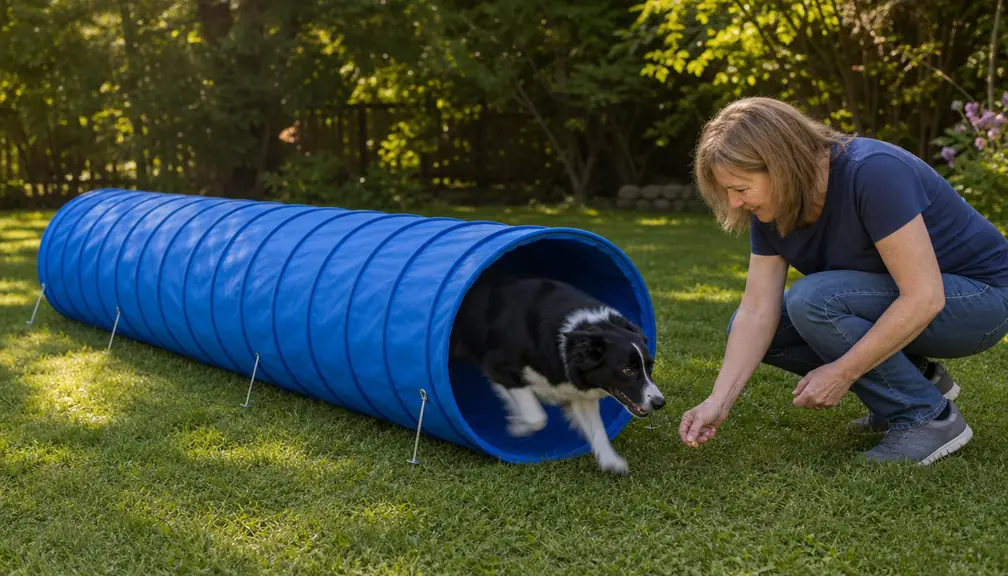
The HDP tunnel is eighteen feet long with a twenty four inch opening and it weighs 2.4 pounds. Those numbers are easy to read and hard to picture. The weight is the one that matters, and I will come back to it. It arrives in a carry case with a steel spring inside the Dacron cover, so it folds down to something I can carry from the shed to the fence line in one hand. Eighteen feet of tunnel, one hand, one trip.
The first setup was not eighteen feet. I squeezed it down to about five feet so Juno could see daylight at the far end, staked it in the grass, and stood at the exit with a treat. She went around it. She went around it again. Four sessions over two weeks is what it took before she ran the whole thing without stopping in the middle, and I want to be straight about that, because a tunnel is not a piece of gear that fixes anything on its own. It is a shape your dog has to decide is not a trap.
Now it runs at close to full length in a gentle curve along the back fence side of the yard, which is the longest clear line I have. Setting it out takes about five minutes, and five minutes fits inside a fifteen minute session on a Tuesday. It is always staked, at both ends and through the middle, because 2.4 pounds of HDP tunnel moves when a twenty eight pound dog hits it at speed and I do not want it sliding into the fence while she is inside it.
The hurdle set came first, twenty four months ago, and a session still starts there. Three jumps in a straight line. Then the tunnel goes down past the last one and the whole thing becomes a sequence instead of an exercise. Jumps, tunnel, then ten seconds of tug with the rope toy and we are done. The tunnel is the part that made the sequence feel like a sport rather than a drill.
Four sessions over two weeks before she ran it without stopping. A tunnel is not a piece of gear that fixes anything on its own.
The piece that gave my Tuesday sessions somewhere to go
Eighteen feet of staked tunnel, a carry case, and a five minute setup. That is the whole reason my yard works now.
Amazon Check Today's Price on Amazon →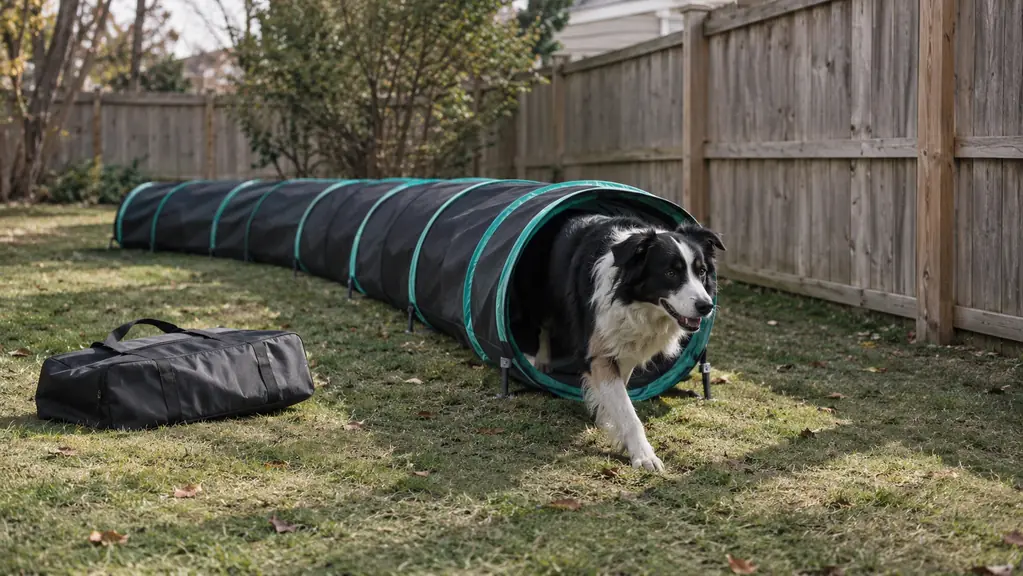
Here is what nobody tells you about an eighteen foot tunnel in a small yard. It takes up most of it. My yard is about forty by sixty feet with a slight slope, and once the tunnel is down there is room for the jumps and not much else. The Dacron cover picks up mud and grass every single session, and after rain it holds water, so it gets draped over the fence to dry before it goes back in the case. That is a chore and I do it anyway, because the cover is still intact after eighteen months of Tuesdays and Thursdays and I would like to keep it that way.
2.4 pounds is light enough to carry in one hand and light enough to move with a dog in it. On a windy day it will shift if you only stake one end. I use every stake that came with it, every time, and I have never once left it out overnight. Left out, it is a kite. Staked, it stays where I put it, even when Juno cuts a corner and slams the side.
Before this one I looked at a pop up play tunnel, the collapsible kind, and I handled one in a pet store. They fold flat in a second and they take up nothing in a closet, and for a dog who just wants to run through something in the living room they are fine. What they are not is eighteen feet of staked tunnel that a dog can push against. I never owned one, so I am judging it on listings and the thirty seconds I spent holding it, and I am comfortable saying the HDP tunnel was the right call for a yard with room.
What the tunnel did not do is make us good. I still make handling mistakes, still send Juno into the wrong end of a sequence, still reward a second late. The tunnel gave me a place to practice those things in. She is the same dog she was eighteen months ago, we have never entered a trial, and the gear has never once made up for a timing error on my end.
What I'd Tell You If We Were Sitting at My Kitchen Table
If you asked me over the table whether to buy an eighteen foot tunnel for a back yard, I would ask you two questions first. How long is your longest clear line, and will you actually stake it and dry it. If the answer to the first is less than about twenty feet, get the collapsible thing and save yourself an argument with the fence. If the answer to the second is no, the cover will be muddy and wet in the case by week three. But if you have the room, and you will do the five minutes of setup and the drying over the fence after rain, this is the piece of gear that changed what a Tuesday evening could be. I would say that with the mud and the stakes and the drying all included.
If your yard has twenty feet of clear line, this is the one
Eighteen feet, twenty four inch opening, 2.4 pounds, stakes and carry case included. Staked it stays put, and it goes back in the bag after every session.
Amazon Check Today's Price on Amazon →