
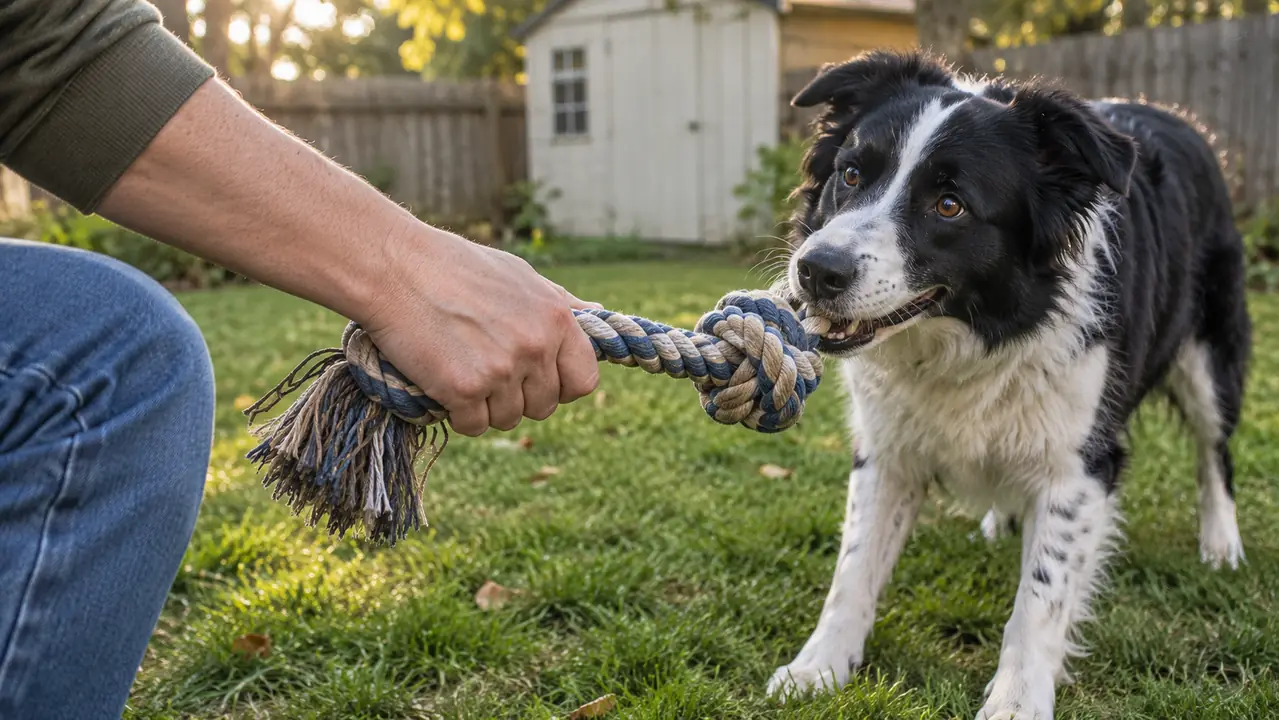
I bought the Mammoth Pet Products Flossy Chews rope tug 22 months ago, about two months after I started taking agility classes with my dog Juno. I want to give you the honest version of how that has gone, because most of what I read before I ordered it was one line long and mostly about the size of the thing. Nobody mentioned the part that decides whether you end up liking it. So here is the version I wish I had found: what it does well, where it stops working, and the two situations where I would tell you to leave it on the shelf.
Up front, so you can decide whether to keep reading: nothing about this tug is impressive to look at. It is a cotton and poly rope with three knots, 15 inches end to end, listed as a Small for dogs between 15 and 30 pounds. No squeaker, nothing to grip with your foot, no clever design. What it has is a job, and it does that job every Tuesday and Thursday evening in my back yard. It is the smallest thing in my gear bag and the one I would replace first if it went missing.
The Quick Verdict
A plain knotted rope that does one job, as a short play reward, better than anything else I own. Buy the right size and expect to replace it about once a year.
Amazon Check Today's Price →The size matters more than the toy itself.
Juno is 28 pounds and the Small 15 inch suits her. A dog well over 30 pounds needs a bigger rope, not a longer game with this one.
Amazon Check Today's Price on Amazon →How I've Used It for 22 Months
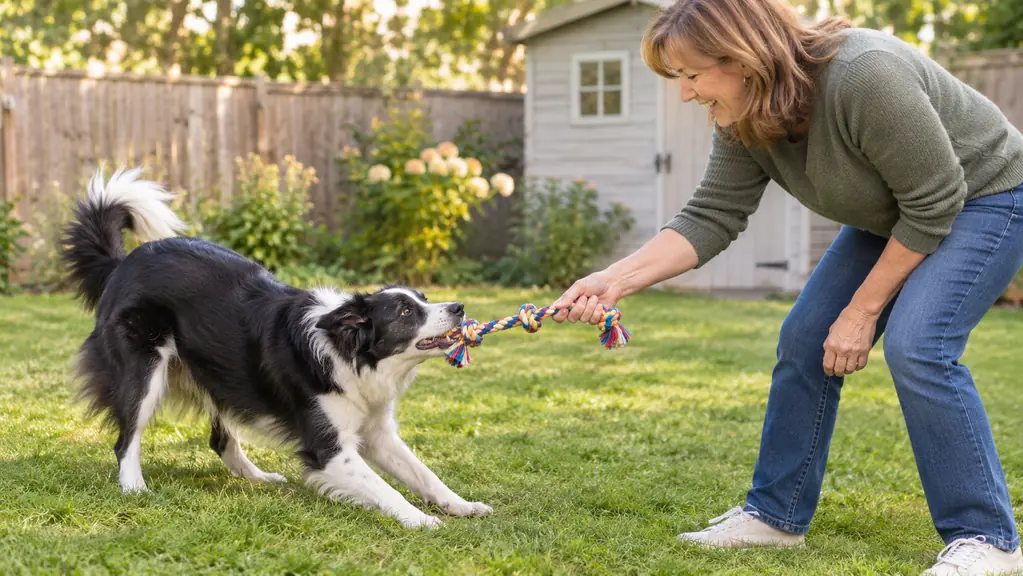
My routine has not changed much in two years. Juno and I work in the back yard on Tuesday and Thursday evenings for about 15 minutes, never in the heat of the day. The tug comes out at the end of a sequence, not at the start. She runs a short line of jumps, or the tunnel, or both, and then I bring the rope up and we tug for about ten seconds. Then it goes back in my hand and we set up again. That is the whole relationship. The tug is not the activity. It is the thing that tells her the activity paid off.
Food and play are separate in my bag on purpose. The soft chicken treats live in the treat pouch on my right hip, and the rope lives in the side pocket of that same pouch or in my hand. Treats come out when I am teaching something new and I need her to think. The tug comes out when she has done something and I want her to feel good about it. Juno would work for either one, but she works differently for the rope. She gets louder about it.
The Mammoth Pet Products tug has never been the star of a session and I think that is the point. It is the punctuation at the end of the sentence. If you are looking for a toy that will occupy your dog while you do something else, this is not that, and I will get to why in a minute.
What Nobody Tells You: The Rope Frays, and That Is the Product
Here is the part I never saw in a review. Rope frays. The first one I bought started shedding loose fibers around the knots after roughly ten months of twice-a-week tugging, and by the year mark it looked tired enough that I threw it out and ordered the exact same thing again. I did not switch brands. I did not leave a complaint. A knotted rope that a dog pulls hard twice a week is going to come apart at the knots. If it did not, I would assume the rope was too stiff to be any fun to bite.
The second one is the one I have now, and it has been in service for about a year. It is starting to look the way the first one did near the end of its run. I am not bothered by that. I would rather replace a rope every twelve months than own a rope that never wears out because my dog never really pulls on it. What I will say is this: if loose strings hanging off a dog toy make you twitchy, you will not enjoy this one. Trim them or ignore them, but do not expect them to stop.
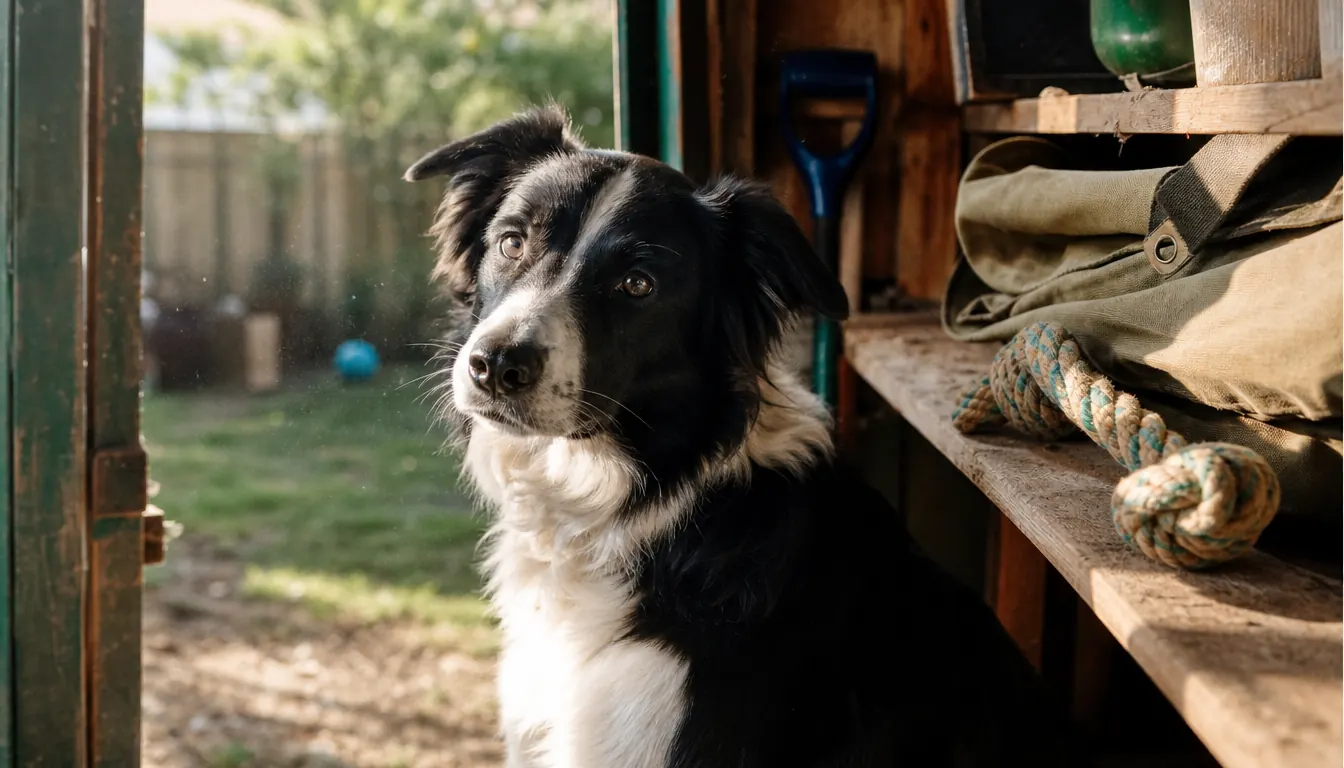
The other thing nobody says out loud is that a frayed rope near a dog's mouth is a supervision toy, not a leave-it-in-the-yard toy. Mine has never been left out with Juno. It lives in my hand during a session and on the shed shelf after, and it is picked up the second we are done. If your plan is to hand your dog a rope and walk away, buy something built for that instead, because this is not it and the listing never claims it is.
The Size Number Is the One That Actually Matters
The listing contradicts itself and it is worth knowing before you order. One of the attribute fields says the breed recommendation is all breed sizes. The size line says Small, 15 inch, and the description says 15 to 30 pounds. Those two things cannot both be true. Trust the size line. This is a small dog rope, and everything about it, the length, the thickness, the spacing of the three knots, is built around a dog in that weight band.
Juno is 28 pounds and about 17 inches at the shoulder, which puts her near the top of the range. The Small is right for her. She can get a full grip on the rope between two knots without me having to crouch, and I can hold the far end at about waist height without leaning back. If your dog is 40 or 50 pounds and serious about pulling, you will be holding a rope that is too short for the pair of you, and the knots will land in the wrong place for a big mouth.
The numbers are 15 inches long, 2.5 inches across, and 1.9 ounces. That last one matters more than it sounds. The tug is light enough that I can swing it gently to start a game and it will not drag my arm down over a 15 minute session. A heavier rope would feel nicer in the hand and be worse for the dog, because a 28 pound dog does not need weight, she needs something she can grab.
Where It Fits in an Actual Session
There is a version of tug that ruins a training session, and I have done it. The dog gets the rope, the dog keeps the rope, and the next thing you know the rope is the most interesting object in the yard and the jumps are furniture. What worked for me was making the rope scarce and short. Ten seconds, then I take it back. If Juno does not release, we do not tug again that evening. It took her about three weeks to learn the second half of that deal.
Because it is a reward and not a possession, it never gets left with her. Not in the yard, not in the house, not in the car. The only time it exists is when I am holding one end. That single rule is why a rope that has been in service for a year still looks like a rope and not a frayed stub. It is also why I have never had to wonder what she is working on when I am not looking, because she is not working on this.
One practical note. The rope goes in the side pocket of the treat pouch, which is exactly the right size for it, and that is where it waits during a session. It is a small thing, but it means I am not putting a wet rope in my jacket pocket, and I am not walking back to the shed halfway through. If you train in a yard with no table nearby, that pocket trick is worth copying.
On Saturdays the rope goes to the club in the same side pocket. The club has the full size equipment and I do not own any of that, so the tug is the one piece of my own kit that comes along. The rule is the same there: ten seconds at the end of a run, then it goes away and we go back to being spectators.
Dirt, Water, and the Washing Machine
It gets dirty fast. Grass, mud, the general gray of a back yard in South Carolina. The listing says it is not water resistant, and my experience matches. A wet rope is a heavy rope, so on a damp evening after rain I try to keep it off the ground, and it still ends up on the ground. Mine goes through the washing machine with a load of towels now and then and dries on the line. It comes out stiff and softens back up after a few good pulls.
It has no scent, which I did not think about when I ordered it and now notice when I do not have it. My treat pouch smells like chicken. The rope does not smell like anything, so when it goes back in the side pocket it does not make the whole bag worse. Small thing. If you have ever opened a treat pouch and regretted it, you know why I mention it.
Storage is a shelf in the garden shed by the back gate. It goes in dry and it comes out dry, which is the only maintenance it really needs. Two years of hot summers and damp winters in an unheated shed has not done anything to it that a rope would not do to itself.
What 22 Months Has and Has Not Changed
The gear did not make my dog better, and I want to be careful here because this is where reviews get silly. Juno is not a champion. We have never entered a trial and we are not going to. What the rope tug changed is smaller than that. It gave me a way to end a session on a good note in ten seconds, every time, without a pocket full of food. For a hobby handler with 15 minutes on a Thursday, that is not nothing.
What it has not changed is my handling. I still turn my shoulders too early on a front cross. I still say her name when I should be quiet. A rope cannot fix any of that, and no piece of gear I have bought in two years has fixed it either. If you are hoping a toy will make your dog faster or cleaner, save the order. If you want a reliable way to say well done, this is a good one.
What I Looked At Instead, and Why I Stayed
I have never owned a leather bite tug. I have looked at them online and I have watched people use them at the club on Saturdays, and I understand the appeal: leather is tidier in the hand and it does not shed fibers all over your grass. I still did not buy one. The rope tug is a reward for a dog who has just done a jump or a tunnel, and for that job I want something I can wash, something I can replace without thinking twice, and something I do not have to be precious about.
There is also a handling reason. Juno is a 28 pound dog and I am a 52 year old woman with a bookkeeping job. A rope lets me absorb a pull gradually. Leather, in the wrong hands, and I include mine, invites me to brace and jerk. For a hobby handler in a back yard, the rope is the more forgiving tool. If you compete, or you have a dog who works for a bite, that calculation changes and you should look at leather properly.
What I Liked
- Does the one job, a short play reward, better than anything else I have tried
- Light at 1.9 ounces, so it does not tire my arm over a 15 minute session
- Machine washable, no scent, and it dries on the line
- Three knots give my 28 pound dog a clean grip between them
- Inexpensive enough to replace once a year without a second thought
Where It Falls Short
- Frays at the knots after about ten months of regular use
- The Small 15 inch is only right for roughly 15 to 30 pounds
- Not water resistant, so wet grass makes it heavy
- The listing's all breed sizes field contradicts the size line
- Not a chew toy and not something to leave with a dog unsupervised
The first one frayed at the knots after about ten months, I threw it out, and I bought the exact same one again. That is the whole review.
Who This Is For
This is for the handler who already has a routine and needs a small, plain reward to end a sequence with. If you work your dog for 10 or 15 minutes in a yard or on a club field and you want a toy that means we are done and you did well, the Mammoth Pet Products rope tug does that with no fuss. It suits a dog between 15 and 30 pounds. It suits someone who wants to wash the toy and not think about it. And it suits someone who is fine buying a replacement once a year.
Who Should Skip It
Skip it if your dog is much bigger than 30 pounds, because the rope is too short and the knots are spaced for a smaller mouth. Skip it if you want a toy your dog can have on her own out in the yard, since this is an in-your-hand toy from the first minute. Skip it if loose fibers bother you. And skip it if you are shopping for something that will keep a dog busy while you do something else, because that is a different product and this one will disappoint you.
Buy the size, not the idea. Mine is the Small 15 inch.
If your dog sits between 15 and 30 pounds, this is the one I would order again. If she is bigger, size up and keep the session short.
Amazon Check Today's Price on Amazon →