
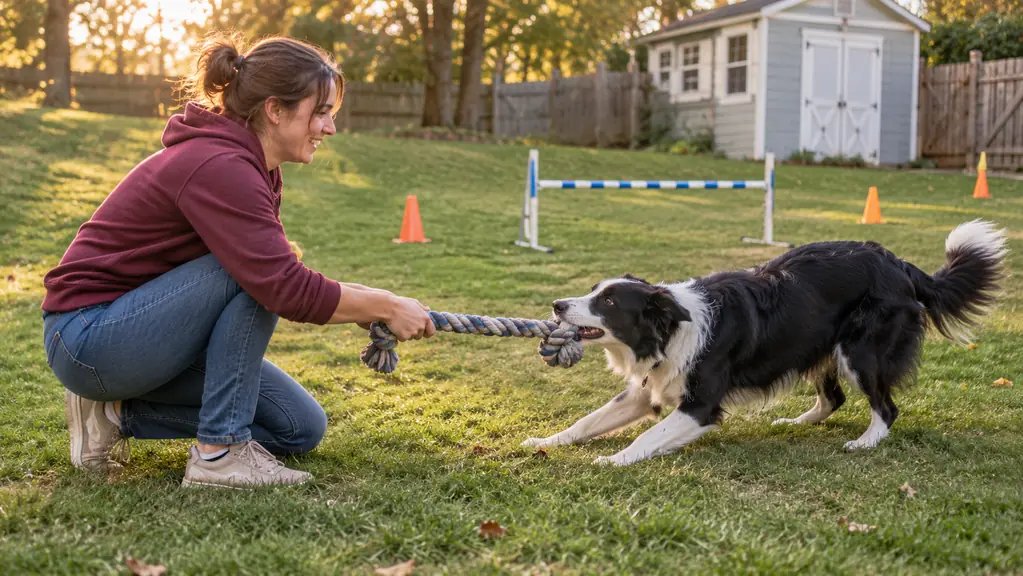
The problem with most training rewards is that they are too easy. Juno is a five year old border collie mix, 28 pounds, and if I so much as touch the treat bag she is already sitting in front of me before I have asked for anything. Food is fast and it is reliable. What it is not is exciting. I wanted something she would work toward, something I could pick up and put back down in ten seconds flat. That is how the Mammoth Pet Products Flossy Chews Color Rope Tug ended up in my bag 22 months ago, and it is why I bought the identical tug again when the first one finally frayed.
I am not a trainer. I am 52, I do bookkeeping part time in Easley, South Carolina, and I took up agility two years ago because the beginner class at the county fairgrounds cost less than a gym membership and Juno needed a job. We have never entered a trial. No titles, no ribbons, no times worth writing down. What I do have is 22 months of Tuesday and Thursday evenings in a 40 by 60 foot back yard, Saturday mornings at nine with the club, and a fairly hard nosed idea of which gear earns the space it takes up in the bag. This tug has earned it twice.
The Quick Verdict
A 15 inch cotton-poly tug with three knots that has lasted 22 months of twice-weekly sessions, one replacement, and a regular run through the washing machine. The best reward in my bag, and the fraying is the price of admission.
Amazon Check Today's Price →The reward Juno will run a whole sequence for
Small 15 inch, three knots, cotton-poly yarn, listed for dogs of 15 to 30 pounds. It lives in a treat bag pocket and comes out for ten seconds at a time.
Amazon Check Today's Price on Amazon →How I've Used It
The tug arrived 22 months ago, in the same order as my treat bag. I am on my second one. The first frayed at the knots after about ten months of twice weekly sessions, so I threw it out and then did the least interesting thing a reviewer can do, which is order the exact same item again. The second one has been in service for 12 months and the knots are still holding.
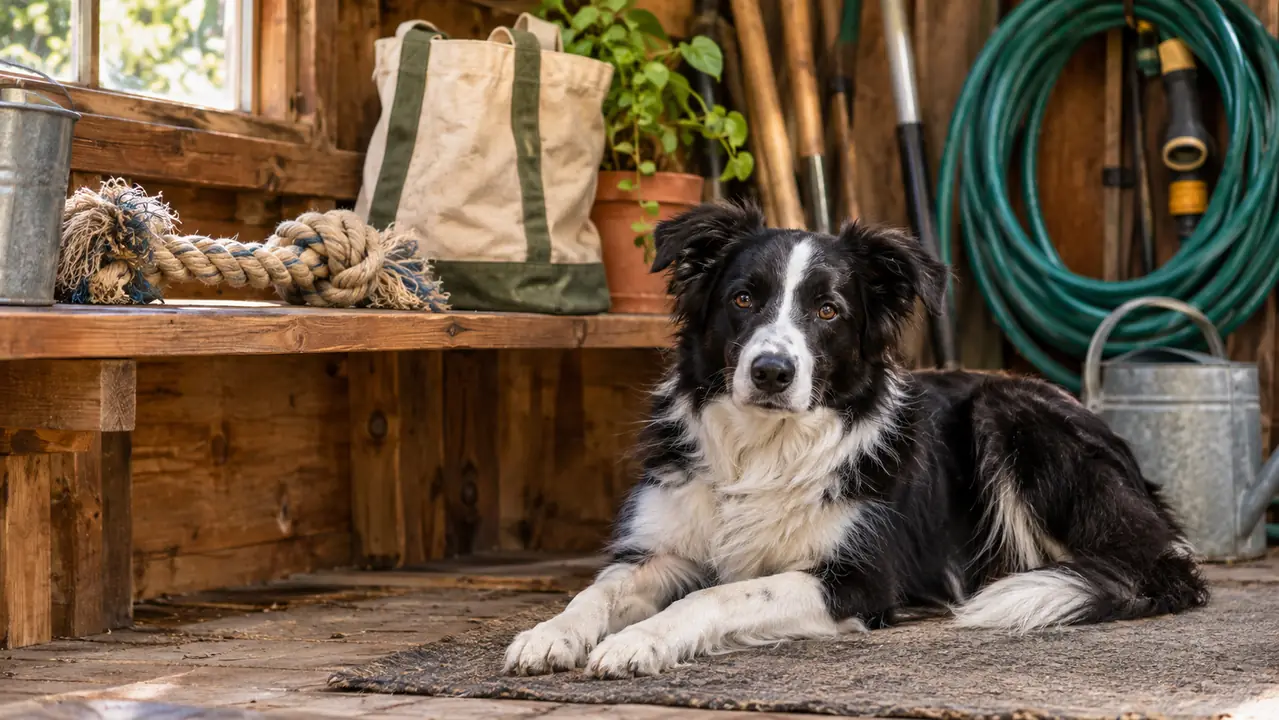
During a session it lives in the side pocket of the treat bag or in my hand. Otherwise it sits on the shelf in the garden shed by the back gate. It comes out for a reason and it goes away when the reason is done. I have never left it on the grass for Juno to work on by herself, because this is a play thing and not a chew, and 22 months of use has not changed my mind about that.
Our week looks the same as it did a year ago. Tuesday and Thursday evenings, about 15 minutes, in the back yard. Jumps first, then the tunnel, then one short sequence that links the two, then the tug. Ten seconds of tug and it goes back in my hand. Saturday at nine at the fairgrounds with the beginner group, where the club owns the big equipment and I bring a bag of pea sized chicken treats and this tug. Food comes out of the bag. Play comes out of the tug. Keeping those two jobs apart is the most useful thing I have done with my training budget.
Juno took to it the first evening, which is more than I can say for most of what I have bought her. I sat on the back step and dragged it through the grass and she grabbed on and pulled. Two years later she does the same thing, and the only change is that she will now hold a sit while I walk to the far side of the yard with the tug behind my back, because she has worked out what comes at the end of the sequence.
What You Actually Get
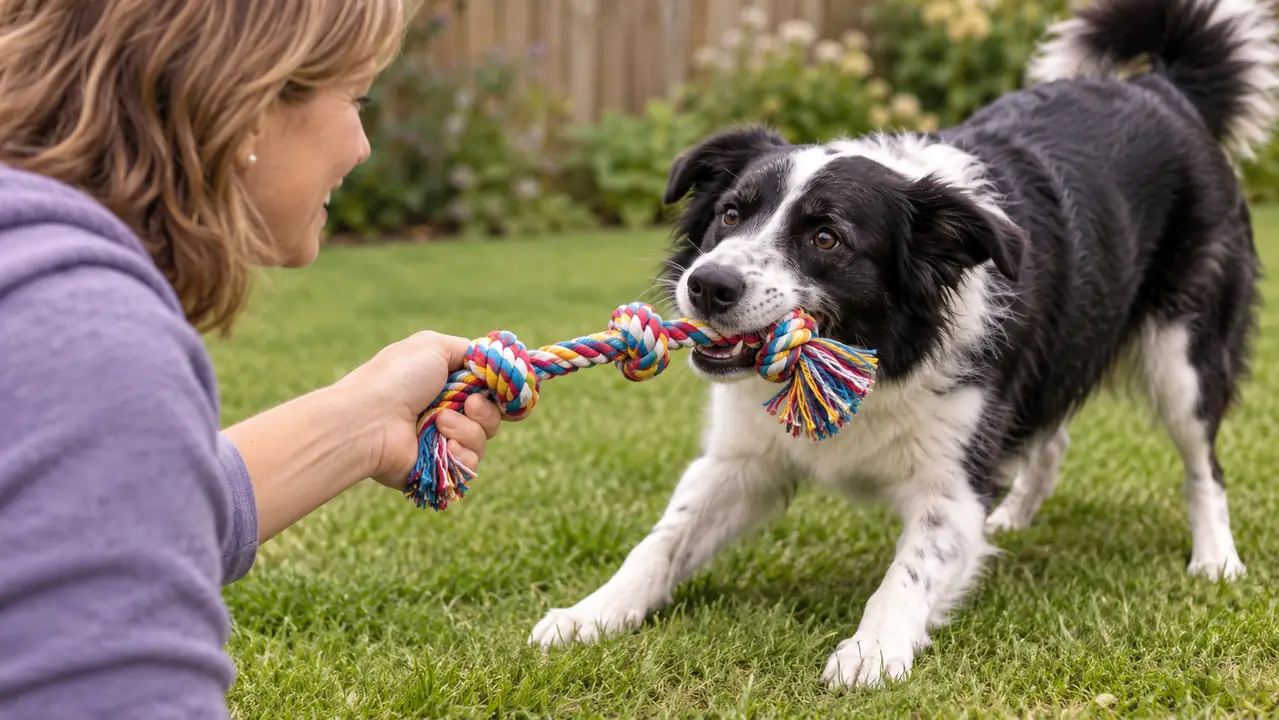
The Mammoth Pet Products listing measures it at 15 inches long, 2.5 inches across and 1.9 ounces, and those numbers hold up in the hand. Three knots sit along the length, which gives Juno a grip at either end and gives me something to hold that is not a smooth rope sliding through my fingers. It is made from cotton and poly yarn. It is listed as unscented and as not water resistant, and the colors are assorted, so what turns up is luck of the draw and not worth planning around.
The 1.9 ounces matters more than it sounds. A wet rope toy dragging a treat bag sideways off my hip is a small annoyance I do not have with this one. It also means that when I toss it a few feet for Juno to chase at the end of a run, nothing in the yard gets knocked over and nothing gets hurt.
Because the yarn is a blend rather than a solid braid, it has a bit of give to it. When Juno hits the end of it at a run I feel it in my shoulder, but the tug does not jerk out of my hand the way a stiffer material would. I have no measurement for that, only two years of Tuesday evenings, and I notice it most when I pick up a firmer rope in a store and it feels like a length of cable by comparison.
The listing bullet points mention teeth. I am not going to make a claim about Juno's teeth, because I am not qualified to say what helped and what did not. What I can tell you is how the thing behaves in a back yard twice a week, which is the part I actually know something about.
How It Has Held Up Over 22 Months
Here is the honest history. Ten months in, the knots started to shag out. Not falling apart, just fuzzy and loose enough that I did not love the look of it going into Juno's mouth, so I replaced it. That works out at one Mammoth Pet Products tug every ten months of twice weekly work plus Saturdays. Twelve months on the second one, the ends have gone soft again but the knots are still tight and it still takes a hard pull without complaint. I expect to replace it again before the year is out and I will not be annoyed about it.
The cotton and poly mix picks up grass and mud quickly, and because it is not water resistant it holds damp from the yard. Mine goes through the washing machine on a cold cycle every few weeks and then onto the line to dry, which takes most of a morning. The first one went through that same routine for ten months and the machine did not finish it off. The yard did.
The knots are the part that matters and they are also the part that goes first. The end I hold takes more of a beating than the end Juno grips, because my hand is dry and hers is not. Both have gone fuzzy. Neither has come undone, and I have never had to retie one.
Nothing has snapped, split or come untied. No splinters, no sharp edges, no plastic pieces to find in the grass in bare feet. For something that lives outdoors half the year and gets pulled on by a 28 pound dog, that is a fair record.
I bought the same one twice. The first frayed at the knots after ten months of twice-weekly sessions, I threw it out, and I ordered the identical tug that week. That is the whole review, really.
Why a Tug Ends a Sequence Better Than a Treat
A treat is a transaction. I ask, she does, I pay, we move on. A tug asks her to use her mouth and her weight against mine instead of sitting and waiting for the payment to land. When we finish a clean run of jumps and tunnel, I bring the tug out from behind my back, she grabs it, and we pull for ten seconds. Then I say drop, she drops, and it goes away.
The other reason is value. Because the tug only ever appears at the end of a sequence, and only for a few seconds, it has not gone stale in 22 months. The chicken treats are the same treats I use for everything, and Juno will take them or leave them depending on her mood. The tug she will work for. If I had left it on the floor with her other toys she would be bored of it by now, and that is exactly why I do not.
There is a practical side too. A tug does not need a second person, a launcher or a fenced field. It needs me, the dog and about six feet of grass. On the evenings when the yard is soft from rain and I do not want to set out the hurdles, we still finish with ten seconds of tug on the patio, and that is enough to end the session on the right note instead of just walking back inside.
One thing I got wrong at the start. I let the game run until she lost interest, which meant it ran about four minutes and she came out of it over excited and mouthy at the edges. Fifteen seconds and a clean stop is better. I pick the moment, not her. That took me a couple of months to learn, and no piece of gear fixes it.
The Parts I Don't Love
It frays. That is the trade for a soft rope that a dog actually wants to grip, and I have made my peace with it, but if you want one toy to last three years, this is not that toy. Ten months of regular work is a realistic expectation in my house, and I am working a 28 pound dog on grass, not a 90 pound dog on gravel.
The size is the bigger limitation. The small is 15 inches and it is listed for dogs of 15 to 30 pounds. Juno sits at 28, near the top of that range, and it fits her well. If your dog is 45 pounds and pulls hard, this exact one is going to feel like a shoelace in their mouth and you should look at a larger size in the same line. That is not a knock on the tug. It is just the size I bought.
The other small thing is drying time. After a washing it comes off the line still holding a little damp in the middle of the knots, so I leave it out a few hours longer than I think it needs. Put away wet, it sits in the bag smelling like damp rope, which is what it is.
And it is not a chew. If you hand it over and walk away, a determined dog will have it in pieces inside a week. It is a two-handed toy. That is the point of it, and it is also why it is still on the shelf 22 months later.
What I Liked
- 15 inches and 1.9 ounces, light enough to live in a treat bag side pocket without dragging the bag sideways
- Three knots give a dog a grip at either end and give the handler something to hold
- The cotton and poly yarn survived 22 months of twice weekly sessions plus Saturdays with one replacement
- Goes through the washing machine on a cold cycle and dries on the line
- Small is listed for dogs of 15 to 30 pounds, and a 28 pound dog fits it well
Where It Falls Short
- Frays at the knots. Mine went at about ten months of regular use
- Picks up grass and mud fast and is listed as not water resistant
- Small only. A dog well over 30 pounds needs a larger size
- Not a chew toy, and it will not survive being left with a dog
Who This Is For
This is for the hobby handler with a small or medium dog who wants a reward they can hold in one hand and put away in one second. It suits a dog who would rather play than eat, which Juno is about half the time, and it suits a person training in a small yard where a thrown ball would end up in a neighbor's garden.
I would also point a first time agility buyer at this ahead of anything with a squeaker in it. A squeaker makes noise, and noise winds a dog up in a yard with a fence and a neighbor on the other side of it. A rope tug makes no noise at all, which at nine in the morning on a Saturday is worth something.
It also suits anyone building a first training bag. If you are at the stage of working out what actually earns a place in the bag, I wrote about that in my notes on 10 reasons a rope tug earns a spot in the training bag, and this is the tug I was writing about.
Who Should Skip It
Skip it if your dog is well over 30 pounds, or if your dog's idea of tug is a full body, feet off the ground pull. Get the bigger size instead. Skip it if you want something to leave in a crate or on a bed for a dog to work on alone, because this is not a chew and it will not survive being treated like one.
Skip it if you mind a toy looking used. It goes fuzzy, it goes grey brown with yard dirt, and it sits on a shed shelf looking like a piece of old rope, because that is what it is. And if you are weighing a rope tug against a leather bite tug, I compared the two in my notes on the rope tug versus a leather bite tug, and the short version is that for a hobby handler with a small dog on grass, the rope is the easier thing to live with.
Two evenings a week, one tug, ten seconds at a time
The Mammoth Pet Products small 15 inch tug, three knots, cotton-poly yarn, listed for dogs of 15 to 30 pounds. If your dog will work for a rope, this is the one I bought twice.
Amazon Check Today's Price on Amazon →