
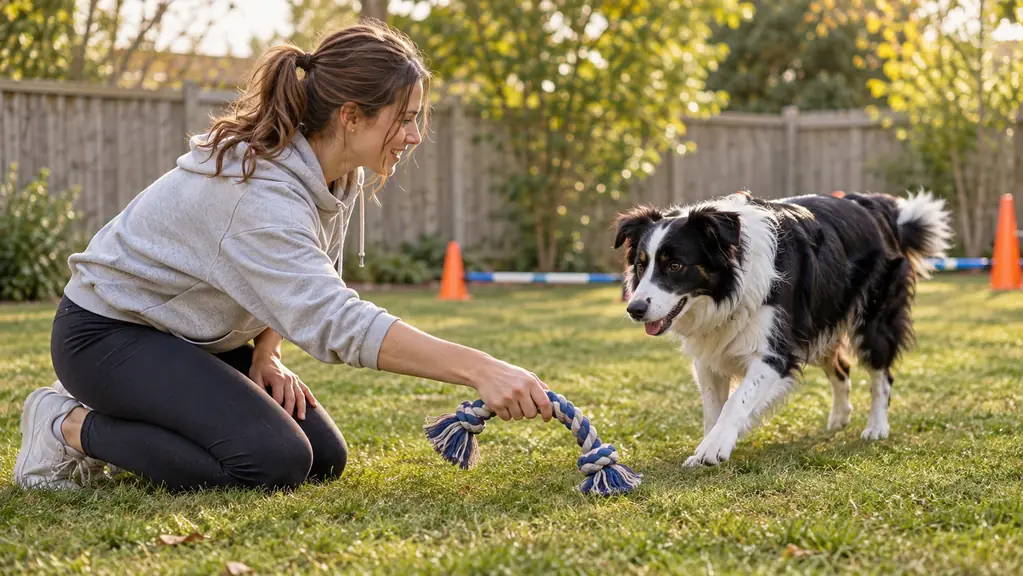
When Juno was three, I made the mistake most new handlers make with a rope tug. I held it out, she grabbed it, I pulled, and within ten seconds the game turned into keep away with me chasing her around the yard. The tug was not the problem. I was. The Mammoth Pet Products Flossy Chews Rope Tug is the tool I use now, a small 15 inch cotton-poly rope with three knots, and it has been in my training bag for 22 months. I am on my second one after the first frayed at the knots. What changed was not the rope. It was the rules around it.
Tug is not just a rainy day game for us. In agility, I use it as the reward at the end of a sequence. Food comes from the treat bag. Play comes from the tug. That split matters. Juno will work for chicken, but she will work harder for ten seconds of tug and then a chance to do it again. The trick is teaching the take, the hold, and the release before you ask for any real pulling. This guide is the five step version I wish I had two years ago. It is built around the Mammoth Pet Products rope tug because it is the one I own, it is the right size for a 28 pound dog, and it is easy to put away the second the game is over.
The tug that ends every rep on a good note
The Mammoth Pet Products Flossy Chews Rope Tug is the small 15 inch, three knot rope I keep in my treat bag pocket. It is listed for dogs 15 to 30 pounds, which fits Juno at 28. Check the current listing if that size fits your dog.
Amazon Check Today's Price on Amazon →Step 1: Pick the Right Tug and Set Your Rules Before the First Pull
A 15 inch rope with three knots gives me two clear ends to hold and a knot to stop my hand sliding. The listing puts it at 1.9 ounces and for dogs 15 to 30 pounds. Juno is 28 pounds, so she sits at the top of that range. A much heavier dog would need a bigger tug, and I would not ask a small rope to take that pull. The cotton-poly rope is light in my hand, which matters when I am asking for a release and not a wrestling match.
My first rule is that I start the game and I end the game. The tug lives in my hand or in the side pocket of my treat bag. It is not a toy that stays on the floor. Juno gets it when I offer it and gives it back when I ask. That rule protects the game. If she grabs it and races off, the game is over and I go get her, calmly, and put it away. No chase, no raised voice, no second chance in that moment.
My second rule is that the tug is not a chew. I never leave it with Juno. It is not water resistant, so I keep it off wet grass and dry it on the line if it gets damp. It goes through the washing machine now and then. The first one frayed at the knots after about ten months of steady sessions, and I replaced it with the same tug. That is not a knock. It is a rope that gets pulled on every week, and I would rather replace a rope than have a frayed end in my hand.
Step 2: Teach a Clean Take and a Clean Release
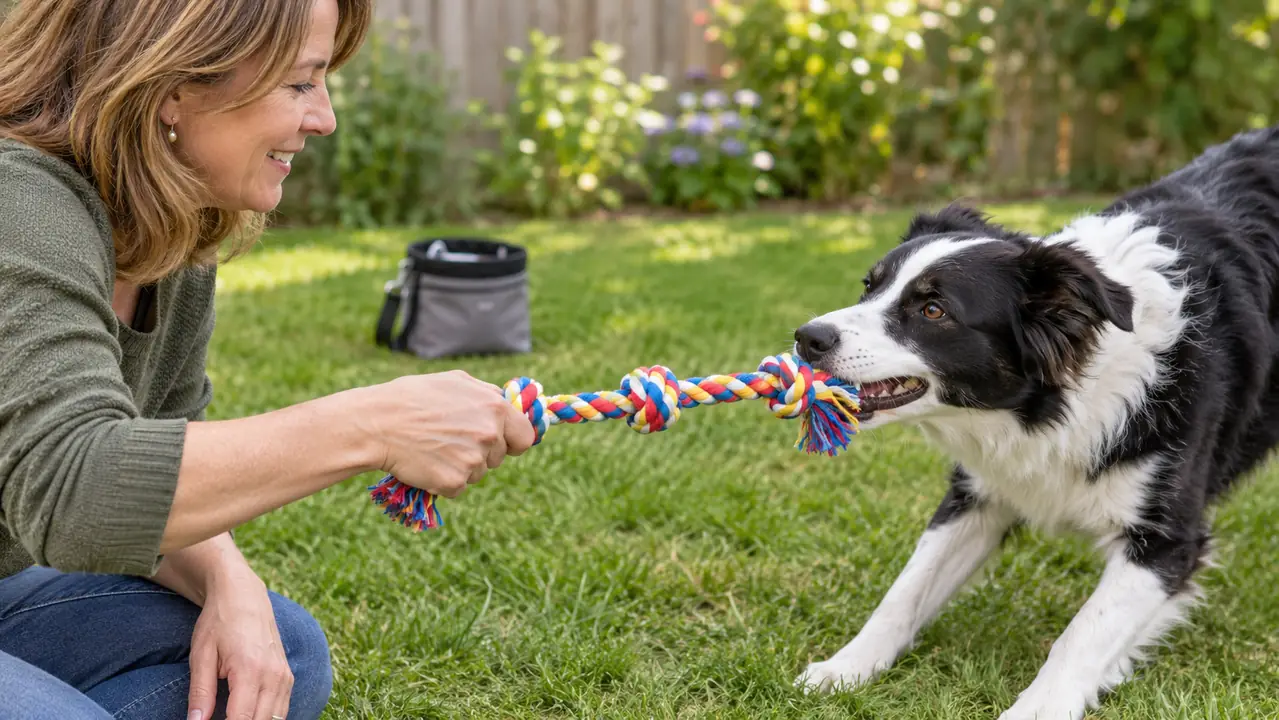
I hold the tug low and still, say 'take', and let Juno close her mouth on it. I do not yank. I mark with 'yes' and then say 'give' almost at once, before she has a chance to set her feet. When she opens her mouth, the tug goes still and I feed a pea sized piece of chicken from the OllyDog bag. That is the first lesson. The tug is not a fight yet. It is a thing we share and then let go of.
The first week, I did not care about pulling. I cared about the mouth opening on cue. Five takes, five releases, then the tug went away. Juno learned that the tug would come back. That is the whole lesson. The dog that thinks the game is gone forever fights to keep it. The dog that knows it returns gives it up faster. I kept those first sessions to about two minutes, twice a week, in the back yard after our walk.
I use one word, 'give', and I never repeat it. If Juno does not release, I stop moving, hold the tug against my leg, and wait. Boring wins. When she lets go, the game restarts. If she is too wound up to think, I end the session. That is not punishment. It is the same as putting a lid on a jar. The game is only fun while both of us are playing it, and a dog that is over the top is not playing. She is just holding on.
Step 3: Build Drive With Short Wins, Not Long Pulls
A long pull is not a better game. For Juno, three or four steps of gentle resistance are enough. I hold the tug at my hip, let her pull, and then I go still and ask for the release. Ten seconds is a long rep in our yard. Then I put the tug behind my back for a beat, feed a treat, and set up the next rep. The short win keeps her sharp. A long, grinding pull just teaches her to brace.
I start with the tug low, not above her head. I do not want her jumping and twisting for it. I want her driving forward, not upward. I keep my feet planted and let her do the work. If she braces and pulls hard, I go still. If she backs up, I follow a step, just enough to keep the rope straight. The game stays small and controlled. That is the whole point of using a tug with a dog Juno's size.
I also use a count. Three short reps, then a break. Another three, then the tug goes in the bag. That is a full tug session, maybe two minutes, not fifteen. The rest of the fifteen minutes is jumps or tunnel work. Tug is the punctuation, not the paragraph. If I make tug the whole session, Juno stops caring about the jumps. If I make it the last thing, she starts caring about the jumps because they lead to the tug.
Step 4: Put the Tug at the End of a Sequence
This is where the tug earns its place. I set three jumps in a line, the cones at 8.5 inches, which is the height I use now. Juno runs the line, I say 'yes' at the last jump, and then I bring out the tug. Ten seconds of tug, then the tug goes back in my hand. The reward is not the jumps. The reward is the game after the jumps. That is how the tug builds value for the work. It also keeps me from over praising every single step, which is a habit I had to break.
I do the same with the tunnel. The HDP tunnel is staked through the grommets at about full length along the back fence. Juno runs it, I meet her at the exit, and the tug comes out. If she pops out early, no tug. She gets a second try, and if it is clean, she gets the game. I am not a trainer. I am a hobby handler with a stopwatch and a rope. The rule is simple. Clean rep, tug. Sloppy rep, reset. That is the whole system, and it works because the tug is worth more to Juno than a piece of chicken.
At the club on Saturday, I use the same pattern. The club owns the full size equipment, so I only bring my treat bag and the tug. I watch the other handlers, I take my turn, and when Juno finishes a short sequence, we play. I keep the tug in the side pocket between turns. I never leave it on the ground where another dog can grab it. That is not just manners. It protects the value of the game. If the tug is always out and always available, it stops being a reward.
Step 5: Keep the Game Safe, Clean and Worth Repeating
Tug is a game of balance. I do not lift Juno off the ground by the rope, I do not spin her, and I do not pull her across the yard. I keep the tug between us, low and steady. If she shakes her head or braces hard, I stop and ask for the release. The point is a fast, clean game that ends with her wanting more. A dog that is allowed to go past that point is not learning anything except how to hang on.
The rope gets dirty. Grass stains, slobber, and dust from the yard are normal. I wash it now and then and hang it on the line. Because it is not water resistant, I do not leave it out in the rain. The first one frayed at the knots after about ten months, and I cut the loose ends, then replaced it when the fray got worse. I keep the current one in the treat bag pocket or on the shed shelf. It has a place, and that place is not the floor.
I also watch the size. The Small 15 inch is right for Juno at 28 pounds. If your dog is under 15 pounds, this size will be too much rope. If your dog is over 30 pounds, look at a bigger Mammoth Pet Products tug. The listing says 15 to 30 pounds, and I would follow that. A rope that is too small for a strong dog is not a fair game for either of you. The right size makes the release easier and the whole game cleaner.
What Else Helps
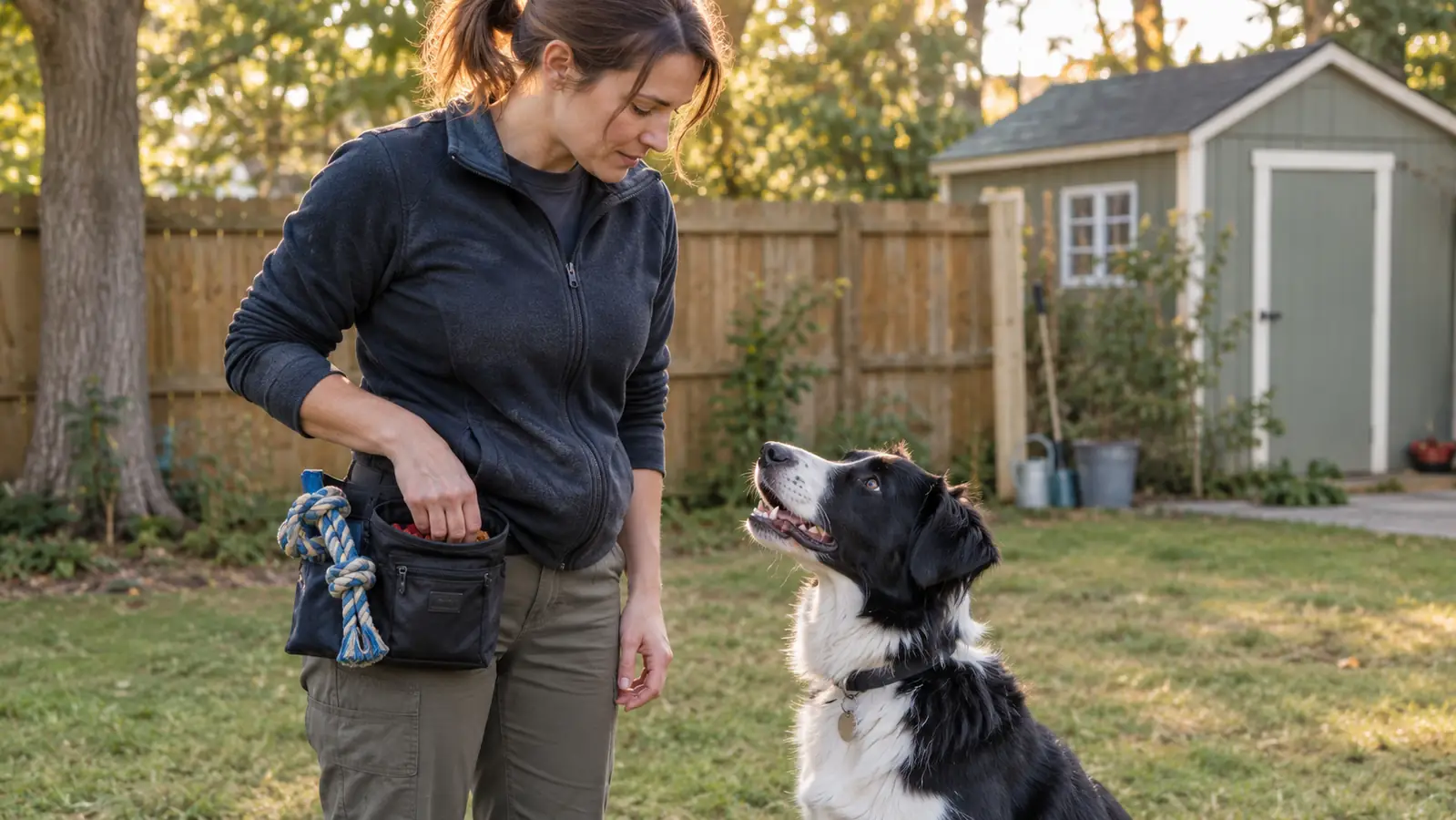
The tug is the reward, but it does not work alone. I keep the OllyDog Goodie Treat Bag on my right hip with pea sized chicken in the main pocket and the tug in the side pocket. That bag replaced my jacket pocket, which was slow and smelled like chicken. The bag holds enough for one session, and the quick release buckle means I can take it off when we are done. The treat bag and the tug are a pair. Food pays for the release. Tug pays for the work.
I also use the TRIXIE hurdle set and the HDP tunnel as the work before the reward. The jumps are set at 8.5 inches, three cones and three rods, and the tunnel is staked along the fence. I do not need a full course. A line of three jumps and one tunnel run is enough for a Tuesday evening. The Mammoth Pet Products tug is the last thing that happens, not the first. That order is the whole method.
One more thing: keep sessions short. Fifteen minutes, twice a week, is what we do. If the tug comes out and Juno is too tired to pull, we stop. A tired dog does not learn. A short game ends with both of you wanting another turn. That is the best place to stop, and it is the reason the tug still works after 22 months.
Ten seconds of tug at the end of a clean sequence did more for Juno's focus than a pocket full of treats ever did.
Put the tug where the work ends
If you want a reward that fits in a treat bag pocket and suits a dog in the 15 to 30 pound range, this is the one I buy again. It is the Mammoth Pet Products Flossy Chews Rope Tug, Small 15 inch, three knots. I keep it in the side pocket and bring it out after the last jump.
Amazon Check Today's Price on Amazon →