
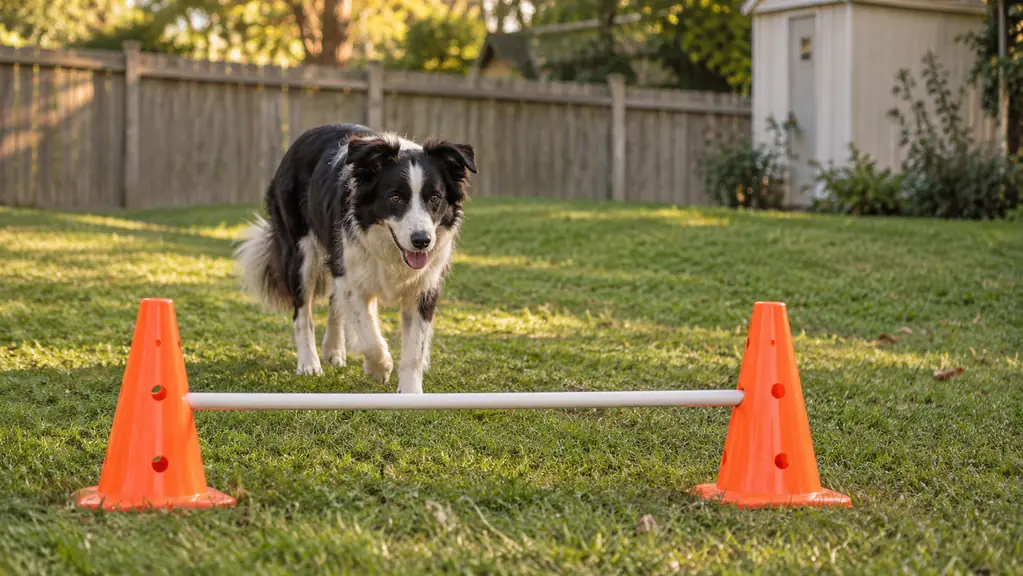
Juno is a 28 pound border collie mix who came home from a shelter at a year old. The first time I set a jump in front of her, she walked around it. Not over it. Around it. The rod sat 2.5 inches off the ground, low enough that a rabbit could have cleared it without thinking, and she gave the whole thing a wide berth like it might bite.
That was two years ago, in the back yard of my place in Easley, South Carolina. What I know now that I did not know then is that the jump is never the hard part. The hard part is teaching a dog that a rod strung between two cones is a doorway and not a wall, and that is a lesson you cannot rush and cannot buy your way past. What you can do is buy a set that makes the lesson easy to teach. For me that set was the TRIXIE Dog Agility Hurdle Cone Set, six cones and three rods that have lived on a shed shelf for two years and have not cracked yet.
A rod that falls the moment a dog touches it, which is exactly the point
Six cones and three rods make up to three jumps, and the crossbar sets at 2.5, 5.5, 8.5 or 13 inches. The whole set weighs under three pounds and assembles in about a minute. One year warranty. This is the set I learned on and the set I still use on Tuesday nights.
Amazon Check the TRIXIE Hurdle Set on Amazon →Step 1: Set one jump, not three, and set it at 2.5 inches
Six cones and three rods means the set can build three jumps at the same time. Ignore that for the first couple of weeks. Two cones and one rod is the entire course. A dog who has never seen a hurdle does not need options. She needs one thing to figure out, in a spot where she can clearly see the other side of it.
The rod rests in the cone tops at one of four heights: 2.5, 5.5, 8.5 and 13 inches. Start at 2.5 even if your dog is tall enough to stroll over the top setting without lifting a paw. At 2.5 she steps over the rod instead of launching over it, and stepping is the movement you want her to rehearse a hundred times before anything goes higher. The TRIXIE set comes with a small booklet of training tips, and it is worth one read before the first session, mostly so you know the four settings exist before you go looking for them. The set is light enough to come out of the shed and stand up in under a minute, which matters more than it sounds. A jump that takes twenty minutes to build is a jump that does not get built on a Thursday after work.
Ground matters more than I expected. My yard runs roughly 40 by 60 feet with a slight slope toward the back gate, and a jump set on that slope has one high side and one low side, which is quietly confusing to a dog approaching it. I set mine on the flat, a few paces out from the shed, on short grass with a clear run up from both directions. Gravel, a deck, or a hard patio surface is a bad idea for the first month. Save those for much later, if ever.
Step 2: Walk her over it on a loose leash before you ask her for anything
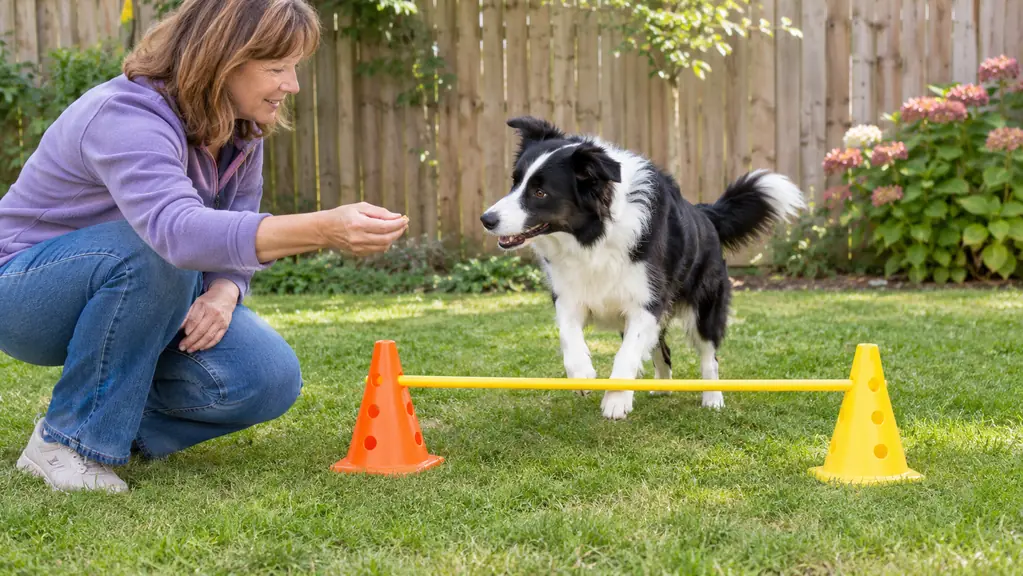
Leash on, no cue, no send. I walk Juno across the jump at my normal walking pace with the leash hanging slack, and I let her work out for herself that her feet belong on the far side of the rod. First pass she stopped and looked back at me. Second pass she stepped over it. Third pass she stepped over it without slowing down, which is the entire goal of the first night.
The reward lands after her back feet hit the grass on the far side. Not while she is in the air, not while she is mid step, and never tossed in front of the jump where she can reach back for it. Small soft chicken treats, cut to about the size of a pea, one per pass. I keep them on my right hip in a treat bag rather than a jacket pocket, because a pocket means one hand digging and a dog standing there waiting, and standing there waiting is not what you are paying for.
Three or four passes and I stop. That is the whole session, and it takes about four minutes. Repeat it Tuesday and Thursday for a week. If your dog is still stopping to stare at the rod after three sessions, pull the rod out entirely and let her walk between the bare cones for a night with nothing to step over. Then set it back at 2.5. The rod is not the obstacle nearly as much as the picture of the rod is.
Step 3: Drop the leash and add a hand cue
Once she crosses without hesitating, the leash comes off. I stand at the far end, a couple of paces to the side of the line, and sweep my right hand toward the jump as she comes in. That sweep becomes the cue. It is not a spoken command and it does not need to be. What it does is tell her where I want her to go next, which is the only thing a single jump is ever really teaching.
Resist the urge to crowd the jump as she commits. My mistake early on was stepping in beside the cones to cheer her on, which narrowed her approach and pushed her wide around the whole thing. Stand back, keep your shoulders pointed down the line you want, and let her own the middle of it. A handler who moves late is a handler a dog can read.
When she clips the rod, and she will, the rod falls. That is what it is built to do. Reset it, walk back to your spot, and run the same easy rep again. No correction, no sighing, no restarting from a harder angle to prove a point. A rod that clatters onto the grass and a handler who says nothing teaches a dog that contact with the bar is not a crisis. That is worth more at this stage than any clean run.
Two clean passes and the rod goes up one notch. Two clatters and it comes back down. That is the entire rule, and it has not changed in two years.
Step 4: Raise the rod one notch at a time and make her earn the next one
The four settings on the TRIXIE crossbar do not have to be used on a schedule, but they should be earned. My rule is simple. Two clean passes in a row at the current height and the rod moves up a setting at the next session. Two knocked rods in a row and it comes down for the rest of that night. No debate, no reading the mood, no negotiating with myself about whether she looked tired.
Juno walked over 2.5 inches for the first week. We moved to 5.5 inches after about three weeks and to 8.5 inches after roughly two months. She stands about 17 inches at the shoulder and weighs 28 pounds. I tried the 13 inch setting a handful of times and went back to 8.5 every single time, because what I want out of a Tuesday evening is clean, easy repetition and not height. A dog scraping over a bar by an inch is not learning anything except a habit of scrambling.
Judge the session by the last two reps, not the first two. The end of a session tells you what the dog actually took away from it. If the final pass is sloppy or slow or she drifts around the cones, the height was too much for that night and the next one starts a notch lower. Write the number down somewhere, because in three weeks you will not remember whether you were at 5.5 or 8.5. Mine is in a note on my phone with the date beside it.
Step 5: Set all three jumps in a line, then quit while it is still fun
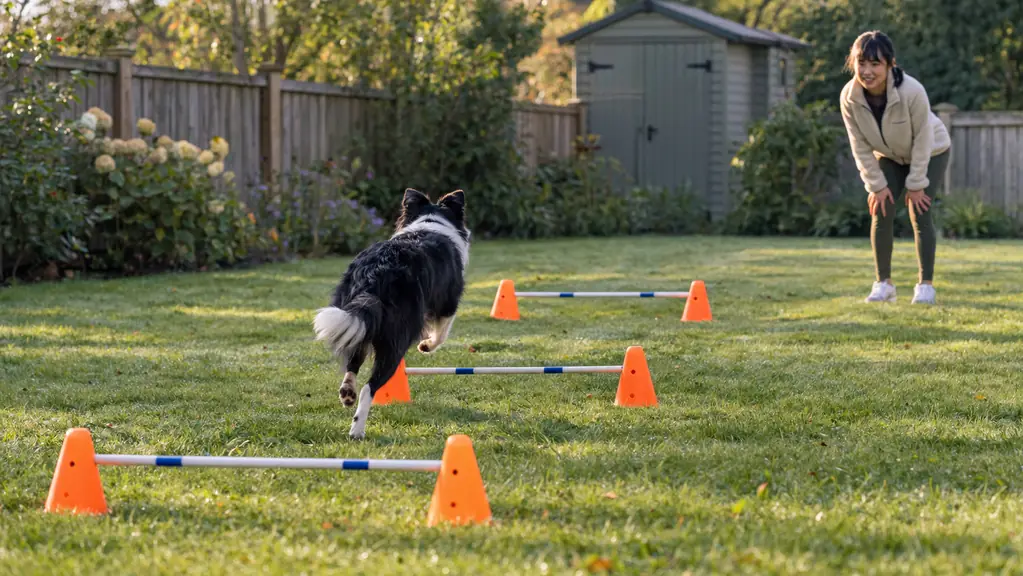
When she is crossing a single jump at 8.5 inches without a second thought, put all three out. Two cones and a rod, a few paces of flat grass, two more cones and a rod, then again. Straight line, one direction, no turns yet. The first evening Juno saw three in a row she took the first jump and stopped dead at the second, which is a completely normal response to a picture that changed without warning.
Run the line one jump at a time at first, paying after each one. Then two jumps, then the whole line. A fifteen minute session now looks like three minutes of walking over one jump, five or six minutes working the line of three, and ten seconds of tug on a rope toy before we go inside. Tuesday and Thursday, evenings, never in the heat of the day. Juno still gets her walks. The jumps did not replace anything, they were added on top.
The TRIXIE set is light, and it is a starter kit rather than club equipment. A strong wind will tip the cones, so mine comes back into the shed when the forecast looks rough, and my yard is sheltered enough that it is usually fine. After two years nothing has broken and it still stores on the same shelf. On rainy weeks I have also set the cones alone in the garage as a simple slalom, which is not what the training tips suggest but is something any bored dog will happily accept.
What Else Helps
The jumps are the lesson. Everything else exists to make the lesson easier to deliver and easier to finish on a good note. For me that came down to two small purchases and one standing Saturday appointment. The TRIXIE hurdle gear does the teaching at home. The rest just keeps me from fumbling while it happens.
I spent my first two months pulling chicken out of a jacket pocket, which is slow, and by the end of a session the pocket smelled like a deli counter. The OllyDog Goodie Treat Bag fixed that. It rides on the waist belt at my right hip, holds enough pea sized treats for one full session, and the magnetic closure opens one handed while I am still watching the dog instead of my hand. I wash it by hand about once a month and let it air dry.
Every session ends with ten seconds of tug on a Mammoth Flossy Chews rope tug, and then it goes back in my hand. Food pays for the work, play ends the session. That distinction took me a while to get, and it made a bigger difference than any equipment I have bought.
If you keep going, a tunnel is the natural next thing. Mine is an HDP open tunnel, 18 feet, staked through the grommets because it is light enough to shift when a dog hits it at speed. It goes up after the jumps in the same session and takes about five minutes to set out. Beyond that, the club I train with on Saturday mornings at nine on the county fairgrounds field has the full size equipment and the weave poles, and I own none of it. Two years in, that split still works for me. Small gear at home, big gear at the field.
Set it at 2.5 inches tonight and see what your dog does
Six cones, three rods, four height settings and a crossbar that falls instead of fighting your dog back. One year warranty, under three pounds, stored in a shed without a mark on it after two seasons of use.
Amazon See today's price on Amazon →