
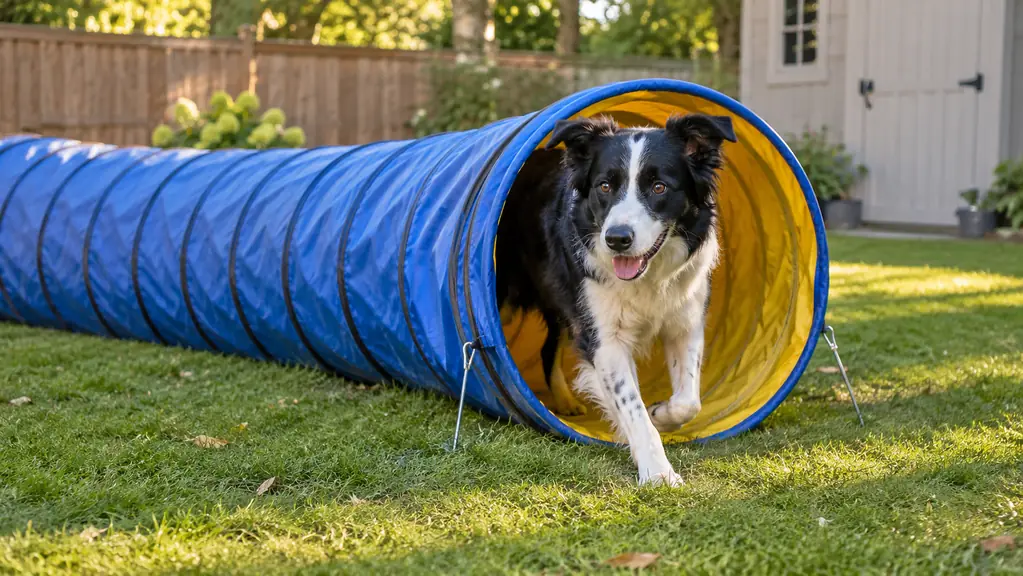
If you have read my long term notes on this tunnel, this is the other half of the story. Not the timeline. The stuff I would tell you standing next to it in my yard, holding a leash and a bag of chicken treats, before you click buy.
I have had the HDP 18 Ft Open Tunnel for eighteen months. One tunnel, one dog, Tuesday and Thursday evenings in a fenced back yard in Easley, South Carolina. I am not a trainer. I am a 52 year old part time bookkeeper who took up agility two years ago because my border collie mix needed a job and I needed to leave the house. So treat this as notes from a hobby handler, not a buying guide from an expert.
Here is the short version. The HDP tunnel is a real piece of agility equipment and it has held up for a year and a half without a single tear. It also has three genuine annoyances that nobody mentions in the listing photos, and it takes up more of a small yard than you think it will. Whether that is a problem depends entirely on what you are asking it to do.
The Quick Verdict
A durable, genuinely useful first tunnel that is heavier than it looks on paper and hungrier for yard space than the photos suggest. Great for one dog and a small lawn. Wrong for anyone who wants to leave it out or move it weekly.
Amazon Check Today's Price →Eighteen months, no tears, and still the piece of gear Juno runs to first
The HDP tunnel is the one thing in my yard that turns a flat 15 minute session into something my dog actually pulls toward. Current price and the full listing are on Amazon.
Amazon Check Today's Price on Amazon →The Thing Nobody Tells You First: It Is Not a Lightweight Toy
The listing says 2.4 pounds. That number is accurate and also misleading, and I want to be plain about why.
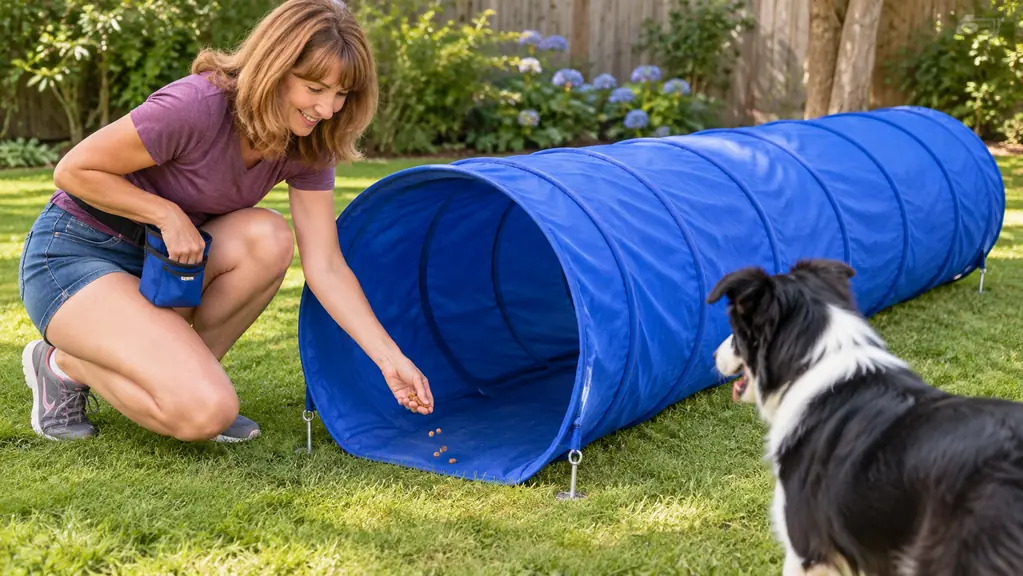
Two point four pounds is what the tunnel weighs folded in the case. Set it out at full length and it becomes a long sail. The moment Juno hits it at speed, the whole thing shifts, and the first week I set it up I spent more time chasing it across the grass than she spent in it. The eight stakes of 7 inches that come with it are not optional equipment. They are the difference between a tunnel and a kite.
Stake it through the grommets. Every session. Not just on windy days. I learned that in the first week and I have not skipped it since, and I have not had a tunnel roll on me since either.
This matters because the photos make it look like a pop up play tunnel. It is not. It is a real open tunnel with a steel spring frame and a Dacron cover, and it behaves like a real open tunnel. Heavy enough to hold a shape, light enough to move if you do not pin it down.
The Strengths, Honestly
The fabric has taken eighteen months of a dog running through it, dragging a leash through it, and being carried in and out of a shed, and it has not torn. Not a rip, not a seam opening, not a hole at the grommets. That is the single best thing I can say about it and it is the reason I would buy it again.
The 24 inch opening is right for Juno. She is 28 pounds and about 17 inches at the shoulder, so she fits through with room to spare and without ducking. A much bigger dog would still fit, but a much smaller one might find the opening loose and the whole tunnel a bit cavernous at first.
Setting it out takes me about 5 minutes. That includes unclipping the case, walking the tunnel out along the fence, and pushing eight stakes into the ground. Five minutes is short enough that I do not dread it on a Tuesday evening after work, which is the whole test for home gear.
And the shape holds in a curve. I run mine in a gentle bend along the back fence side of the yard, and it stays in that bend through a session. A tunnel that flops into a straight line every time a dog touches it teaches nothing. This one keeps the curve I set.
Eighteen months, one dog, two sessions a week, and the HDP cover has not torn. That is the whole case for it, and it is a good case.
The Weak Spots, Starting With the One That Actually Bothers Me
It takes up most of my yard. My back yard is about 40 by 60 feet with a slight slope, which is a decent hobby sized space, and at full length along the fence this tunnel eats the long side of it. When the tunnel is out, the jumps are cramped. When the jumps are out, the tunnel is rolled up in the shed.
That is a real constraint and it is the one I would want a stranger to tell me before buying. If you have a postage stamp lawn, an 18 foot tunnel will own it.
The fabric picks up mud and grass. It is a Dacron cover on a spring frame, and it holds onto whatever the yard throws at it. After a wet week it looks worse than it is.
It holds water after rain. This is the annoying one. Because it is an open tunnel and not a sealed play tunnel, water collects and the thing has to dry. Mine goes over the fence rail in the sun before it goes back in the case. Never packed wet. Never left out overnight.
And it is a two hand job to pack. The spring wants to fight you. Eighteen months in I have the fold down, but the first month I looked like I was wrestling a tarp in a windstorm.
What I Liked
- Cover has not torn in eighteen months of twice weekly use
- 24 inch opening suits a mid sized dog without ducking
- About 5 minutes to stake out at full length
- Holds a gentle curve through a whole session
- Packs into its own carry case and stores on a shed shelf
- Stakes included, and they are necessary
Where It Falls Short
- 2.4 pounds sounds light but it shifts without staking
- Consumes most of a small back yard at full length
- Fabric holds mud, grass and water after rain
- Must dry before it is packed away
- Fiddly to fold for the first month or so
What I Got Wrong in the Beginning
I set it out at full length on day one because that is what the picture showed. Juno would not commit to it. She walked in about three feet, stopped, turned around, and came out the way she went in.
So I squeezed it down. I compressed it to roughly 5 feet long, so she could see daylight at the far end from the near end. That is not in the listing. It is just something another handler mentioned to me at the field, and it worked. She ran it in four sessions over two weeks, and once she was running a short tunnel without stopping, I stretched it out again a couple of feet at a time.
Nobody tells you that part. A tunnel that is too long for a nervous dog to commit to is not a training problem, it is a setup problem. The HDP compresses, which is the whole reason this worked. A rigid tunnel or a fixed length play tunnel would not have given me that option.
I also got the staking wrong, but I already covered that. Consider it covered twice, because twice is how many times I learned it.
How It Compares to the Pop Up Play Tunnel I Did Not Buy
I handled a pop up play tunnel in a pet store and I have looked at plenty of listings. I never owned one, so take this as the judgment of someone who chose against it, not a review of something I used.
A pop up play tunnel is cheap, collapses in a second, and weighs almost nothing. It is also a play tunnel. The fabric is thin, the frame is a coil that wants to fold, and a dog hitting it at speed will crush it out of shape. Fine for a puppy to walk through in the living room. Not fine for teaching a dog to drive through a curve at speed.
The HDP is the other kind of object. It is equipment. The steel spring keeps the shape, the cover is a proper Dacron, and the 8 stakes tell you what the manufacturer expects you to do with it. It weighs more, packs harder, costs more, and does the job the play tunnel is imitating.
If you want your dog to learn the tunnel obstacle, get the real thing. If you want your puppy to have a fun thing in the hallway, the pop up is genuinely fine and cheaper. Those are two different purchases and I do not think it is honest to pretend otherwise.
The one that keeps its curve when a dog hits it at speed
Real spring frame, Dacron cover, 24 inch opening, 8 stakes and a carry case. Mine has survived eighteen months of twice weekly sessions without a tear.
Amazon See the HDP Tunnel on Amazon →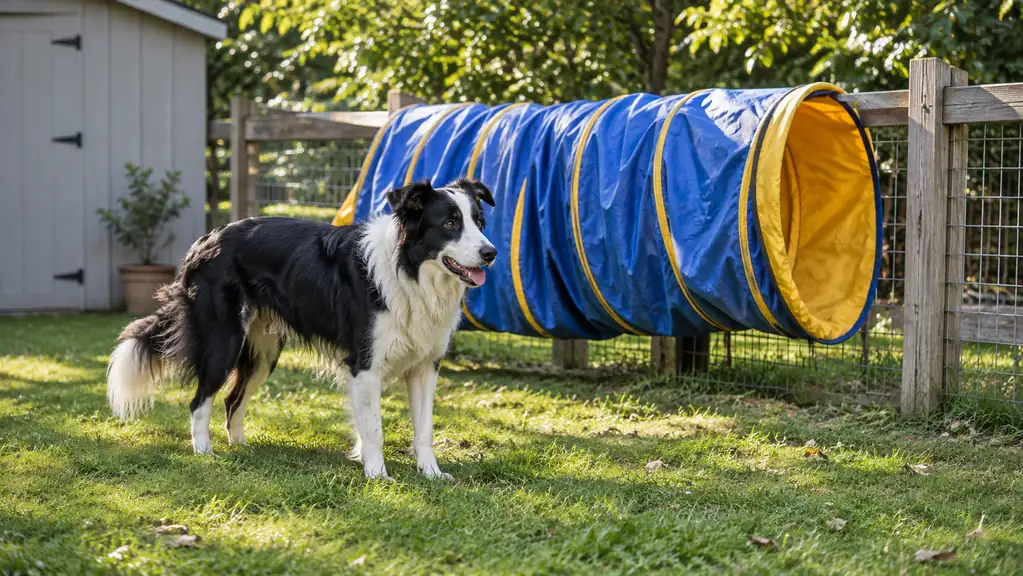
What Living With It Actually Looks Like
A Tuesday session in my yard. I get home, change clothes, put Juno out, and go to the shed. The tunnel case comes off the shelf. I walk the tunnel out along the back fence and bend it into a soft curve. Eight stakes go in through the grommets. Five minutes, maybe six if the ground is hard.
Then we run. I send her through, reward with a bit of chicken from the bag on my hip, send her through again from a different angle, reward, and after about ten good repetitions we stop. Then the tug comes out of the bag pocket for 10 seconds, and back in my hand. That is the whole session. Fifteen minutes, most of it her running and me trying to remember my own handling.
Then the stakes come out, the tunnel compresses, and it goes back in the case on the shed shelf. It never stays out overnight. Not because the listing tells me not to, but because I do not want a wet tunnel in the morning and I do not want to test what a curious dog does with an unattended tunnel at 2am.
That routine is the real review. The gear you use is the gear that is easy enough to set out on a weeknight and pack away before dark. This one clears that bar by about one minute, and on a cold evening one minute matters.
Who This Tunnel Is For
You have one dog, a yard roughly the size of mine or bigger, and you want to practice the tunnel obstacle at home between club sessions or instead of them. You are willing to stake it and take it down each time. You do not mind a wet tunnel draped over a fence now and then.
You also want something that will not fall apart. If you are the kind of person who resents buying the same thing twice, this is the version of the purchase that stops that happening. Eighteen months, twice a week, no tears, and I am still on the original.
And you are training for the doing of it, not for ribbons. I have never entered a trial. I have no titles and no times and no scores. What I have is a dog who lights up when the tunnel case comes off the shelf, and a hobby that gets me out of the house on a Tuesday. That is what I bought.
Who Should Skip It
If your yard is small, skip it. Genuinely. An 18 foot tunnel at full length in a small lawn leaves you nowhere to stand. Look at a shorter tunnel or accept that you will always run it compressed.
If you want to leave it set up permanently in the yard, think hard. My cover picks up water and mud, and mine dries over a fence before it goes away. A tunnel that lives outside in the weather is a tunnel that will age faster than mine has. I cannot tell you how much faster because I have never done it, and I would rather say that than guess.
If you have a very large or very enthusiastic dog, understand that 2.4 pounds is nothing against a hard hit. Stake it, or it moves. There is no version of this where you skip the stakes.
And if what you actually want is a cheap plaything for a puppy, do not spend real equipment money on it. Buy the pop up. Come back to this when the dog knows what a tunnel is.
The Honest Bottom Line
The HDP 18 Ft Open Tunnel is the second piece of agility gear I ever bought and it is the one that made the hobby feel real. Before it, I had three jumps and a dog who was bored of them. After it, I had a small course and a dog who pulls toward the fence line.
It is not perfect. It is heavier than the number suggests, it eats yard space, it holds water, and it is a nuisance to fold for the first month. Every one of those is a fair complaint and I would not argue with anyone who chose something else because of them.
But the cover has held for eighteen months without a tear, it sets out in five minutes, and it keeps the curve I put it in. For a hobby handler with one dog and a fenced yard, that is the whole job. If that is your situation, this is a good place to put your money.
Eighteen months in, I would buy this tunnel again tomorrow
Steel spring, Dacron cover, 24 inch opening, 2.4 pounds packed, 8 stakes of 7 inches and a carry case. Staked, dried and packed away twice a week since the day it arrived.
Amazon Check Today's Price on Amazon →