
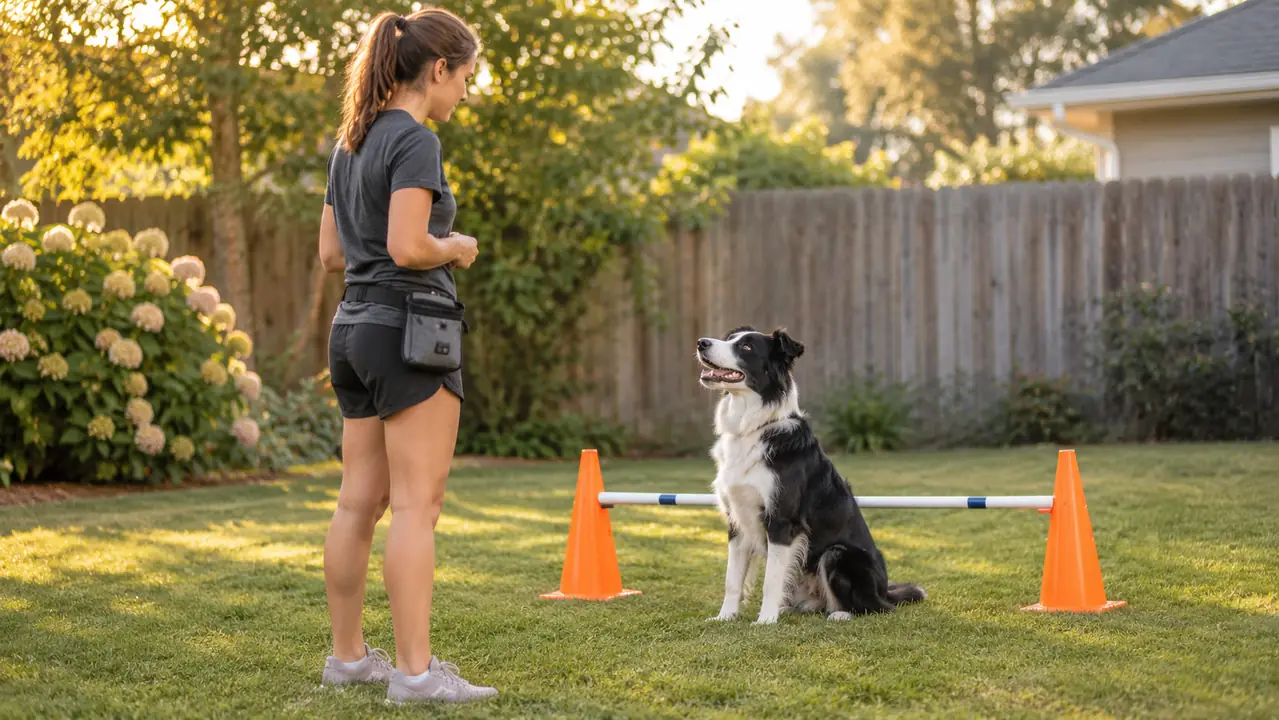
I bought the OllyDog Goodie Treat Bag 22 months ago, in the same order as a rope tug, the week I finally admitted that my jacket pocket was not a training system. I had used that pocket for two months before the bag showed up. Two months of standing in my back yard with my hand jammed in a pocket, feeling around for a pea sized piece of chicken while Juno bounced at the end of her leash and slowly lost interest in whatever I had just asked her to do. The bag arrived on a Thursday. I stopped using the pocket that day.
I want to be clear about what this thing is before I go any further, because a lot of reviews make it sound like a piece of gear that changes your handling. It does not. It is a small bag that goes around your waist and holds food. What it changed for me was the gap between the moment Juno does the right thing and the moment she gets paid for it. That gap is now almost nothing. This is what 22 months of Tuesday and Thursday evenings in the back yard, plus Saturday mornings on the field at the county fairgrounds, taught me about the OllyDog bag, including the parts I do not love.
The Quick Verdict
A small, well made pouch that puts a treat in your hand in about a second. The included belt is what makes it work. It is not a bag for a long day out.
Amazon Check Today's Price →The reward lands while your dog is still right
The OllyDog Goodie Treat Bag rides on an adjustable waist belt with a quick release buckle, so the food is already where your hand is. Mine has been on my right hip for 22 months of twice weekly sessions.
Amazon Check Today's Price on Amazon →How I Have Actually Used It
Mine has ridden on my right hip, on the included waist belt, for every session since the day it arrived. Not on a belt loop, not clipped to a jacket. The belt is the whole reason it works for me. It goes on before the first jump is set out and comes off when the last one is packed away, and the quick release buckle means I can get it off one handed while I am still holding a leash. Juno is 5 and about 28 pounds, and she has learned that the bag is where food comes from, which means she now watches my right hip the way she used to watch my pocket.
The setup is two pockets. The main one holds the treats. The side one takes the rope tug or my keys, and I have used it for both. For one of my 15 minute sessions at home, the main pocket holds more than enough of the small soft chicken treats I cut to pea size. I fill it on the tailgate of the SUV, walk to the yard, and I have never once run out mid session at home. At the club on Saturday mornings I top it up between runs, which is not a hardship, but it is a real difference from a bigger bag and I will come back to it.
To give you a number, a 15 minute Thursday session takes 30 to 35 pea sized pieces, and that leaves the main pocket about two thirds full. I count them onto the tailgate because I got tired of guessing. On a club Saturday I go through that twice, so I keep a tub in the SUV and top up between runs. The field is a good walk from the parking area and the bag has never come loose or slid around on that walk, which my jacket pocket used to do.
At the club, the bag is the one piece of my own gear that goes onto the field with me. The full size equipment belongs to the club, so my kit is a pouch of treats cut small, a tug in the side pocket, and Juno on a leash. It is a very short list and it fits in two pockets, which is the point.
A home session is just me and Juno, so I have no idea how the bag behaves with a second person pushing in for a treat or with a partner holding the leash. What I can tell you is that after 22 months of twice weekly use plus club mornings, nothing has broken. The magnetic closure still closes. The belt still adjusts. I hand wash it about once a month and let it air dry, and the fabric has held up to that without complaint.
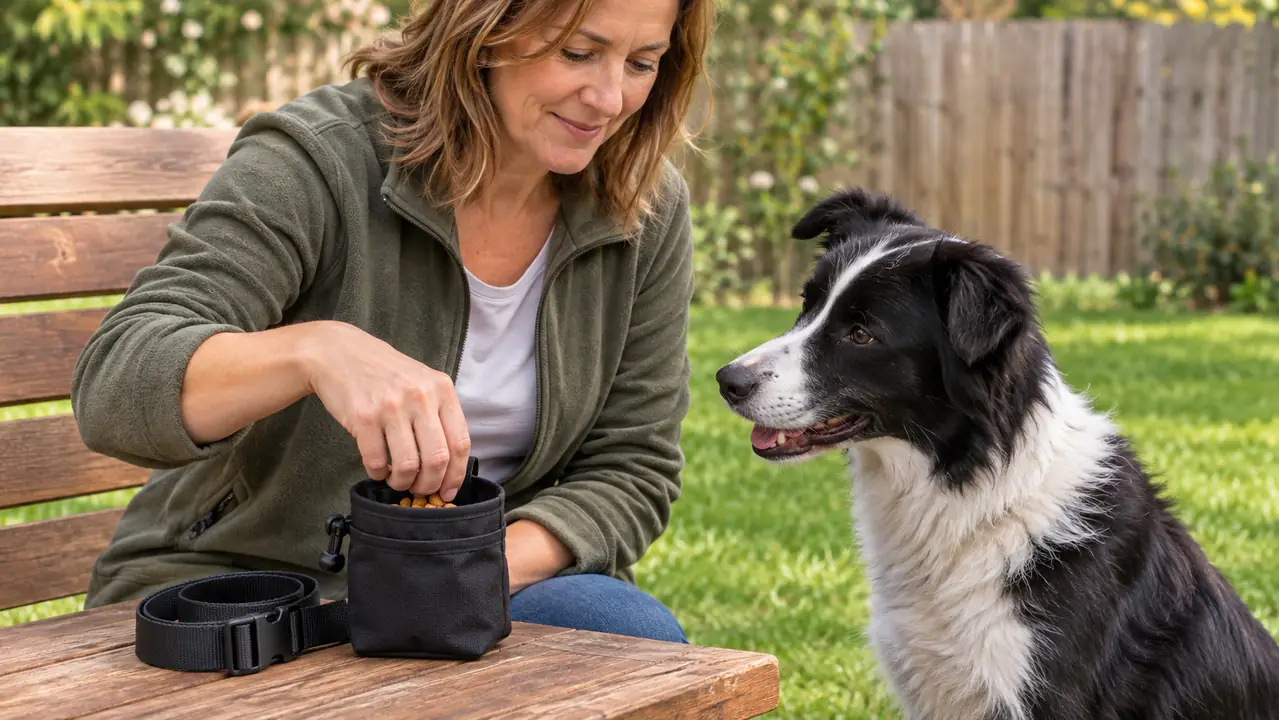
The Jacket Pocket It Replaced
For two months before this, my training pouch was the right hand pocket of an old jacket. It is worth being honest about why it failed, because those reasons are the reasons this bag works. The pocket was slow. I had to get my hand past a zip or a flap, find a treat by feel among the keys and a receipt, and get it back out, and by the time I managed it Juno had usually looked away. The pocket also smelled of chicken within about a week, permanently, in a way that washing did not fix. And a pocket is only available if I am wearing that jacket, which in a South Carolina September is not something I can promise.
What finally pushed me to buy was a Saturday in September. That pocket was holding a set of keys, a folded receipt, my phone and about 20 pieces of chicken, and every time I reached in I had to sort the chicken from the metal by feel. My hand came out holding a key twice in one session. Juno did not care about the keys. She cared that the food was late. I ordered the bag that night, from the yard, still holding a leash.
The other difference is that a pocket is behind me and a bag is at my side. When the food is in a pocket, my hand crosses my body and my shoulder turns, and Juno reads that turn. When the food is on my right hip, my hand drops and comes back up and nothing else moves. That sounds like a small distinction. It is not. Juno is a border collie mix and she watches everything I do with my hands, and removing the shoulder turn removed a signal I did not know I was sending.
What Nobody Tells You Before You Buy One
The first thing nobody tells you is that a treat bag does not fix sloppy timing. I assumed it would. For the first couple of weeks I was still late, just late with better equipment. The bag removes the fumbling. It does not remove the half second where you are deciding whether that attempt was good enough to pay for. Juno did not care how the food arrived. She cared when.
The second thing is that the magnet is doing more work than it looks like it is. You are opening and closing that pocket a few dozen times in 15 minutes with one hand, and you are often doing it while you are walking. A zip would have driven me out of my mind. The closure opens when your hand goes in and closes behind it, and I stopped noticing it somewhere in the first month, which is the highest compliment I can give a piece of training gear.
The third thing is that the bag is small on purpose, and small is a trade. It holds a session, not a day. When I go to the club I keep a bigger tub of treats in the SUV and top up between runs, because the pouch alone will not cover a long morning. If you want to load up once and not think about it again, that will annoy you in a way it never annoyed me, because my sessions are short and my house is 10 minutes from the fairgrounds.
The fourth thing is that the closure is not airtight. Cut treats go a little dry by the end of a hot session. I noticed it properly in July, when I cut a whole week's worth on a Sunday and by Thursday the edges had gone leathery and Juno sniffed a piece and walked away from it. She is not a fussy dog, so when she turns her nose up at chicken I pay attention. Now I cut about 35 pieces on a Thursday afternoon, 20 minutes before we go out, and nothing lasts long enough to go stale.
The bag does not make me a better handler. It makes me a faster one, and for a dog, faster is what counts.
The Fit Details That Actually Matter
The listed size is 4 1/4 by 5 1/4 by 3 inches, and the belt runs out to 52 inches. I am not a small person and I have never had the belt anywhere near its limit. It adjusts with a normal slider and it stays where I put it, which matters more than it sounds like it should, because a bag that slides around your hip during a session is worse than no bag at all. The whole thing weighs next to nothing, and I forget I have it on until I sit down in the SUV.
There are 2 pockets, a magnetic closure, and a water resistant nylon fabric made from recycled plastic bottles, three of them per bag by the listing. Mine has been out in damp grass and light rain and wiped clean with a cloth afterward. It is water resistant, not a dry bag, and I would not trust it in a real downpour. The listing also mentions a lifetime warranty. I have never needed to test that, so I can only tell you it exists and that the bag has given me no reason to call anyone.
The listing gives 3 ways to wear it. I have only ever used the waist belt, and I have no plans to change. I did try one of the other carry options once, and it sat lower and moved more, so I went back to the belt inside of a week. That is not a knock on the bag. It is an honest note that the belt is the version I can actually vouch for after 22 months.
What I Liked
- Food is in my hand in about a second, with no zip and no fumbling
- The included waist belt and quick release buckle are the reason it works
- Two pockets, so the tug has somewhere to live during a session
- The magnetic closure opens and closes one handed while you are moving
- Water resistant fabric wipes clean after a wet session
- 22 months of twice weekly use and nothing has broken
Where It Falls Short
- Small on purpose, so it holds one session and not a full day at a club
- A very full bag does not snap shut as neatly as a half full one
- Water resistant only, not something to trust in real rain
- Hand wash only, and I have to remember to do it
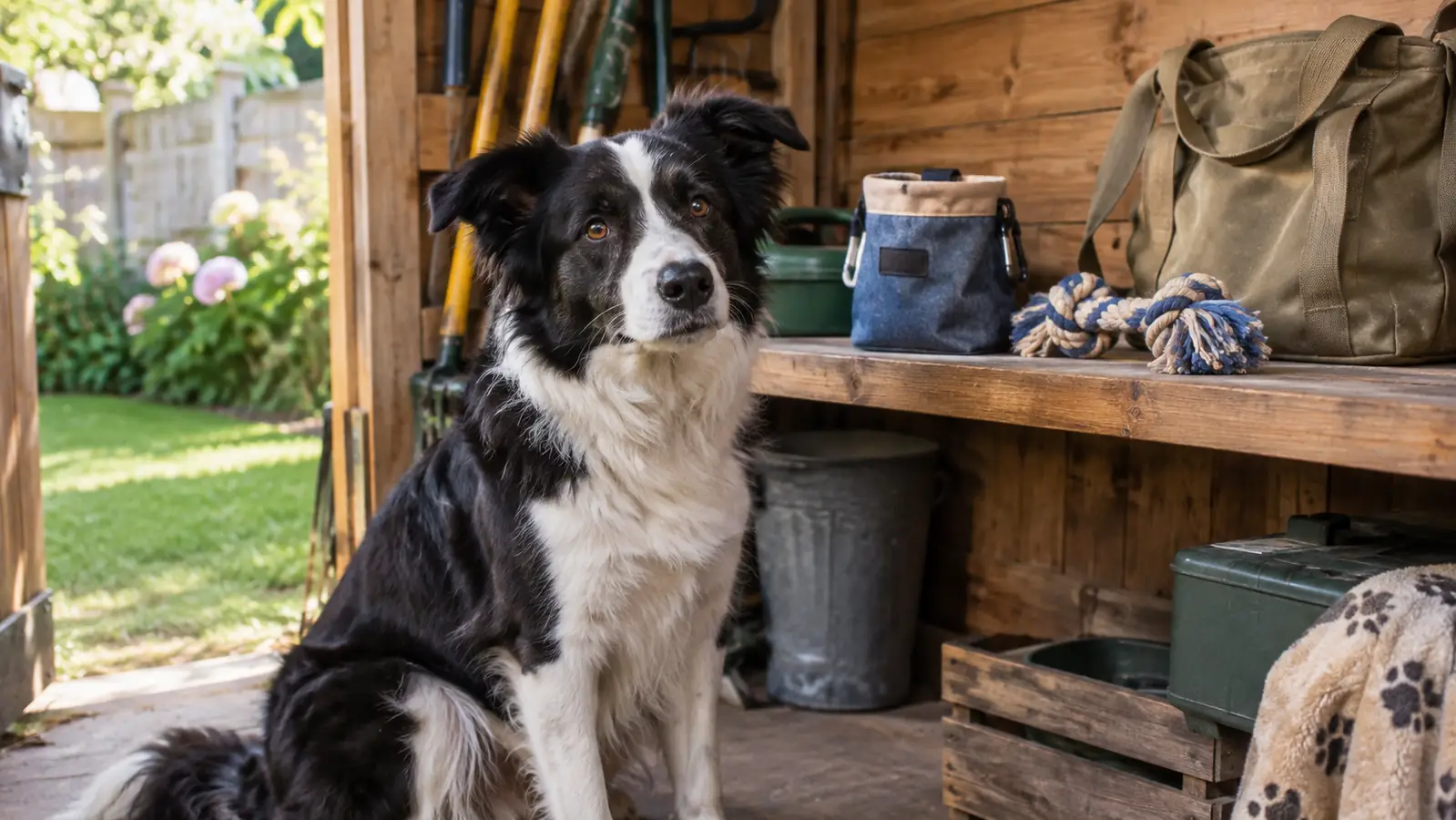
Where It Falls Short
The size is the main one. This bag is built for a training session, not an outing. On a club morning I am topping it up repeatedly, and if I were the kind of person who wanted one bag to cover a whole day of walking, training and a stop for lunch, this would not be it. I knew that going in, because I bought it to solve one specific problem, but I would rather say it plainly than have someone find out after a long day away from home.
The closure is the second one. When the bag is packed right to the top, the magnet does not pull it shut as neatly as it does when the bag is about two thirds full. Nothing has ever spilled on me and I have never lost a treat, but I have noticed it, and I have started filling it a little less full on purpose. That is genuinely the only gripe I have after 22 months, which tells you most of what you need to know.
Here is the exact thing I noticed. On a Thursday when I cut 50 pieces instead of 35, the top of the bag sits proud of the magnet and the flap rests instead of closing. Nothing fell out on the walk from the SUV to the yard and nothing fell out during the session, but I could hear the difference in how it opened. At 35 pieces it closes with a soft snap. At 50 it does not. That is the whole defect list.
What I Would Change
If I could change one thing, I would want the pouch a little deeper without being any wider, so a full bag would close as neatly as a half full one. That is the whole list. Everything else that bothers me is a limitation I signed up for when I chose a small bag on purpose, and I would rather have a small bag that works than a big one I stop wearing.
I would also like to have known up front that hand washing is part of the deal. I do it about once a month, in the sink, with a bit of dish soap, and it air dries overnight on the line. It is five minutes of my life and it has kept the fabric from getting greasy, but if you are someone who will never wash a treat pouch, the inside will eventually tell on you. That is true of every pouch I have seen at the club, including the bigger ones the other handlers carry. It is not a flaw in this one.
Who This Is For
This is for the person whose training starts at their waist. You have a dog that works for food, you train in short bursts a few times a week, and your current system is a pocket, a plastic tub on the ground, or nothing at all. It is also for anyone who has watched their dog give up on an exercise because the reward took three seconds too long to produce. If your sessions are short and your treats are small, the OllyDog bag does its job without you thinking about it, which is exactly what you want from this kind of gear.
Who Should Skip It
Skip it if you need to carry a lot. A full day out, a long walk with training mixed in, or a club day where you are working several dogs means you will want something bigger, and you will end up carrying a tub anyway. Skip it if you train with toys rather than food, because this bag does its best work filled with treats and the toy can live in your hand. And skip it if you want one bag that also carries your phone, your poop bags and a water bottle, because this one is deliberately not that bag.
22 months, two pockets, and a closure that still closes
I stopped using my jacket pocket the day this arrived and I have not gone back to it. If your training happens at your waist and your sessions are short, this is the one I would buy again.
Amazon Check Today's Price on Amazon →