
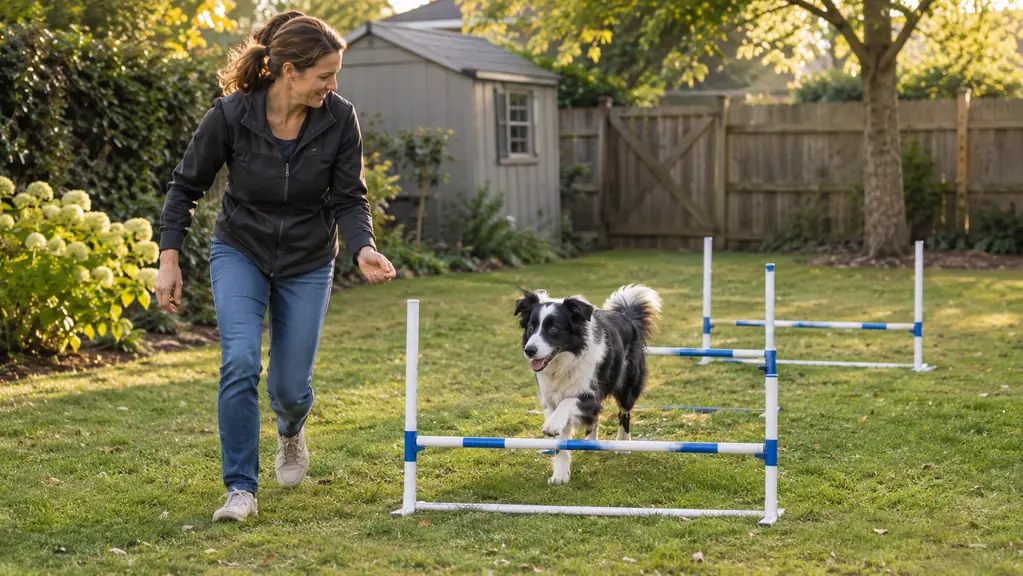
I started agility with Juno two years ago, and the first thing I got wrong was not the jumps. It was the treats. For two months I stuffed pea-sized chicken treats into my jacket pocket, then fumbled for them while Juno lost interest and started sniffing the grass. The day the OllyDog Goodie Treat Bag arrived, I stopped using the pocket. I have worn that bag on my right hip for every back yard session since, and I wear it to the Saturday beginner group at the county fairgrounds.
Juno is a 5-year-old border collie mix, 28 pounds, about 17 inches at the shoulder. We train Tuesdays and Thursdays for about 15 minutes in the back yard, and Saturdays at 9am with the beginner group. I am a hobby handler, not a trainer. These are ten plain reasons the bag earns its place in that routine, plus one honest note about what I would skip.
Stop digging in a pocket between reps
The OllyDog Goodie Treat Bag has a magnetic closure, two pockets, and an adjustable waist belt with a quick-release buckle. It holds one session of pea-sized treats and keeps the rope tug out of the chicken.
Amazon See the OllyDog Goodie Treat Bag on Amazon →Your treat hand stops hunting
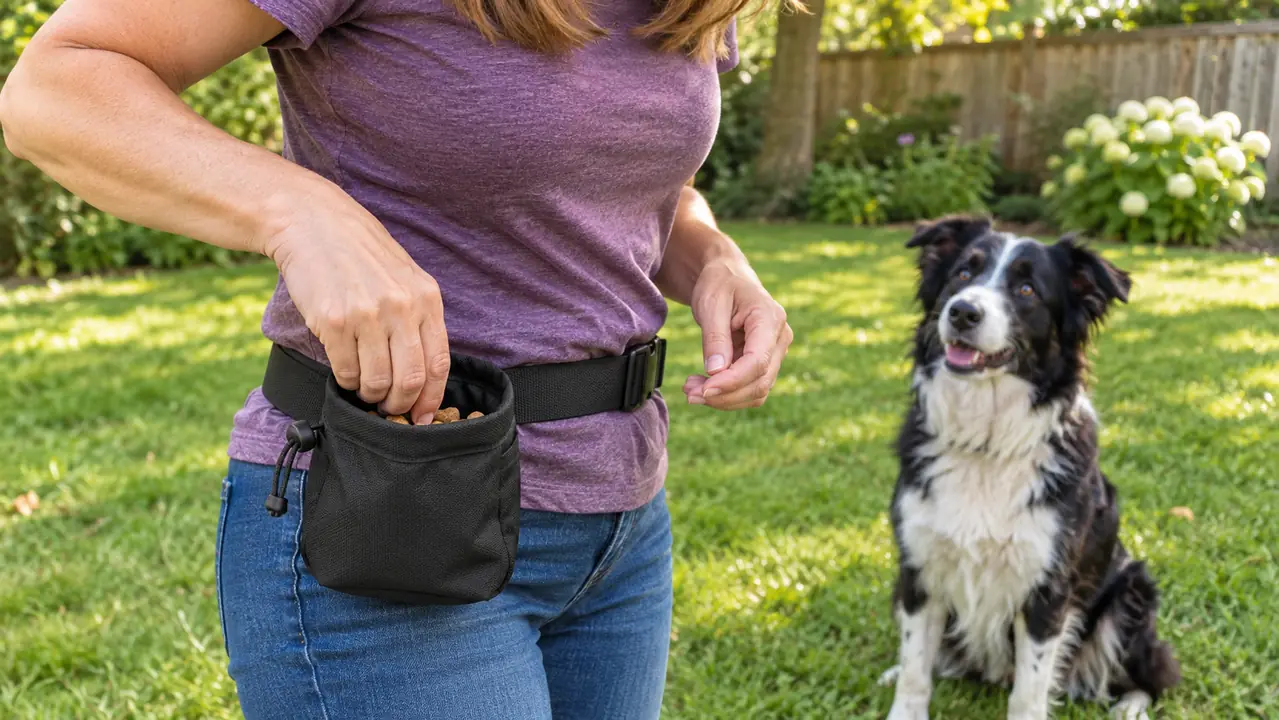
The closure is magnetic, so I can open it with the hand that is already free, take one pea-sized piece of chicken, and press it shut without looking away from Juno. The bag sits on my right hip, which means my hand goes to the same spot every time. That sounds small. In a 15-minute session, it removes dozens of little pauses. I used to lose Juno's attention while I dug around in a pocket. Now the treat is there, the rep continues, and I am not repeating myself.
It holds one session, not a week
The bag measures 4 1/4 by 5 1/4 by 3 inches. That is enough for the treats I need for one full session with Juno. I fill it before we start, and when it is empty, I am done. That limit is useful. A bigger pouch would let me carry more than I need, and more than I need turns into a habit of drilling too long. Juno is 5 and we are working on clean, easy repetition, not volume. The bag matches the size of the job.
The jacket pocket loses on every count
I used my jacket pocket for two months before the OllyDog bag arrived. It was slow. The treats slid into the corner of the pocket, and I had to fish them out while Juno waited. It also smelled of chicken, which is not a thing I wanted to notice every time I put the jacket on. I stopped using the pocket the day the bag came, and I have not gone back. The bag keeps the treats in one place, and it comes off my waist when the session is over.
Two pockets keep food and play apart
The main pocket holds the chicken treats. The side pocket holds the rope tug or my keys. That separation matters because food comes from the bag and play comes from the tug. If I mix them, I end up with a rope that smells like chicken and treats that pick up grass. I do not need to think about it during a session. Treats on one side, tug on the other, and my hand knows where to go.
The waist belt is the part that makes it hands-free
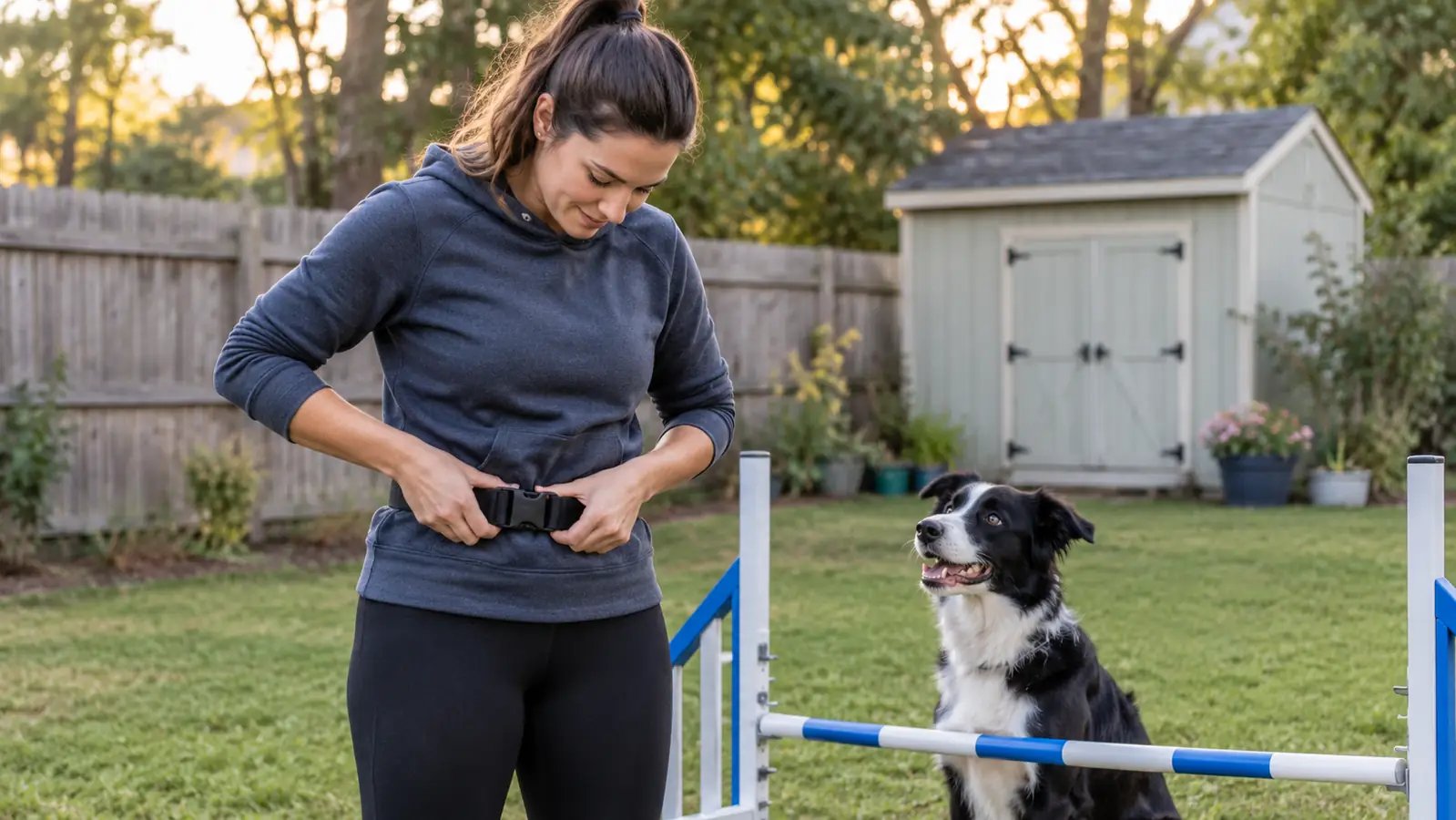
The bag comes with an adjustable waist belt and a quick-release buckle, and the strap length is listed at 52 inches. I wear it on my right hip and leave it there for the whole session. When I am done, the buckle releases and the bag comes off. I have not used the other ways to wear it, because the waist belt is what works for the way I train. My hands stay free for the leash, for opening a gate, or for holding the tug at the end of a sequence.
The bag is not why Juno learned to run a tunnel. Repetition did that. The bag is why I stopped wasting repetitions on fumbling.
It handles a grassy back yard without a fuss
OllyDog makes the bag from water-resistant recycled vegan fabric with a nylon build. My back yard is grass with a slight slope, and the bag has been out there in ordinary weather for nearly two years. It gets dusty and it gets grass on it. I hand wash it about once a month and let it air dry. I am not careful with it, and it has held up. The water-resistant part matters when the grass is damp, because I am not stopping a session to wipe down a pouch.
It is small enough to forget you have it on
The bag weighs almost nothing and sits close to the hip. I do not notice it while I am moving between the jumps or sending Juno through the tunnel. That is the point of a training pouch. If I notice it, it is because I am adjusting it. I set the belt once and it stays where I put it for the 15 minutes. Then it comes off and goes on the shed shelf with the tug.
Club days get one less thing to juggle
At the Saturday beginner group, the club owns the full-size equipment. I bring Juno, a leash, and the bag. I am not a trainer and I am not running the session. I am just another handler in the group. The bag gives me a place for treats that is not my hand and not a pocket, so I can pay attention to the instructions and to Juno. It is a small thing, but club mornings are busy enough without me patting down a jacket.
The quick-release buckle ends the session cleanly
I like a clear ending. Juno gets her last treat, I release the buckle, and the bag comes off. The treats go back in the kitchen, the tug goes on the shed shelf, and the session is over. That sounds like housekeeping, but it is training. A clean finish is easier to repeat than a slow drift away from the jumps. The bag is part of that finish because it is easy to put on and easy to take off.
It makes the routine repeatable
Two evenings a week, about 15 minutes, same bag, same hip, same pea-sized chicken treats. That is the whole system. I am not a champion handler and Juno is not a trial dog. We are a woman and a border collie mix in a back yard, working on clean reps. The bag helps because it removes the small friction that used to break the routine. When the routine is easy to start, I start it. That is the reason it stays in my kit.
What I'd Skip
I would skip the jacket pocket, and I would skip any pouch that is bigger than the session. The OllyDog bag is small. On a long day out it is not enough, and a very full bag does not snap shut as neatly as a half-full one. For a 15-minute session in the back yard it is right. I would also skip using the side pocket for extra treats. Keep the treats in the main pocket and the rope tug or keys in the side pocket, or you will be sorting by feel in the middle of a rep. One bag, one belt, washed once a month, is the whole setup.
If your treats live in a jacket pocket, start here
The OllyDog Goodie Treat Bag holds one session, wears on the waist belt, and has two pockets so the rope tug does not smell like chicken. It is the small piece of kit I reach for every Tuesday and Thursday.
Amazon See the OllyDog Goodie Treat Bag on Amazon →