
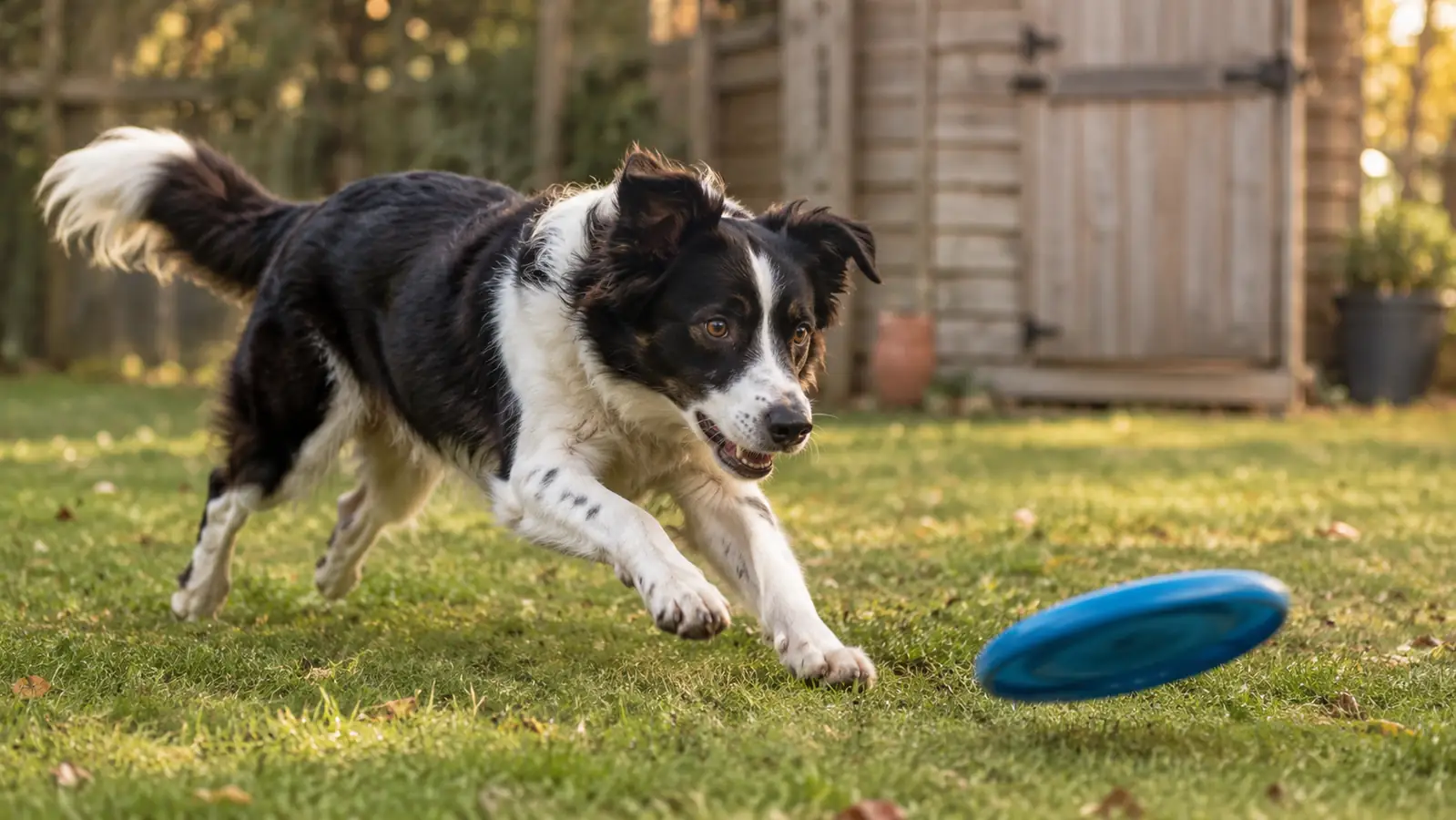
Most dogs do not catch a disc the first time you throw one. They watch it leave your hand, they lose it against the sky, and they arrive a second late and a foot behind. The disc lands, they look at you, and you both stand there. That is not a training problem and it is not a stubborn dog. It is a tracking problem, and it gets solved with short low throws and a lot of repetition.
I started teaching my border collie mix Juno to catch 12 months ago, on Sunday mornings in my back yard in Easley, South Carolina. I am not a trainer. I am a 52 year old part time bookkeeper who took up agility two years ago and wanted one more thing to do with her dog on a weekend. The Chuckit! Paraflight Flying Disc was the only disc we used, and it is what I would hand to anyone starting from zero.
The disc I used to teach the whole thing, from first roll to first catch
The Chuckit! Paraflight is a Large 9.75 inch disc with a soft rubber edge and a multilayer nylon interior, listed for medium to large dogs. It is the one Juno learned on, and a year later it is still the one on the shed shelf.
Amazon Check Today's Price on Amazon →Step 1: Build the value of the disc before you ever throw it
Juno did not care about the disc at all at first. That is normal. A disc is flat, it does not squeak, and it does not bounce. So for the first two weeks I did not throw it once. I rolled it along the grass.
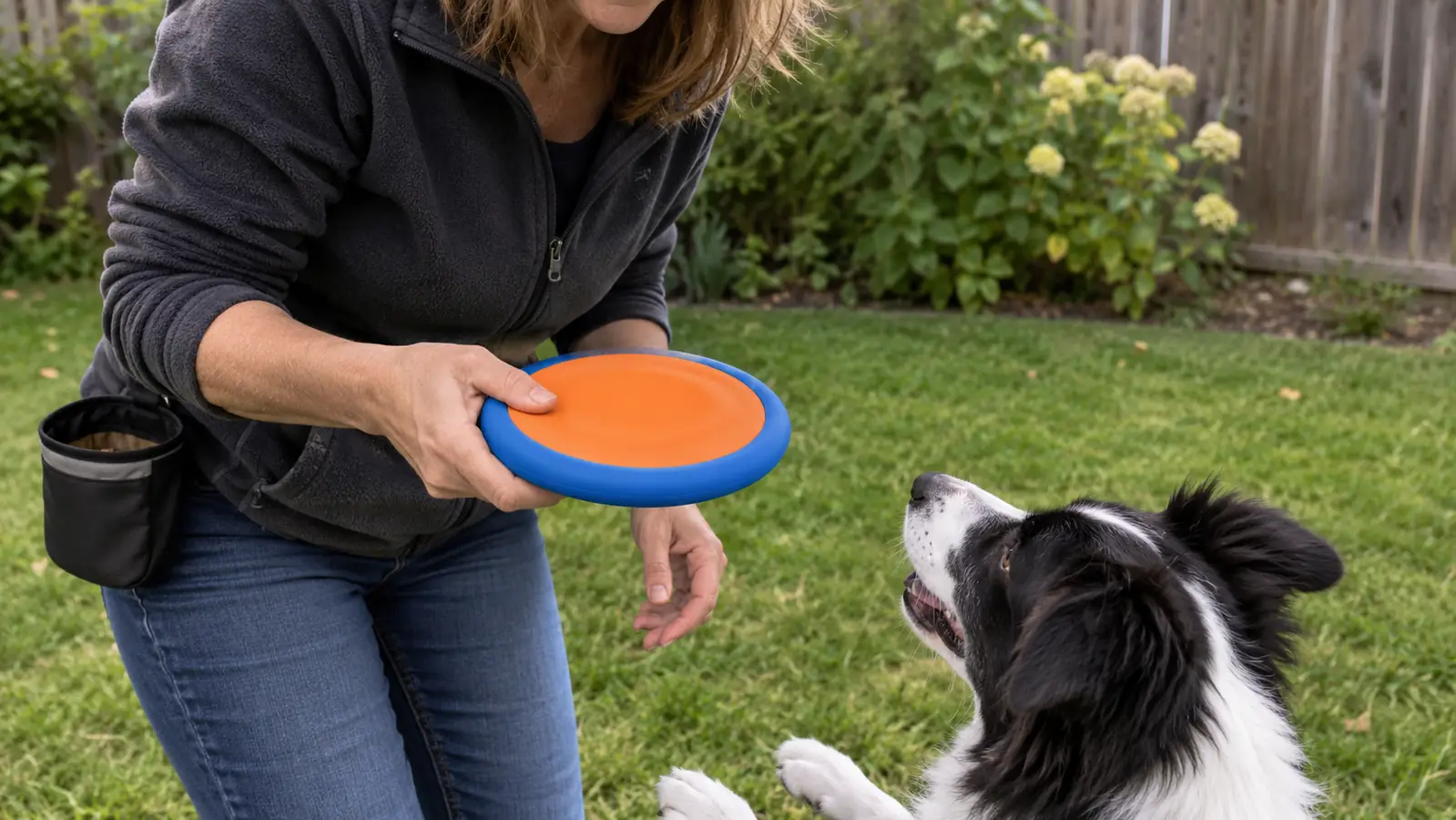
A rolling disc is easy to track. It stays on the ground, it moves in a straight line, and a dog can put her nose on it without solving a physics problem. I rolled it maybe ten feet, let Juno chase it, and when she put her nose on it or grabbed it I gave her a small soft chicken treat cut to pea size from the bag on my hip. Two or three rolls, a treat, then done.
I counted rolls rather than minutes in those early weeks. Ten rolls was a session, and most of them started from about six feet away, close enough that Juno could get her nose on the disc before it stopped moving. If she wandered off to sniff the fence line, I did not call her back and I did not repeat the word I was using. I picked up the disc and put it away, and the next session she was keener. Two weeks of that, six or seven short sessions in all, and she started moving toward the disc the moment I lifted it off the shed shelf.
The point of this step is not catching. It is teaching one idea: that disc equals good things. Keep the sessions short enough that she is disappointed when you stop, not bored before you do.
Step 2: Swap rolling for short, low, flat throws
Once Juno was chasing the roll with some enthusiasm, I started lifting it just off the grass. Not a big loopy throw. A short flat throw, maybe fifteen feet, that rose a foot or so and came down gently.
This is the step where most people ruin their own progress, and I nearly did. The temptation is to throw it far and high because that looks like disc dog on television. A high floating throw hangs in the air, the dog loses it against the sky, and she learns that running at the disc does not pay. Low and flat keeps the disc in her field of view the whole way, and she can practice the actual skill you are teaching, which is reading a flight path.
My first flat throws were genuinely bad and I want to say so plainly. I put one into the fence at about head height, I threw one that wobbled left and clipped the shed, and I sent one almost straight up because I flicked my wrist at the last second. What fixed it was standing still with my feet set, releasing the disc level, and letting my arm finish toward the target instead of upward. Juno did better on my ugly throws than I deserved, mostly because the bad ones stayed low and she could see them the whole way.
The Paraflight is a good tool for this specific step because of the soft rubber edge. A hard plastic disc off a bad throw stings a dog's mouth and many dogs quietly decide they want nothing to do with it after that. The soft edge means a clumsy early grab is not punished.
Step 3: Teach the chase first and the catch second
You cannot catch something you are not already running at. So the catch is the second half of a behavior, and the first half is chase.
I would throw the disc low and flat, and the second Juno was running toward it I would say one word, "get it," in the same cheerful voice every time. When she got to the disc, whether she caught it or it hit the grass three feet away, I marked it with a treat. That is deliberate. In the early weeks I was rewarding the chase and the effort, not the catch.
I used exactly one marker word and I used it at the moment her nose reached the disc, not after she turned around. Timing matters more than the word you pick. Say it when she is already walking back and you are marking the walk back, so she learns to touch the disc and immediately spin away from it. Pea-sized treats make that easy, because you can hand one over fast and get the disc back in the air before she loses interest.
It took her about a month of Sundays to make an actual mid-air grab. I remember it because I dropped my coffee. Before that there were a lot of near misses and a few moments where she simply sat down and looked at me as if I had invented an unfair game. That is a dog telling you the throw is too hard. Go shorter and flatter.
One thing I never ask for is a high leaping catch. I do not throw discs up and expect Juno to leap for them. She is 28 pounds and about 17 inches at the shoulder, the disc is Large, and I am a hobby handler in a back yard with a slight slope. Low running catches are the whole game here, and they are plenty for a Sunday morning.
Step 4: Fix the drop before it becomes the habit
Almost every dog gets to a point where she catches the disc, takes two steps, and spits it out instead of bringing it back. That is not defiance. It is usually one of two things: she does not yet know that returning is part of the job, or you have been chasing the disc yourself, which teaches her that a dropped disc is a thing you will go and fetch.
The fix is the same as Step 1. When Juno dropped the disc near me, I gave her a treat for the drop and picked it up myself without comment. When she happened to carry it toward me, even two steps, I made a much bigger deal of that with the treats and with a short tug on the rope tug I keep in my treat bag side pocket.
Having that tug already in my hand instead of buried in the bag did more for the drop than anything else I tried. Ten seconds of tug at the end of a good rep, then the tug goes back in my hand and the disc comes out again. Food comes from the bag and play comes from the tug, so the tug stays a reward and not a toy she can wander off with. If she dropped the disc and came at the tug instead, the tug disappeared and we reset from the start of the rep.
Sessions are Tuesday and Thursday evenings, about 15 minutes, and never in the heat of the day. The disc game is separate from those. It is a Sunday morning game and I keep it separate on purpose, because a dog who thinks a jump or a tunnel is coming will not settle into a disc lesson.
Step 5: Add distance slowly and quit while it is going well
Distance is the last thing you add, not the first. Once Juno was reliably catching a low flat throw at fifteen feet, I spaced the throws out over a few weeks until she was working at maybe thirty feet across the yard. Every time I added distance I threw a couple of short easy ones in between, so the session never felt like it was getting harder and harder.
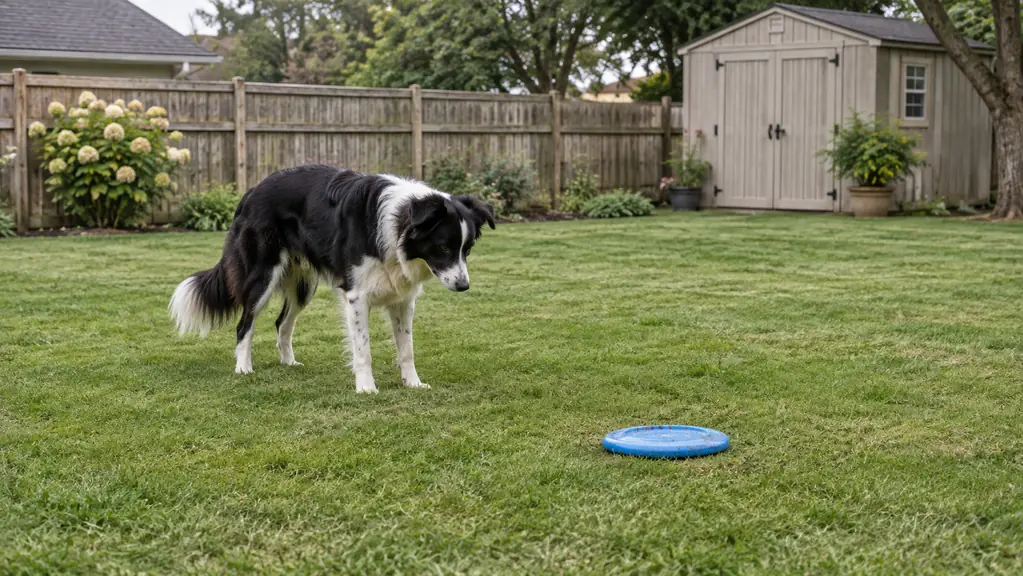
Counting throws helped me more than counting minutes. Thirty feet in my yard is roughly from the shed across to the middle of the lawn, so that is the distance I actually mean when I say thirty. I kept a rough count in my head: six or seven throws at the new distance, then three short easy ones, then stop. If the last throw of the day was a bad one, I threw one more easy one before I quit, because I did not want to walk back to the house on a miss she could not fix.
The last rule is the one I am still working on. End the session while it is still good. If you keep going until the dog is slow or distracted, whatever you did in the last two minutes is what you practiced. Ten good throws and stop beats forty that end with you feeling annoyed.
I was rewarding the chase and the effort, not the catch. It took about a month of Sundays before she actually made a mid-air grab.
What Else Helps
A treat bag worn at the waist, rather than treats in a coat pocket, makes this much smoother. I wore a jacket pocket full of chicken for two months before I finally bought a proper bag, and the pocket was slow, my hands fumbled, and my jacket smelled like a chicken. Getting the reward out fast is the whole reason a marker word works.
A second thing that helps is a disc you can throw straight. The Paraflight has a strong multilayer nylon interior and soft rubber edges, and the Large is 9.75 inches across. I will tell you the honest limitation of that: the Large is a little big for a 28 pound dog. Juno manages it fine, but if your dog is Juno's size or smaller, look at a smaller size rather than this one.
It also does not fly well in wind. My yard is fenced and fairly sheltered, so most Sundays are fine, but a breezy day turns a flat throw into a wobbling one and makes the lesson harder than it needs to be. The listing says the disc floats, and it is waterproof and lightweight, but that is a listing fact for me. Ours has never been in water. I have no pond and no pool, and I have never thrown it into anything but grass.
One more habit worth building: put the disc away when the game is over. It is a fetch toy and not a chew toy. Mine lives on the shed shelf and comes out on Sunday. Juno has left small tooth marks in the edge over a year of catches, which is normal wear and not damage, but left alone with a disc a dog will chew it flat.
One disc, one word, ten good throws. That is the whole program.
The Chuckit! Paraflight in Large, 9.75 inches, soft rubber edge, multilayer nylon interior. A year in and it is still the disc Juno learned on.
Amazon See Current Price on Amazon →If you want the longer notes on how the disc has held up over twelve months of Sunday mornings, I wrote those up separately, along with how it stacks up against a ball launcher for a dog who does not chase balls. Neither changes the method above. The method is short low throws, a marker word, and stopping early.
Juno is still not a disc dog champion. She is a shelter dog who came home at age one and now catches low flat throws in a fenced yard on Sunday mornings, and I am a hobby handler who still throws one into the fence now and then. That is enough. Most dogs do not need more than that, and neither do most of us.