
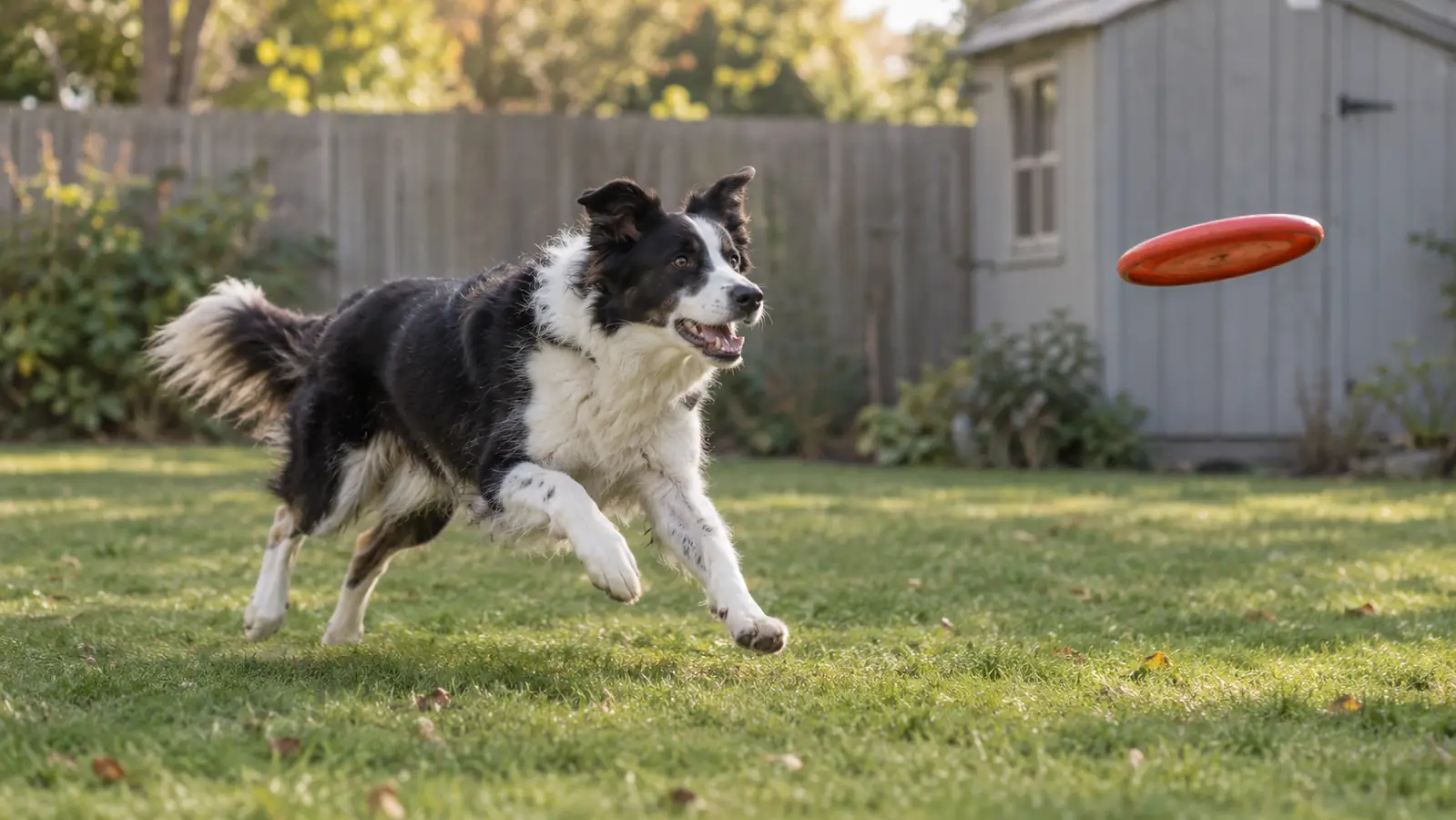
Six Sunday mornings out of ten, I am standing in my back yard in Easley, South Carolina, with a flying disc in my right hand and a five year old border collie mix named Juno watching my wrist. That is our whole disc game. I am not a competitor. I am a 52 year old part time bookkeeper who took up agility two years ago as a hobby, and I bought a Chuckit! Paraflight disc twelve months ago for one reason: Juno will not chase a ball to save her life.
So when somebody at the Saturday class asks whether a disc or a ball launcher is the better first buy for sport games, my answer is short. For a dog like Juno, it is the disc. Not because a launcher is bad gear. A launcher is good gear. It solves a problem I do not have, which is a tired throwing arm, and it leaves alone the problem I do have, which is a dog who does not care where the ball lands.
That is the short answer. The rest of this is how I got to it, the three things a ball launcher genuinely does better, and who should ignore me and buy the launcher instead.
| Chuckit! Paraflight Disc | A ball launcher | |
|---|---|---|
| What you throw | A 9.75 inch disc with a soft rubber edge and a multilayer nylon interior | A ball, sent by your arm or by the launcher's arm |
| Throwing effort | Your arm on every single throw, with no help at all | The launcher's arm does the work, so your shoulder lasts the session |
| Flight in wind | It does not fly well in a breeze and will wobble and drop short | A ball is heavy for its size and barely notices wind |
| Size fit for a small or mid sized dog | The Large is a little big for a 28 pound dog, and a smaller size exists | A ball is an easy size for nearly any dog, with no measuring |
| Catching | The soft rubber edge gives a dog something to take hold of in the air | A ball is caught clean or it is chased, with no edge to grip |
| Water | The listing says it floats, though mine has never been in water | A ball floats too, at least for a while |
| What it does for a dog who does not chase balls | Juno runs and catches it low, twelve months in, every time | Juno watches the ball land and goes to sniff the fence |
Where the Chuckit! Paraflight Disc Wins
Two things, and they happen to be the two that matter most to a beginner with a dog who is not already wild about fetch.
The first is catching. The disc has a soft rubber edge, so there is something for a dog to actually take hold of in the air. Juno does not have to be a leaping, spring loaded catch dog. She runs flat, takes it low, and the edge gives her a grip she can close on. A ball has no edge. It is either caught clean or it is chased, and chasing is only any fun if the dog already believes the ball is worth chasing.
The second is that Juno will do it at all. I have thrown a ball for her. She watches it leave my hand, watches it land, looks at me, and goes to sniff the fence. Twelve months in, she still runs at the disc. Sunday morning is the only time she gets that game and she knows its shape. I open the shed, I take the disc off the shelf, and she is already at the far end of the yard waiting for it.
There is a smaller third thing, and it is about me rather than the dog. A disc thrown low and flat gives me a readable run and a clean catch, which means I get to practise my own timing on every throw. A launcher fires a ball hard and far and the dog is gone in a straight line and back again. That is fine. It is just less of a back and forth between the two of you, and on a Tuesday or a Thursday I already get plenty of drills.
Where a Ball Launcher Wins
Three things, and it wins them without much of an argument.
Your shoulder. A launcher throws for you. Anyone who has spent a full Sunday throwing for a dog that never tires knows what that is worth. I am 52 and by the end of a long session my arm knows it. If your dog will chase a ball for two hours, a launcher keeps you in the game longer than your own arm will, and that is not a small thing.
Wind. My disc does not fly well in a breeze. On a gusty morning it wobbles, turns over and drops short, and Juno has to put the brakes on and come back to me. A ball is heavy for its size and hardly notices wind at all. If you practise on an open field that catches weather, that is a real mark against the disc.
Size. The Large Paraflight measures 9.75 inches across. Juno is 28 pounds and about 17 inches at the shoulder, and the Large is a little big for her mouth. She manages it fine. A smaller dog should be looking at a smaller size than mine, and that means guessing right the first time or buying twice. A ball is an easy size for nearly any dog, with no measuring and no second order.
The disc Juno still runs for, twelve months in
I throw it low and flat over a small back yard, and a soft rubber edge is the reason a 28 pound dog can catch it at all. If your dog watches the air, start here.
Amazon Check Today's Price on Amazon →How I Compared Two Things I Only Own One Of
I should be straight about my method, because it is not a lab test and I am not going to dress it up as one.
I own the Chuckit! disc. I have never owned a ball launcher. My side of this comes from twelve months of Sunday mornings with Juno in a back yard about 40 by 60 feet with a slight slope and a shed by the back gate, plus a year of Saturday beginner classes at the county fairgrounds. The launcher side comes from watching other owners work theirs at a public park, and from handling one for a minute to see how the arm felt in my hand.
That is not a clean comparison. It is how most people decide, though. You see somebody else's gear doing a job and you work out whether it does your job. So the question I answered was narrow on purpose: which one gets my dog running on a Sunday morning in a small fenced yard, with a handler who is not a trainer and a dog who is not a retriever.
Twelve months in, she still runs at the disc. I have never once seen her run at a ball.
The First Two Weeks, With a Dog Who Did Not Care
The disc did not work on day one. Nothing works on day one with Juno.
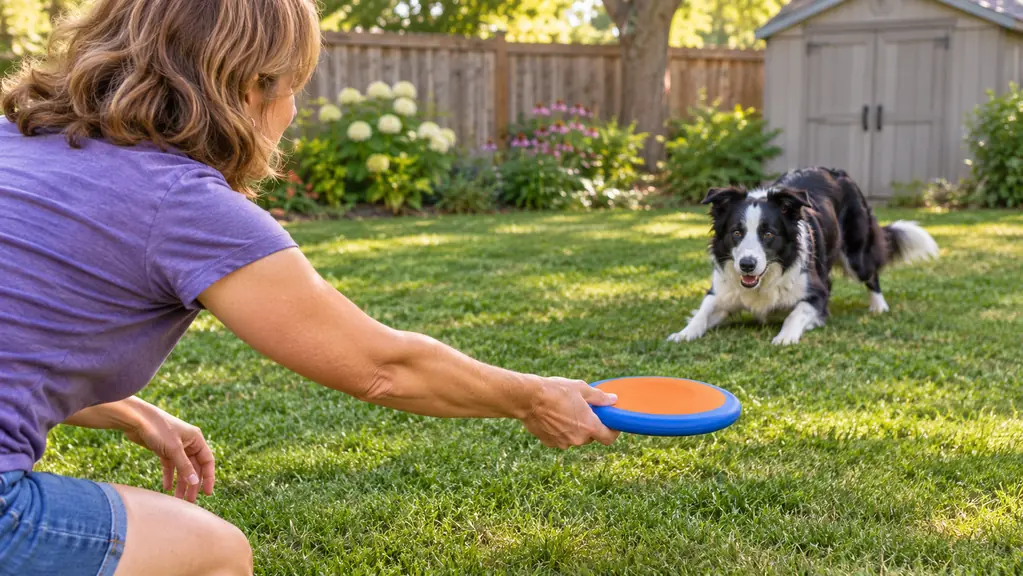
For about two weeks I rolled it along the grass instead of throwing it, and she chased it because it was moving on the ground and not because it was flying. Then I started short, low throws, barely more than a toss, six or eight feet in front of her. The disc stays flat when you do that, and a flat disc at knee height is a thing a dog can catch without ever leaving the ground.
That is where a beginner should live for a while. Short and low. High floating throws look better and teach a dog nothing except to leave early. I still throw low and flat now, a year on, and I do not ask Juno for leaping catches. She is 28 pounds and quick on the ground, so the ground is where we play.
If you go the launcher route, the same patience applies but the shape of it is different. A launcher sends a ball a long way by design, so a beginner ends up throwing forty feet on the first session and the dog either runs it or does not. There is less to build up to, for better and for worse.
How the Disc Fits Around the Jumps and the Tunnel
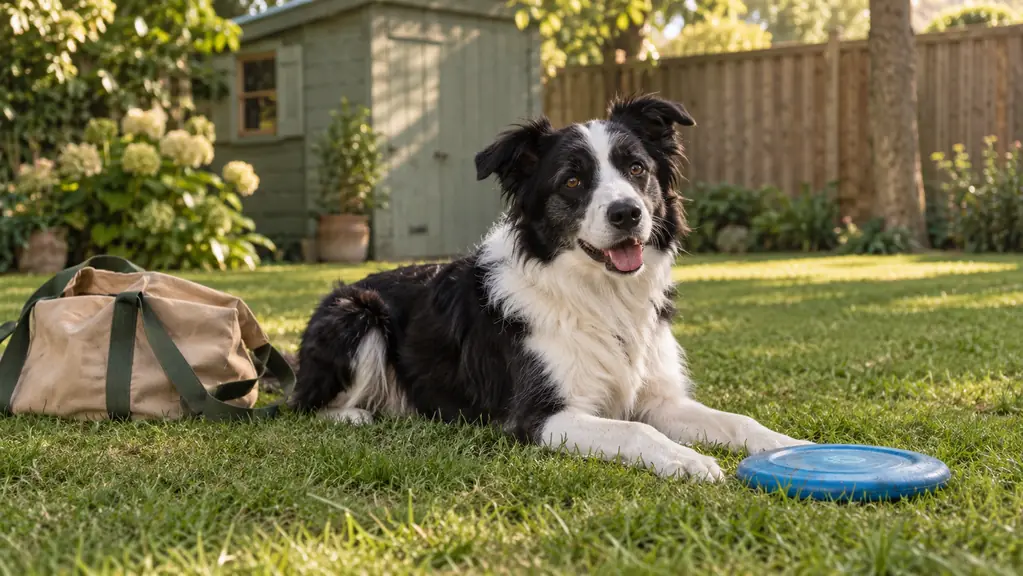
We do agility on Tuesday and Thursday evenings, about fifteen minutes in the back yard, jumps first and then the tunnel. The disc is not part of that. It never has been.
That is on purpose. Jumps and tunnels are a thinking game and a disc is a running and chasing game. The one time I tried to squeeze both into an evening, Juno stopped listening to anything and just kept looking at the shed shelf. So the disc has its own slot, Sunday morning, and it comes out after the other gear is back in the shed. If you are putting together a first set of gear, I would keep your chasing game and your thinking game apart the same way.
It also means the disc earns its place without being a training tool. I am not using it as a reward for anything. It is one game, once a week, that my dog loves, and that is reason enough to own it.
What Twelve Months Did to the Edge
There are small tooth marks along the edge where Juno has caught it. That is the only wear I can point to after a year.
The Chuckit! disc is not a chew toy and I do not treat it like one. It comes off the shed shelf, we play for a while on a Sunday, and it goes back on the shelf. If I left it down with her it would be in pieces, and that would be my fault and not the disc's. The soft edge is built for catching, not for chewing, and I would rather it stayed that way.
It has never been in water. Chuckit! lists it as floating and I have no reason to doubt it, but there is no pond near the house and I am not going to pretend I tested that. What I can tell you is that the multilayer nylon interior has come through a year of low catches on grass without a tear, and that the disc is light enough for me to throw one handed for a whole session without my arm giving out before the dog does.
What I Liked
- The soft rubber edge gives a dog something to grip in the air, which is what makes catching possible for an ordinary dog
- The multilayer nylon interior has held up to a year of low catches on grass with no tear
- The Large measures 9.75 inches and is listed for medium to large dogs
- It flies flat on short, low throws, which suits a small back yard
- Light enough for a hobby handler to throw one handed for a full session
- The listing says it floats, which matters if your dog likes water
Where It Falls Short
- It does not fly well in wind and will wobble and drop short on a gusty morning
- The Large is a bit big for a 28 pound dog, and a smaller size is the better fit for smaller dogs
- The soft edge picks up tooth marks if your dog mouths it
- It is not a chew toy, so it has to be picked up after every game
- A disc wants a handler who will practise low, flat throws rather than just hurling it
- It does nothing about a tired arm, which is the one thing a launcher is good at
Who Should Buy Which
Buy the disc if your dog watches things in the air. If your dog follows a bird, a moth, a falling leaf, or your hand when you pick up anything, a disc gives that dog a job it already understands. Buy it if your space is a back yard rather than a field, because short low throws suit a small space and a launcher wants room. And buy it if you want a game that keeps the dog close enough to watch, because a disc that drops short brings the dog back to you and a ball that flies far does not.
Buy a ball launcher instead if your dog is already a ball dog. A dog that will chase a tennis ball until you stop is not a dog that needs a disc. The launcher takes the load off your arm, it handles wind better than a disc does, and on an open field with a big dog it will outlast you. If your Sunday plan is to stand in a park and send a ball sixty feet until the dog is properly tired, the launcher is the tool for that job and I would not argue with you.
If you are honestly not sure, watch your dog for one afternoon before you spend anything. Throw a ball. Throw a rolled up pair of socks, if that is what you have in the house. You will know inside ten minutes which one your dog cares about, and it will not be a close call. Chuckit! lists the Large at 9.75 inches across and for medium to large dogs, so measure your dog against that before you order, and size down if you have a small one. Juno's answer was clear enough that I have never regretted buying the disc and I have never gone back for the launcher.
Give the dog something worth running at
The Large measures 9.75 inches, is listed for medium to large dogs, and has a soft rubber edge a dog can hold. Juno is 28 pounds and manages it fine, though a smaller dog should look at a smaller size.
Amazon Check Today's Price on Amazon →