
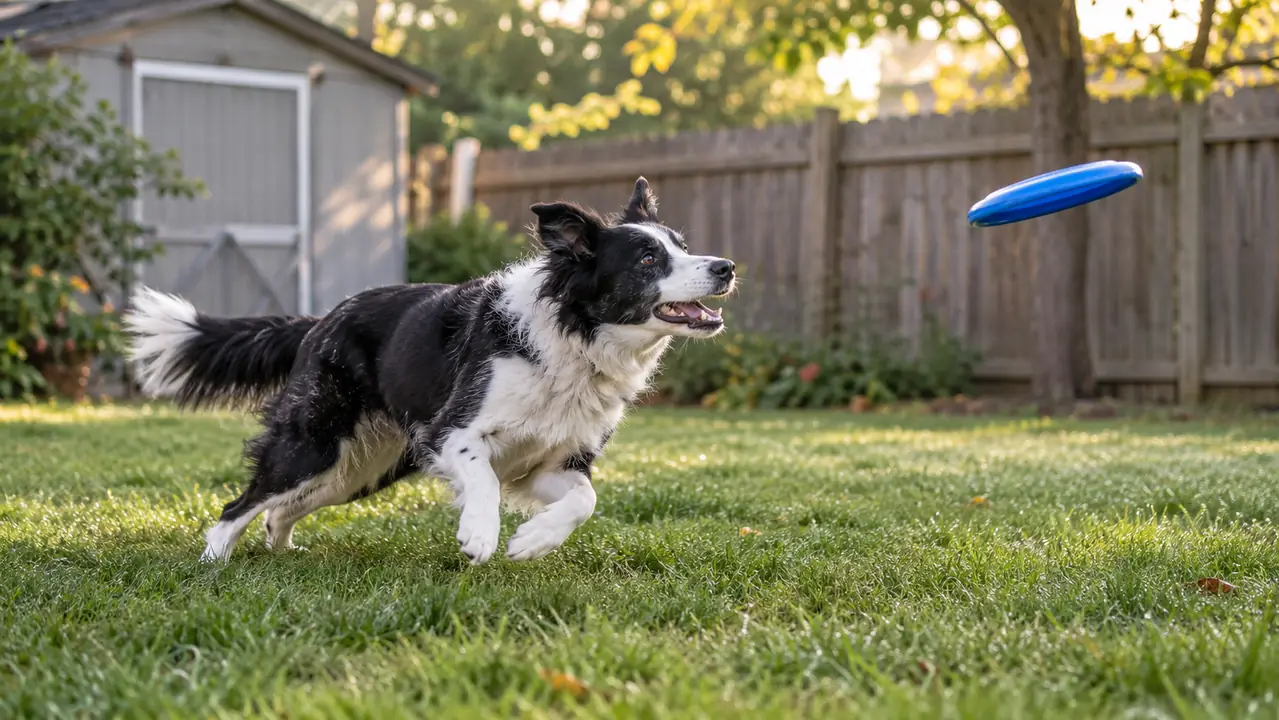
Here is the part most flying disc reviews leave out: for the first two weeks, Juno would not chase the thing. I bought the Chuckit! Paraflight Flying Disc about a year ago, carried it out to the back yard, gave it a flat toss across the grass, and watched a 28-pound border collie mix look at it, look at me, and walk back toward the gate. That is the honest start. If you are shopping for a disc and picturing the first throw ending in a dramatic catch, this is the review that tells you what actually tends to happen in a plain fenced yard with a dog who has never seen a disc in her life.
I am not a disc dog competitor. I am a 52-year-old part-time bookkeeper in Easley, South Carolina, and I train agility as a hobby with one dog. Juno is 5, she came home from a shelter at about a year old, and she stands roughly 17 inches at the shoulder. Tuesday and Thursday evenings we do jumps and the tunnel in the back yard for about 15 minutes. Sunday mornings are a separate thing entirely, and that is the disc game. It has never once been part of a jump session or a tunnel session. I say that up front because this disc has one job in my week and it does that job well. It is not a training tool and it is not a chew toy, and treating it as either one is where most of the disappointment I read in reviews comes from.
The Quick Verdict
A soft edged disc that holds a flat line on short throws and floats per the listing. The Large is a lot of disc for a 28-pound dog, it will not handle wind, and your dog may ignore it for two weeks before anything clicks.
Amazon Check Today's Price →The disc that finally got my dog running, two weeks after I brought it home
Large is 9.75 inches across with soft rubber edges and a multilayer nylon interior. If your dog is medium to large and you have a fenced patch of grass, this is the one I still throw every Sunday.
Amazon Check Today's Price on Amazon →How I've Used It
Every Sunday morning, weather permitting, I take the disc off the shed shelf, walk to the back of the yard, and throw low and flat for 10 or 15 minutes. That is the entire routine. My yard is fenced, grass, roughly 40 by 60 feet with a slight slope toward the back gate, so there is no runway to speak of. A disc that needed an open field to be fun would be useless here. This one works because I am not asking for distance. I am asking Juno to run 20 or 25 feet, catch something at knee height, and bring it back.
I bought it 12 months ago, which makes it the newest of the five things I own for dog sports. It has never been in water. The listing says it floats and I will pass that along as a listing fact rather than something I have tested, because there is no pond or pool here and I am not going to pretend otherwise. What I can tell you is what it does on grass, in a breeze, in a small yard, with a dog who is faster than she is careful.
The disc is 9.75 inches across, with a multilayer nylon interior and soft rubber edges. I did not know what to make of that description until I held it. It is not floppy. There is a firmness to the rim that holds a line when you release it flat, and the edge gives a little when a dog grabs it. That combination is why most of this review is positive. It is also why the review has caveats, and I will get to those.
The First Two Weeks Were Mostly Me Throwing to Myself
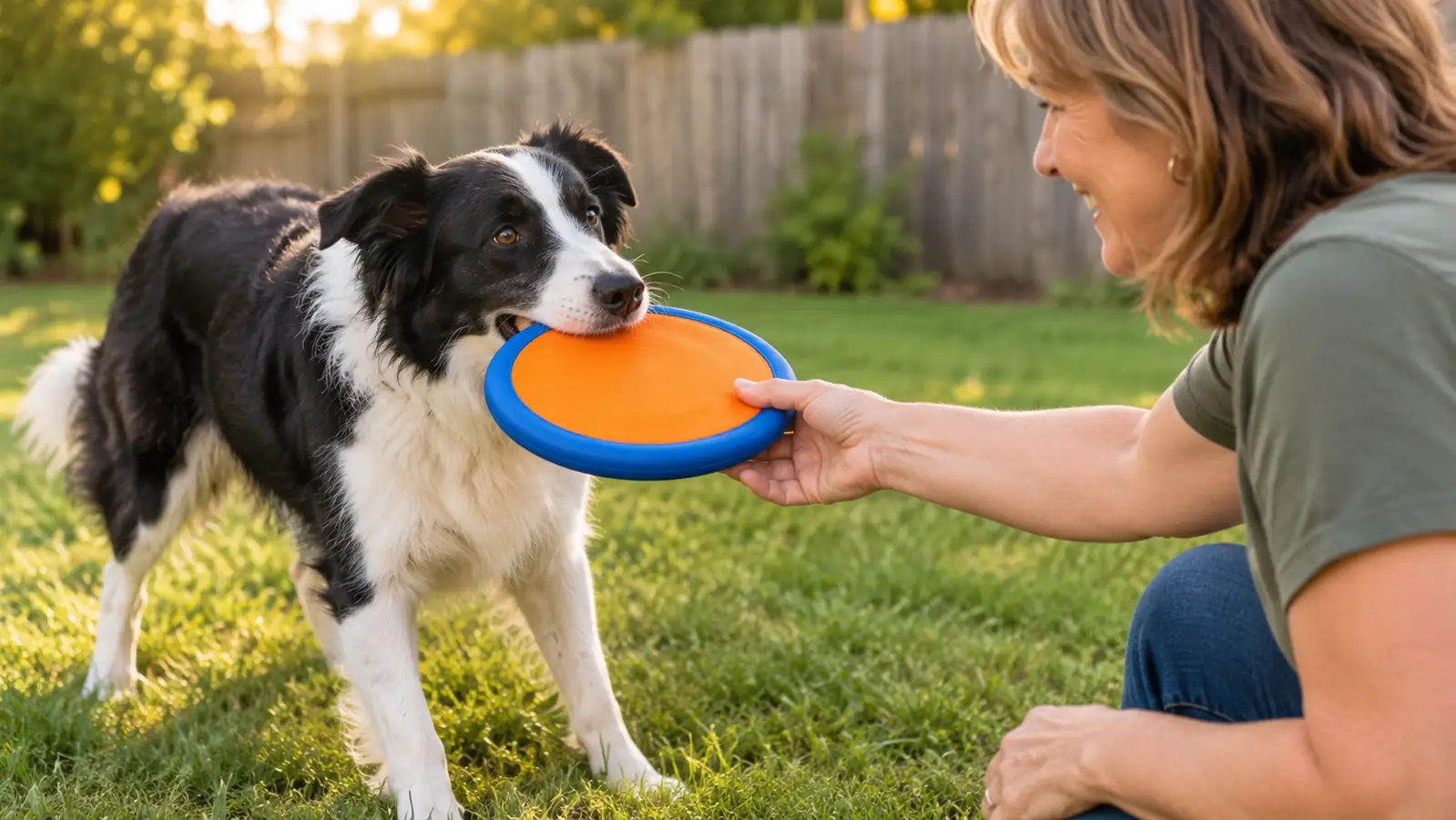
Nobody warned me that a dog might not know what a disc is. Juno is a herding mix with a strong chase drive, so I assumed she would be off the moment it left my hand. She was not. What worked, eventually, was rolling it. For about two weeks I would bowl the disc along the grass so it skittered and wobbled, and she would follow it nose down and pounce when it stopped. That is not fetch. It is closer to watching a dog investigate a very large beetle. But it got her comfortable with the object, and it got her comfortable with the idea that this thing moves and is worth chasing.
For the first few days I tried throwing it properly, and that was the mistake. A disc released with any nose up angle climbs, stalls, and drops behind the dog, and Juno had no reason to chase something that landed ten feet away from her. Rolling it took the flight out of the equation entirely. She only had to chase a thing that wobbled, and once she was chasing, the catching came later.
After two weeks I started throwing short, low, 10 or 15 foot tosses, basically handing it to her in the air. She started catching those. Then I stretched it out a few feet at a time. The honest version of this story is that the first two weeks were me throwing a disc across an empty yard while a border collie mix stood next to me and yawned. If you have a dog who is indifferent to flying objects, that is probably what you are in for too. It was not the disc's fault. It was a dog who had never done this before and had no idea what was being asked.
What the Listing Claims, Tested in a Real Yard
Chuckit! describes the Paraflight as designed for long distance flight, lightweight, with a soft rubber edge and a strong multilayer nylon interior, and lists it as waterproof. Those are the claims on the page. Here is how they held up for me.
Lightweight is real, and it matters more than you would expect. A heavy disc stings on a bad catch, and a dog who gets stung once by a hard rim starts flinching at the next throw. Juno never flinched with this one. The soft edge does exactly what a soft edge is meant to do when a catch goes wrong, and around here catches go wrong fairly often because my throws go wrong fairly often.
The multilayer nylon interior is the part that gives it a spine. A disc made only of soft material would fold in the air. This one holds a flat plane when I release it level, and that is the whole trick with a flying disc. The toy does part of the work and your throw does the rest, and no disc on a shelf can rescue a throw that leaves your hand nose up.
Waterproof is a claim I can speak to only halfway. It has never been swimming. It has spent a year in dew and damp grass, and it wipes clean with a rag and goes back on the shelf without any fuss. The soft edge has picked up a little grass staining and it still looks like a disc, which is all I ask.
Two weeks of rolling it along the grass did more for Juno than any throw I made in the first month.
The Large Is Not a Small Dog Size
This is the note I would tape to the box if I could. The Large Paraflight is 9.75 inches across, and the listing puts it at medium to large breeds. Juno is 28 pounds and about 17 inches at the shoulder, which puts her at the bottom of that range. When she carries it, it looks like she is carrying a dinner plate. She manages, she catches it, and she has never once objected. But there is a version of this where a smaller dog is stretching for a rim wider than her natural bite, and that is not a good time for the dog or for you.
If your dog is meaningfully smaller than mine, look at a smaller size instead of this one. I am not going to pretend the Large is a universal fit, because it plainly is not. It working for a 28-pound border collie mix does not mean it works for a 15-pound terrier, and the reviews that complain about size are, from what I have read, usually right about that exact point.
Wind, Distance, and the Throws I Don't Make
The disc does not fly well in wind. That is less a knock on Chuckit! than a fact about lightweight flyers with a wide surface. A gust catches it, turns it over, and your dog is suddenly running at something falling sideways. On a breezy Sunday I either skip the disc or keep everything very short and very flat. I have not had a single good session in gusty conditions, and I have stopped trying to force one.
I have a simple rule now. If the grass along the back fence is rippling and I can hear the wind in the trees at the edge of the yard, the disc stays on the shelf and Juno gets a walk instead. A disc that turns over in the air gives a dog nothing to track, and a dog that loses the line twice in a row stops caring about the game for that morning.
I also do not ask for high jumps or leaping catches. I throw low and flat over short distances, Juno runs and catches low, and that is the whole game. This is a deliberate choice. I am a hobby handler in a small back yard, not a competitor, and I am not going to describe my dog doing something she does not do just to make a review sound more exciting than my Sundays actually are.
The other thing I do not do is leave it out as a chew. Juno has left small tooth marks in the edge anyway, because she grabs hard and she has a herding dog's grip. The marks have not spread, the rim has not split, and a year in, the disc still flies the way it did in month two. Take that as durability feedback from a dog who grabs hard, not from a heavy chewer, because those are two different animals.
Why a Disc Beat a Ball Launcher for Us
I have never owned a ball launcher. I want to be clear about that, because there are plenty of write-ups that compare things the writer never touched. What I did do is watch other owners use one at a park while I stood there with a leash, and I know my own dog well enough to call it. Juno does not chase balls with any real interest. She will trot after one and lose the thread somewhere around the second bounce. The disc holds her because it moves differently in the air and because she can track it the whole way in.
The other thing I noticed at the park was how much of a launcher session is standing still. The owner loads the ball, throws, waits, loads again. I would rather be moving a little and throwing flat and low from different spots in the yard, because Juno reads my body and starts moving before the disc leaves my hand. That is the part of the game she likes, and a launcher does not really give you that.
A launcher would have been wrong for a second reason too. My yard is 40 by 60 feet with a slight slope toward the back gate. Anything built to throw a ball well past that is not a game, it is a chore with a walk attached. A disc thrown flat at 20 or 25 feet stays inside the fence and stays in play, and Juno gets her run without me fishing anything out from under the shed.
What It Is Not
It is not a training tool. It will not teach a dog to catch, it will not build drive, and it will not fix a retrieve that falls apart at 30 feet. It is a toy you throw, and it is a good one.
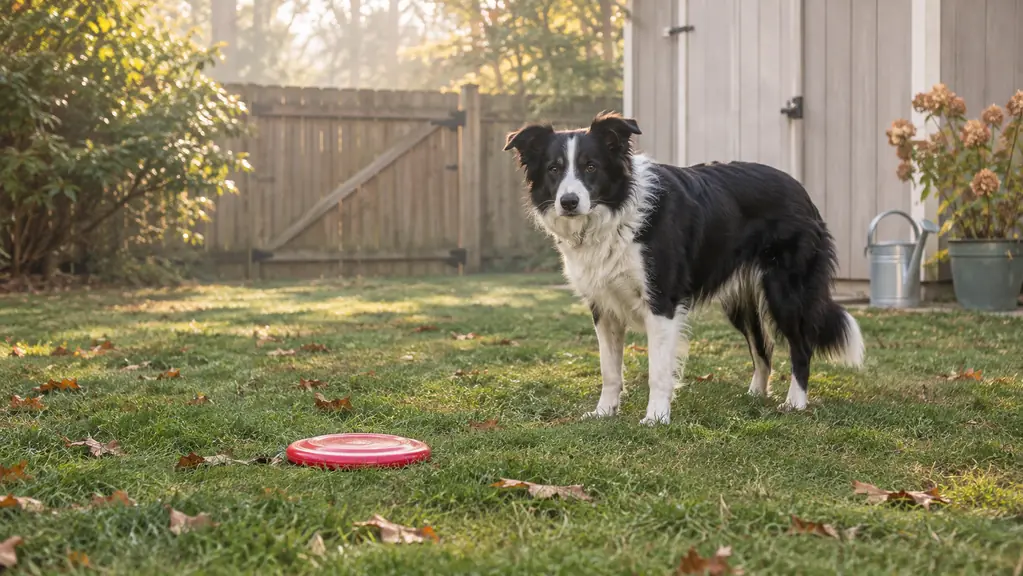
It is also not an everyday object in this house. It lives on the shed shelf next to the tunnel bag, it comes out on Sunday mornings, and it goes back when we are done. Twelve months of that routine has kept it in good shape. Twelve months of a dog left alone with it in the yard would, I suspect, have ended very differently, given how fast those tooth marks showed up.
What I Liked
- Soft rubber edge that does not sting on a bad catch, which kept Juno from flinching
- Multilayer nylon interior holds a flat line when thrown level, even in a modest yard
- Kept its shape and its flight through a full year of Sunday sessions
- Wipes clean after damp grass and stores on a shelf without fuss
- Floats per the listing, which matters if your play area is near water
- Easy to hand off and easy to pick up, no straps, no parts, nothing to lose
Where It Falls Short
- The Large is genuinely large for a 28-pound dog, and smaller dogs should size down
- It does not handle wind at all, and a gust ends the session
- The soft edge picks up tooth marks quickly with a hard gripper
- It is not a chew toy, so it has to be picked up after every single game
- In a small yard the long distance flight claim stays theoretical
Who This Is For
This is for the person with a medium to large dog, a fenced patch of grass, and the patience to spend two or three weeks teaching a dog what a disc even is. It suits someone who throws low and flat and mostly wants the dog running. If your dog already chases flying things, you will skip the awkward stage entirely and get to the fun part faster than I did.
It is also a reasonable fit if you play anywhere near water, since the listing says it floats, and if you want one toy that does one job without any assembly or fuss.
If you already have a routine, this slots in without disturbing it. My Tuesdays and Thursdays are jumps and tunnel, my Sundays are the disc, and nothing about the disc has crept into the training sessions. That separation has been good for both of us. Juno knows which gear means which game, and I know I am not going to accidentally teach her that a jump session ends with a flying toy.
Who Should Skip It
Skip it if your dog is well under 30 pounds, because the Large is a lot of disc and there is a smaller size for a reason. Skip it if your dog is a determined chewer who will get unsupervised time with it, because soft rubber edges and steady jaws do not mix. Skip it if you live somewhere windy, or if your only clear space is smaller than about 20 feet of grass, because a disc needs a little air under it to behave.
And skip it if what you actually want is a toy that trains your dog. This will not. It is a disc, it is a well made one, and that is the whole of what it does.
If your dog is medium to large and you have 20 feet of grass, start here
One Chuckit! Paraflight in Large, thrown low and flat, has been my Sunday morning for a year. Size down if your dog is smaller than a 28-pound border collie mix.
Amazon Check Today's Price on Amazon →